
|
|
|
| synonym |
Empoasca recurvata |
| description |
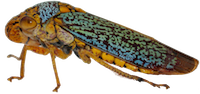
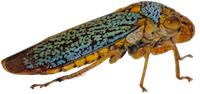
The dorsum is a green color; there are few symmetrical cream-colored markings on the head and thorax. The face is pale, without any dark spots. The pronotum lacks any dark markings and has three white spots, which may sometimes be fused, along the anterior margin. The vertex is strongly rounded and bulbous; it has a pair of pale green spots near the margin. The wings lack any spots and are yellowish-green. The male subgenital plates are long and slender with acute, upturned apices. Adults are around 2.75 mm long. (DeLong, 1931) |
| distribution |
Primarily eastern and central United States (3I) |
| abundance |
Recorded from a couple counties in the mountains and coastal plain; likely more abundant in the right habitat. |
| seasonal_occurrence | |
| habitat |
Agricultural fields, field-type habitat |
| plant associates |
Has been recorded in the state from sweet potata (Ipomoea batatas); also known from Lonicera japonica, Toxicodendron radicans, Aesculus sp., and Pilea pumila, among others (3I) |
| behavior |
Can be attracted at night with a light. |
| comments |
This species resembles E. bifurcata in general appearance. |
status |
[Native:]
[Introduced:]
[Extirpated:] | | list_type |
[Official:]
[Provisional:] |
| adult_id | Unmistakable and widely known Identifiable from good quality photos of unworn specimens
Identifiable from photos showing undersides, or other specialized views [e.g., legs, face]
Identifiable only by close inspection of structural features or by DNA analysis NULL |
| nymph_id | Unmistakable and widely known Identifiable from good quality photos, especially where associated with known host plants
Identifiable from close inspection of specimens or by DNA analysis
Identifiable only through rearing to adulthood NULL |
| G_rank |
|
| S_rank |
|
| rank_comments |
|
| tribe |
Empoascini |
| subgenus |
Alboneurasca |

 »
»