|
|
|
| synonym |
|
| description |
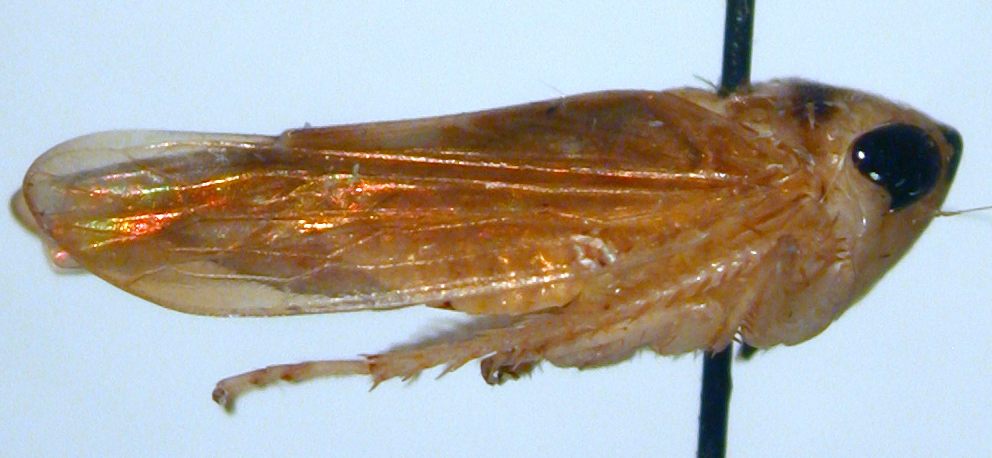
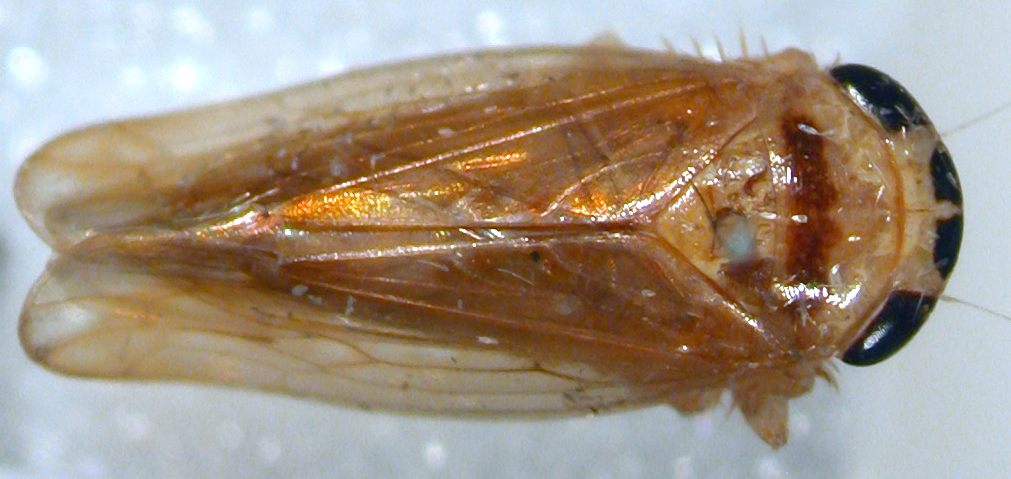
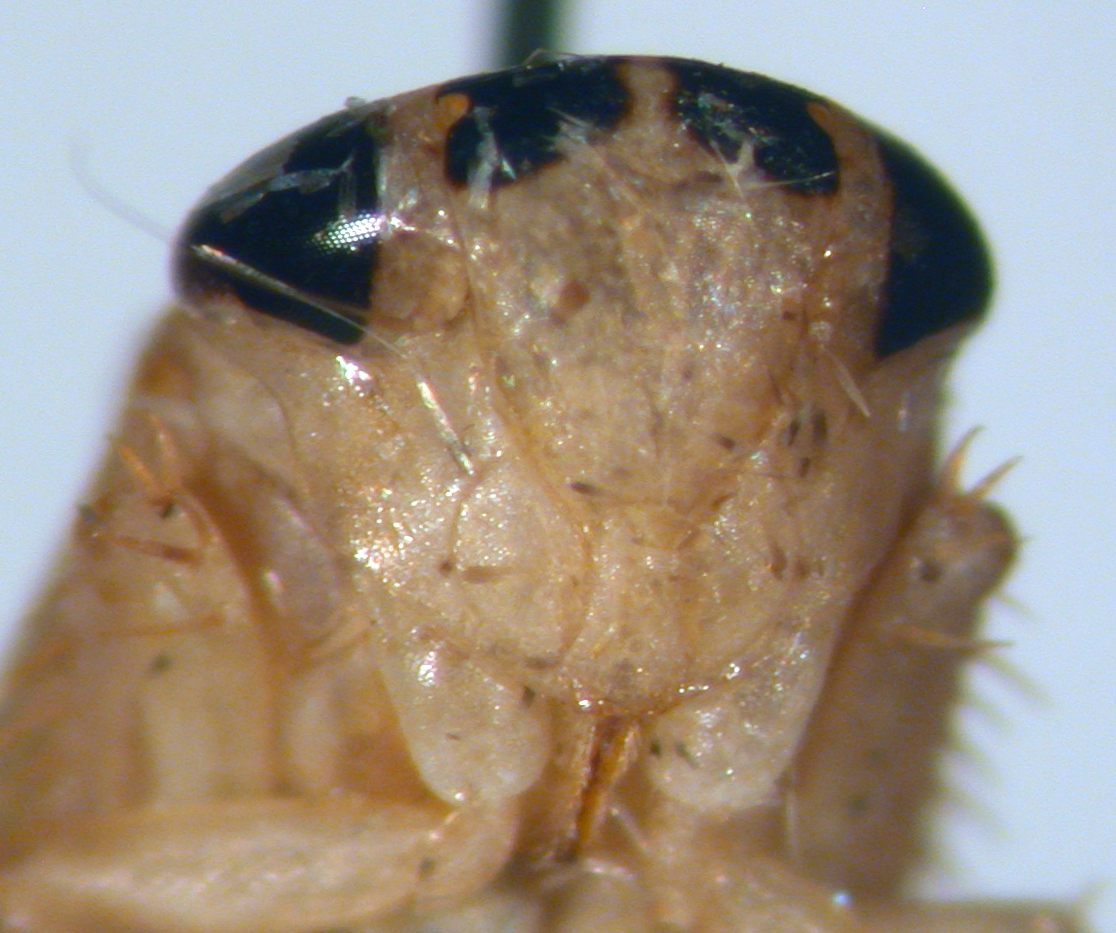
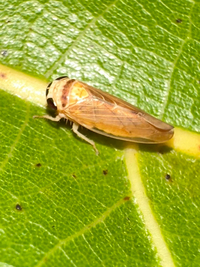
A pale, tan species with two bold black head spots. The frons is yellow with two large separated basal black spots, with oblique markings sometimes faintly indicated. The vertex is yellow with two large black spots along the anterior margin, [usually] separated by a narrow yellow line; these spots and their separation are characteristic of this species. The pronotum is yellow except for a wide fulvous to fuscous band usually covering most of the posterior half, lighter in females (this band can be light or indistinct in some specimens), and the scutellum is yellow to fulvous. The wings are semi-hyaline fulvous with white spots at the apex of the clavus, usually darkened on both sides of this spot (these spots are not always very noticeable). The wing veins are usually concolorous with the cells but may be darkened posteriorly; the apical cells are sometimes slightly infuscated. The female pregenital sternite is less than twice as wide as the length at the middle, with almost straight anterior and lateral margins and a an unnotched median lobe on an otherwise straight posterior margin. Males are 5.5 mm long, females are 6.5 mm. (Hepner 1942) |
| distribution |
Scattered states throughout the eastern United States (Hepner 1942, Metcalf 1967) |
| abundance |
Noted in Metcalf (1967) as occurring in North Carolina, but unclear from where. A few recent records from the Sandhills and Coastal Plain. |
| seasonal_occurrence | |
| habitat |
Pitch pine/scrub oak barrens (Chandler & Hamilton 2017) and similar habitats (such as those found in the NC Sandhills) |
| plant associates |
Oak (Quercus spp.), such as scrub oak (Quercus ilicifolia; Chandler & Hamilton 2017) |
| behavior |
|
| comments |
|
status |
[Native:]
[Introduced:]
[Extirpated:] | | list_type |
[Official:]
[Provisional:] |
| adult_id | Unmistakable and widely known Identifiable from good quality photos of unworn specimens
Identifiable from photos showing undersides, or other specialized views [e.g., legs, face]
Identifiable only by close inspection of structural features or by DNA analysis NULL |
| nymph_id | Unmistakable and widely known Identifiable from good quality photos, especially where associated with known host plants
Identifiable from close inspection of specimens or by DNA analysis
Identifiable only through rearing to adulthood NULL |
| G_rank |
|
| S_rank |
|
| rank_comments |
|
| tribe |
Athysanini |
| subgenus |
Eutettix |
Species Photo Gallery for Eutettix tristis No Common Name |
 | Photo by: Bo Sullivan
Scotland Co.
Comment: females, ~7 mm; near pinewoods | 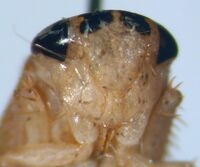 | Photo by: Bo Sullivan
Scotland Co.
Comment: females, ~7 mm; near pinewoods |
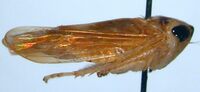 | Photo by: Bo Sullivan
Scotland Co.
Comment: females, ~7 mm; near pinewoods | 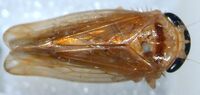 | Photo by: Bo Sullivan
Scotland Co.
Comment: females, ~7 mm; near pinewoods |
 | Photo by: Larry Chen, Sarah Toner
Pender Co.
Comment: | 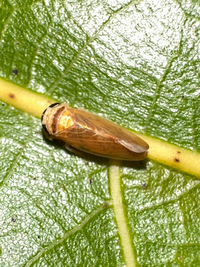 | Photo by: Nick Spigler
Moore Co.
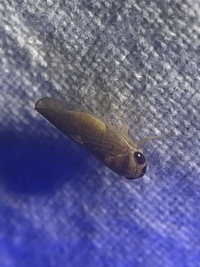
Comment: Sitting on the top side of an oak leaf, along the midrib.rnhttps://www.inaturalist.org/observations/293179033 |
 | Photo by: Nick Spigler
Moore Co.
Comment: Sitting on the top side of an oak leaf, along the midrib.rnhttps://www.inaturalist.org/observations/293179033 |

 »
»