
|
|
|
| synonym |
|
| description |
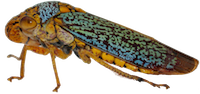
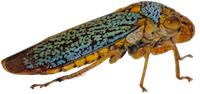
A pale brownish yellow species, with the vertex mottled with orange; the margins and posterior areas of the vertex are light. The reflexed arcs of the face, ocelli, a pair of spots near the ivory apex, and a spot on either side of the vertex midway to the ocellus are black. The face is otherwise brown with pale arcs. The pronotum is olive with five thin, light longitudinal stripes. The wing have the nervures margined with brown and fuscous, and the cells are often washed with dull orange. The vertex is almost twice as long at the apex as against the eye, longer in the middle than the width between the eyes and as long as the pronotum. The pronotum is strongly arcuate in the front and has the side margins almost obsolete. The wings are long, often flaring. The female pregenital sternite has the lateral angles broadly rounded to the posterior margin, which is slightly concave either side of a broad median tooth; the lateral lobes are prominent at the side of the sternite. The male subgenital plates are as wide as the valve and the last ventral segment, gradually narrowing to rather broad, blunt apices. Adults are 3.5 mm long. (DeLong 1926) |
| distribution |
Eastern United States; also Cuba (3I) |
| abundance |
Recorded from the state but unclear from where (DeLong 1926); probably found in the Coastal Plain. |
| seasonal_occurrence | |
| habitat |
In Florida, collected from prairies, dry areas where water receded into marsh, and grassy areas in pinelands. (DeLong 1926) |
| plant associates |
Desert saltgrass (Distichlis spicata), Dichromena floridensis, Rhynchospora divergens (DeLong 1926) |
| behavior |
|
| comments |
This species is described as resembling Polyamia weedi, but has a more produced head, longer wings, and distinct genitalia. (DeLong 1926) |
status |
[Native:]
[Introduced:]
[Extirpated:] | | list_type |
[Official:]
[Provisional:] |
| adult_id | Unmistakable and widely known Identifiable from good quality photos of unworn specimens
Identifiable from photos showing undersides, or other specialized views [e.g., legs, face]
Identifiable only by close inspection of structural features or by DNA analysis NULL |
| nymph_id | Unmistakable and widely known Identifiable from good quality photos, especially where associated with known host plants
Identifiable from close inspection of specimens or by DNA analysis
Identifiable only through rearing to adulthood NULL |
| G_rank |
|
| S_rank |
|
| rank_comments |
|
| tribe |
Deltocephalini |
| subgenus |
|

 »
»