
|
|
|
| synonym |
|
| description |
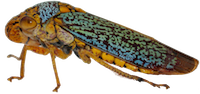
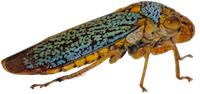
A distinct, boldly marked species that is yellowish-green on the anterior two-thirds of the body and wings. The color of the crown is ivory with a round yellowish spot on the disc either side of the median line. The pronotum and scutellum are yellowish-green, mottled with ivory and with an indistinct longitudinal stripe on either side of the middle. The wings are yellowish-green on the basal two-thirds, with the posterior third black with three large, elongate clear areoles within the black region before the apical crossveins. The underside of the head is largely black, and the rest of the underside of the body is mottled with black. The crown is slightly concave, and the antennae are one-third as long as the body. The female pregenital sternite has the lateral margins one-third as long as the median length, with the posterior margin slightly and broadly trilobed; the underlying membrane is produced into two rounded lobes that are almost as long as the median portion of the sternite. Adults are 5 mm long. (Beamer, 1950)
For images of this species, see: BG. |
| distribution |
An infrequently encountered species that was originally described from and only known from Louisiana (Beamer, 1950). In recent years, it has since been found largely in coastal areas from Texas to North Carolina, but has also been found far inland to Arkansas and Tennessee. |
| abundance |
Rare, one record from the Coastal Plain; likely found elsewhere along the coast. |
| seasonal_occurrence | |
| habitat |
|
| plant associates |
? |
| behavior |
Can be attracted at night with a light. |
| comments |
|
status |
[Native:]
[Introduced:]
[Extirpated:] | | list_type |
[Official:]
[Provisional:] |
| adult_id | Unmistakable and widely known Identifiable from good quality photos of unworn specimens
Identifiable from photos showing undersides, or other specialized views [e.g., legs, face]
Identifiable only by close inspection of structural features or by DNA analysis NULL |
| nymph_id | Unmistakable and widely known Identifiable from good quality photos, especially where associated with known host plants
Identifiable from close inspection of specimens or by DNA analysis
Identifiable only through rearing to adulthood NULL |
| G_rank |
|
| S_rank |
|
| rank_comments |
|
| tribe |
Deltocephalini |
| subgenus |
|

 »
»