
|
|
|
| synonym |
|
| description |
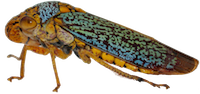
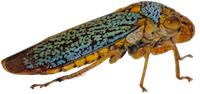
A characteristically very small species, being around 2.25 mm. The color overall is pale yellow to brownish, with four black spots above the margin on the vertex; the inner pair of spots are the largest. In well-marked individuals, that are four to six oblique dashes on the coronal disc. The pronotum has six faint longitudinal stripes. The elytra is a dull white to olive color, with the veins lighter and [sometimes] margined with fuscous. The face is yellowish with several pairs of fuscous arcs. The female pregenital sternite is more than twice as long as the preceding, with the lateral margins rapidly narrowed and rounded to the posterior margin, which is very slightly concave with [sometimes] traces of a small median tooth; otherwise, the sternite is relatively straight. The male subgenital plates are triangular and broad at the base, and concavely rounding to sharp, divergent, upturned black apices. Adult males are 2.0-2.5 mm long, while females are 2.3-3.0 mm. (DeLong, 1926; Kramer, 1971)
For images of a specimen, see: BG. |
| distribution |
Southeastern United States (3I), to Texas. |
| abundance |
Rare, known from a single record from the Coastal Plain. Probably undetected throughout the region, especially based on its habitat. |
| seasonal_occurrence | |
| habitat |
Grassy mats on the seashore between the high and low tide lines. Also found in prairie grasses and other grassy habitats. (DeLong, 1926; Kramer, 1971) |
| plant associates |
Fine-leaved grass (Kramer, 1971) |
| behavior |
|
| comments |
The very small size and male genitalia help distinguish this species (Kramer, 1971). In its tidal habitat, the species is apparently submerged during a part of each day (DeLong, 1926). |
status |
[Native:]
[Introduced:]
[Extirpated:] | | list_type |
[Official:]
[Provisional:] |
| adult_id | Unmistakable and widely known Identifiable from good quality photos of unworn specimens
Identifiable from photos showing undersides, or other specialized views [e.g., legs, face]
Identifiable only by close inspection of structural features or by DNA analysis NULL |
| nymph_id | Unmistakable and widely known Identifiable from good quality photos, especially where associated with known host plants
Identifiable from close inspection of specimens or by DNA analysis
Identifiable only through rearing to adulthood NULL |
| G_rank |
|
| S_rank |
|
| rank_comments |
|
| tribe |
Deltocephalini |
| subgenus |
|

 »
»