| description |
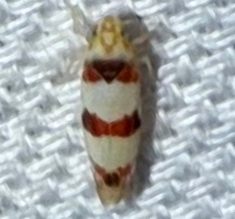
Yellow or white with a red, orange, or brown color pattern. The vertex has orange parallel submedial lines, and the vertex midline is pale; the face is also pale. The mesonotum is entirely dark. The underside of the thorax is entirely pale. The wings have 3 narrow red to black crossbands, with the basal one extending across the scutellum. The forewings have a dark spot on the costal margin.
For additional images of members of this complex, see: BG. |
| comments |
This page serves as an umbrella for any individuals of Eratoneura that have a red three-striped color pattern. Four species fall within this category and are morphologically identical, requiring the dissection of a male specimen in order to differentiate from one another. These species are: alicia, amethica, arpegia, and trvittata. Below are the descriptions in the 3I database for the various Eratoneura in the eastern United States that have this color pattern, and links to specimens of each species. As you can see, these species are very similar to one another. It also does not help that all four species are noted as having the same host plant, so that cannot be used to filter potential species.
E. alicia- Dorsum yellow or white. Color pattern red or orange. Vertex unicolorous. Vertex midline pale. Anteclypeus pale, concolorous with rest of face. Pronotum pale. Mesonotum entirely dark, apex concolorous with rest of mesonotum. Thoracic venter entirely pale. Forewings without oblique vittae, with 3 narrow crossbands. Clavus with separate basal and distal vittae. Forewings with dark spot on costal margin. Forewing apical cell II without distal spot, inner apical cell with brown spot basally.
E. amethica- Dorsum yellow or white. Color pattern red or orange or brown. Vertex unicolorous. Vertex midline pale. Anteclypeus pale, concolorous with rest of face. Pronotum pale. Mesonotum entirely dark, apex concolorous with rest of mesonotum. Thoracic venter entirely pale. Forewings without oblique vittae, with 3 narrow crossbands. Clavus with separate basal and distal vittae. Forewings with dark spot on costal margin. Forewing apical cell II without distal spot, inner apical cell with brown spot basally.
E. arpegia- Dorsum yellow or white. Color pattern red or orange. Vertex unicolorous. Vertex midline pale. Anteclypeus pale, concolorous with rest of face. Pronotum with Y- or V-shaped medial vitta. Mesonotum entirely dark, apex concolorous with rest of mesonotum. Thoracic venter entirely pale. Forewings without oblique vittae, with 3 narrow crossbands. Clavus with separate basal and distal vittae. Forewings with dark spot on costal margin. Forewing apical cell II without distal spot, inner apical cell with brown spot basally.
E. trivittata- Dorsum yellow or white. Color pattern red or orange or brown. Vertex with orange parallel submedial lines (often with lateral branch). Vertex midline pale. Anteclypeus pale, concolorous with rest of face. Pronotum with Y- or V-shaped medial vitta. Mesonotum entirely dark, apex concolorous with rest of mesonotum. Thoracic venter entirely pale. Forewings without oblique vittae, with 3 narrow crossbands. Clavus with separate basal and distal vittae. Forewings with dark spot on costal margin. Forewing apical cell II without distal spot, inner apical cell with brown spot basally. |

 »
»