| Author | Gaudichaud | |
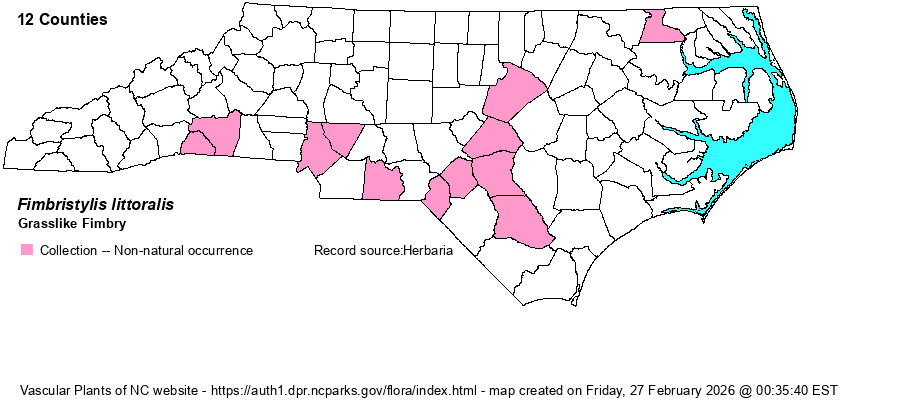
| Distribution | Most records are from the inner Coastal Plain and Sandhills; disjunct to Hertford County, the southern Piedmont, and Polk and Rutherford counties.
Native to Asia; in N.A. found in the neotropics north to NC, KY, AR. | |
| Abundance | Apparently uncommon. | |
| Habitat | Moist or wet soils of roadsides and other disturbed soils. | |
| Phenology | Flowering and fruiting July-September. | |
| Identification | Grasslike Fimbry is not particularly like any grass -- the name comes from its old name miliacea. From all our fimbries, except F. autumnalis, it differs in having styles 3-cleft (vs. 2). Told from F. autumnalis by having strongly folded leaf blades (vs. flat) and having ovoid spikelets (vs. lance-shaped). | |
| Taxonomic Comments | Formerly named F. miliacea.
Plants of the the genus Fimbristylis are very small to tall (3+ feet), with most leaves in a basal tuft, and an open, branched, terminal inflorescence. The spikelets are various shades of rufous, chestnut, or brown (due to the color of the scales) and resemble tiny pinecones. Important key characters include size, shape, and ornamentation of the achenes (seeds); see also other characters used by Weakley et al. (2025). Godfrey & Wooten (1979) have excellent drawings and descriptions. | |
| Other Common Name(s) | | |
| State Rank | SE | |
| Global Rank | G3G5 | |
| State Status | | |
| US Status | | |
| USACE-agcp | OBL link |
| USACE-emp | OBL link |