| Author | (Muhlenberg ex Willdenow) Nesom | |
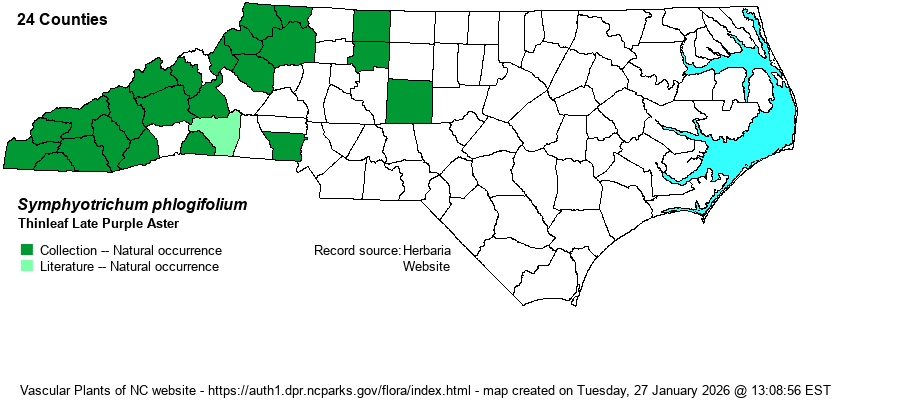
| Distribution | Throughout the Mountains, and into the western half of the Piedmont; ranges up to 5,000 feet. This is a poorly known species of unsettled taxonomy (often included within S. patens), and thus the range map is probably under-populated owing to unfamiliarity of botanists with it. Specimens from Randolph and Wake counties need a careful ID check, as the range in VA is mostly restricted to the Mountains and upper Piedmont.
Southeastern NY to IN, south to NC, SC, GA, and AL. Primarily in the Appalachian Mountains. | |
| Abundance | Apparently infrequent to fairly common in the Mountains, as it has been documented from the entire Mountain region (though with small, un-natural holes). Likely very rare in the western Piedmont, and perhaps truly absent from the central and eastern Piedmont. The assigned State Rank by NCNHP of S3? seems appropriate at the present time. | |
| Habitat | Moist to mesic hardwood forests, cove forests, rocky slopes, ridgetops, wooded roadbanks. Apparently most often found in high pH soils, and more often in forest interiors than is the similar S. patens. |
| Phenology | Flowers and fruits late August-October. | |
| Identification | Thinleaf Late Purple Aster is much like Late Purple Aster (S. patens) in gestalt. It differs markedly in its much longer stem leaves (greater than 3 inches vs. 2-2.5 inches or less), the tapered tip to leaves (vs. blunt or acute), and thinner and less rough texture to the leaves. The leaf color in this species tends to be a medium green, as opposed to a dark green (and obviously thick and leathery) in S. patens. The many photos on Google images clearly show the fairly long and thin-looking leaves and medium green color of them, as opposed to dark green leaves of S. patens; thus, there is a wonder why this taxon went for such a long time subsumed within S. patens or just a variety of that species. | |
| Taxonomic Comments | NOTE: The genus Aster was examined by G.L. Nesom (1994), who determined that it was composed of a number of discrete genera (a few of which were already split off by authors as Sericocarpus, Ionactis, etc.). The earliest available name for North American "Aster" is Symphyotrichum, a name regrettably long and hard to spell.
Some authors place this as a variety within S. patens, but it has distinct morphology and range. By 2025, most authors do consider it as a valid species.
| |
| Other Common Name(s) | Appalachian Clasping Aster. Though the most prevalent common name is Thinleaf Late Purple Aster, that leaves "Late Purple Aster" as a nested name, because that is the main common name of S. patens. However, no good common name is alternatively available for S. phlogifolium, and no references use Thinleaf Purple Aster. | |
| State Rank | S3? | |
| Global Rank | G4 | |
| State Status | | |
| US Status | | |
| USACE-agcp | | |
| USACE-emp | | |