| Author | | |
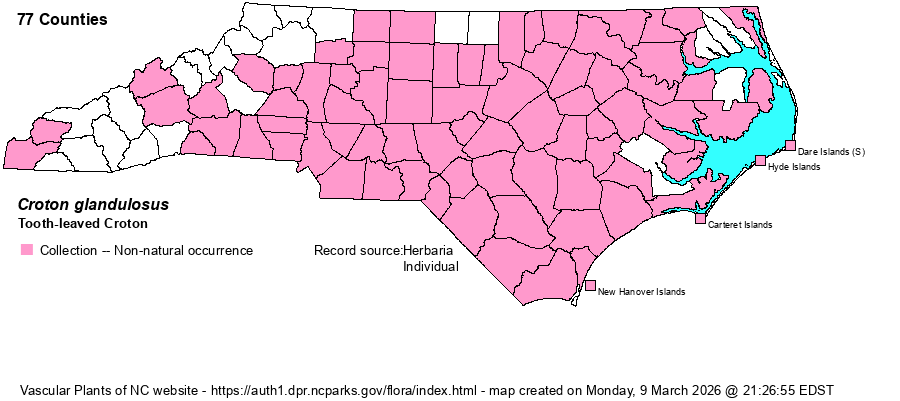
| Distribution | Widespread from the coast through the Piedmont; scarce in the Mountains. Since the variety septentrionalis is native exclusively to the U.S. and northeastern Mexico, it could be argued that NC plants could be treated as natives. However, the pre-Columbian range is unclear, and Weakley (2025) maps it as alien in NC. Our plants are var. septentrionalis.
The species in general is native of the New World; this variety perhaps native from NJ to MN and NE, south to FL, TX, and northeastern Mex. | |
| Abundance | Frequent to often common, except rare in the Mountains. | |
| Habitat | Dry sandy soil of roadsides, cropfields, old fields, pastures, waste places, weedy lots, clearings, scrapes, etc. | |
| Phenology | Flowering and fruiting May-November. | |
| Identification | Tooth-leaved Croton usually grows 1-2 feet tall (maximum of 3 feet), moderately branched. Leaves are elliptical, 2-7 cm long, margins crenate-serrate, both surfaces moderately stellate-hairy. The toothed leaf margins separate it from our other species of Croton. | |
| Taxonomic Comments | NC plants are var. septentrionalis.
| |
| Other Common Name(s) | | |
| State Rank | SE? | |
| Global Rank | G5 | |
| State Status | | |
| US Status | | |
| USACE-agcp | | |
| USACE-emp | | |