| Author | | |
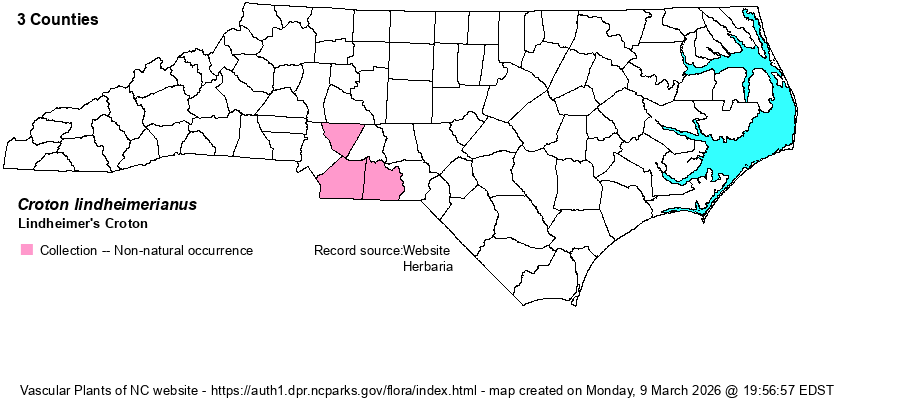
| Distribution | Collected only from 3 counties: Cabarrus County along a railroad in 1956; Union County in a strawberry field in 1957, a Blackjack Oak woodland in 1957, a roadside in 2010; and Anson County in 2024.
Native to IN to NE, south to LA, TX, NM, AZ; disjunct and adventive to NC and SC. | |
| Abundance | Very rare. | |
| Habitat | Dry sandy soil mixed with clay, railroad R-O-W. | |
| Phenology | Flowering and fruiting May-November. | |
| Identification | Lindheimer's Croton grows up to 1.5 feet tall, dichotomously branched. The leaf blades are suborbicular, with a blunt apex. The plant is densely velvety pubescent. It has been confused with C. monanthogynus, but that native species (in NC) has brown-dotted undersides of the leaf blades (the dots actually the centers of the stellate hairs). | |
| Taxonomic Comments | There had/had been confusion in the past over the very similar names and somewhat similar appearances of this species with the "other" Lindheimer's Croton --C. lindheimeri. This latter species has a similar southern Great Plains range and ranges east to SC, but not yet known from NC. It is a notably taller plant than is lindheimerianus, up to nearly 3 feet tall; it is better known as Woolly Croton or Lindheimer's Doveweed. That SC species also has relatively narrowly elliptic to lanceolate leaves with an acute tip, as opposed to a more orbicular or rounded leaf in lindheimeranus.
| |
| Other Common Name(s) | | |
| State Rank | SE * | |
| Global Rank | G5 | |
| State Status | | |
| US Status | | |
| USACE-agcp | | |
| USACE-emp | | |