| Author | (Beadle) R.W. Lance | |
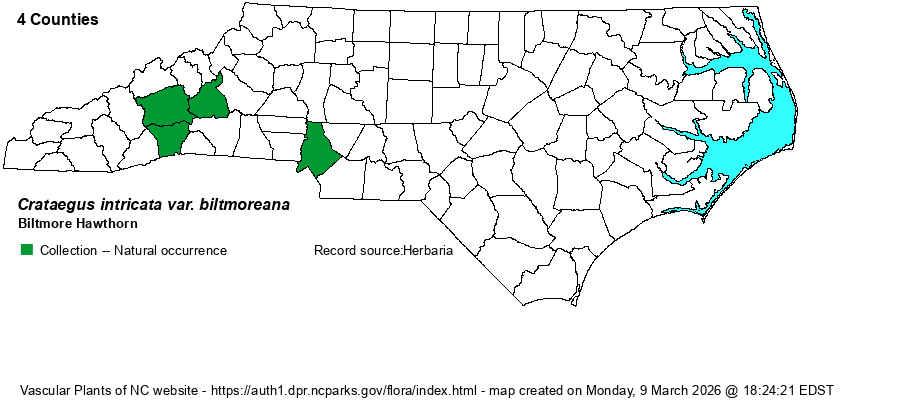
| Distribution | Occurs primarily in the Mountains, perhaps throughout the province, and likely onto the edge of the Piedmont. Lance’s (2014) range map shows essentially this pattern, though Weakley (2025) shows it as perhaps uncommon in both the Mountains and Piedmont. SERNEC (2026) has specimens from Buncombe, Henderson, McDowell, and Mecklenburg counties. The last was annotated from C. flava by J.B. Phipps in 1998 (herbarium UNCC).
The range in Lance’s book shows its occurrence from PA and MO south to AR and northern GA.
| |
| Abundance | Apparently uncommon to possibly locally numerous in the Mountains. Rare (?) in the foothills, but perhaps absent farther to the east. This website has tentatively given this taxon an S3? state rank. | |
| Habitat | This taxon occurs mainly on exposed rock outcrops, ridges, and other rocky or exposed dry sites, including thickets. | |
| Phenology | Blooms from late April to May, and fruits from September to October. | |
| Identification | This is a large shrub, mainly growing to 10’ tall, and often somewhat sprawling. The leaves are broadly ovate to deltate (triangular), with obvious serrations and somewhat straight or slightly rounded margins tapering to an acute point. The leaves may have slight basal lobes. The leaves, branches, and fruit are all quite tomentose/hairy. | |
| Taxonomic Comments | Recent references – Lance (2014) and Weakley (2025) – list this taxon as C. intricata var. biltmoreana. (Note – these authors list quite a few other varieties of C. intricata.) Prior to that, it was listed as a full species as C. biltmoreana (Flora of North America website), but older references subsumed this taxon within the somewhat large C. flabellata (e.g., RAB 1968). NatureServe has it listed as a separate species, at least for now.
| |
| Other Common Name(s) | None | |
| State Rank | [S3?] | |
| Global Rank | [G5T5] | |
| State Status | | |
| US Status | | |
| USACE-agcp | | |
| USACE-emp | | |