| Author | L. | |
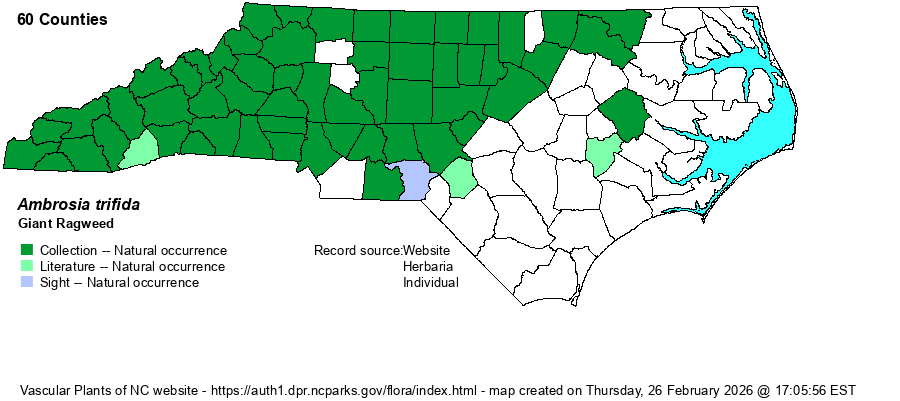
| Distribution | Mountains and Piedmont; absent from the Sandhills proper and almost all of the Coastal Plain.
N.S. to B.C., south to northern FL and CA. | |
| Abundance | Frequent to common in the Mountains and Piedmont; very rare in the Coastal Plain. Much less numerous in these regions than is Common Ragweed (A. artemisiifolia). | |
| Habitat | This species favors moist or rich soil, typically in disturbances and thus usually in partial shade. Found most often in alluvial forests, especially along margins and openings. However, it can also occur in farm yards, fallow fields, and pastures. |
| Phenology | Flowering and fruiting July-October. | |
| Identification | Giant Ragweed is unmistakable, with its large (often 6 inches long) deeply 3-lobed (sometimes 5-lobed) leaves and great height -- from 3 feet to rarely 12 feet tall. Inflorescences are much like Common Ragweed, but grow from leafy branches as well as terminally. This conspicuous species can be frequently found by walking along greenways through floodplain forests, for example. | |
| Taxonomic Comments | None
| |
| Other Common Name(s) | Great Ragweed | |
| State Rank | S5 | |
| Global Rank | G5 | |
| State Status | | |
| US Status | | |
| USACE-agcp | FAC link |
| USACE-emp | FAC link |