| Author | | |
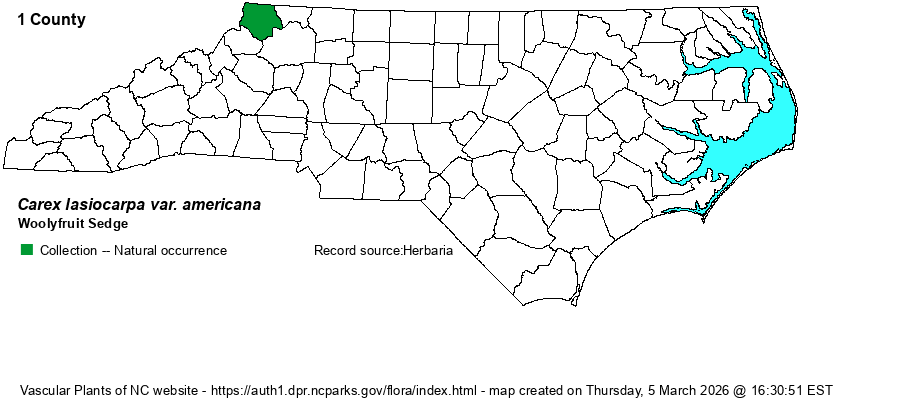
| Distribution | Mountains only. A single collection in Ashe County from Long Hope Valley in 1999 by Patrick McMillan and Weakley. This is the southeastern end of the range.
Newf. to AK, south to northwestern NC, IA, CO, northern CA. | |
| Abundance | Very rare, with just the single known location. Farther north it forms large colonies or swaths in boreal marshes and lakes. This is a State Special Concern species. | |
| Habitat | "Shrub-herb seepage bog" in NC. Elsewhere, it occurs in rather specialized habitats, such as seeps, open springs, fens, and other mostly small, shallow water sites, often over mafic rock. | |
| Phenology | Flowering and fruiting in June. | |
| Identification | Woolyfruit Sedge is colonial from creeping rhizomes; flowering stems grow to 3.5 feet tall. The leaves are skinny (less than 2 mm wide), wispy towards the tip, rolled or folded so as to be round or channeled in cross-section. | |
| Taxonomic Comments | The species is circumboreal; var. lasiocarpa is Eurasian. A synonym of var. americana is C. lanuginosa.
The genus Carex is the largest in North America, and among the largest in the world. In temperate and boreal regions, Carex is often the dominant or co-dominant ground layer in many habitats. Seeds (achenes) are valuable food for birds and small mammals, while foliage is used by birds and mammals to make nests and as food by mammals. Species of Carex often look vastly different from one another -- spikes erect vs. drooping, tiny inflorescence vs. whopping, culms leafy vs. naked, perigynia beaked vs. beakless, stems densely bunched vs. single, etc. The genus has been divided into many sections (or groups), based on shared characters; some taxonomists have suggested that these be different genera, but that proves unworkable (so far). All Carex share the feature of a perigynium (an outer covering) which completely surrounds the achene (seed). This covering may fit tightly or loosely (like a small bladder), depending on which group or species. Details of perigynia shape, ornamentation, presence and size of beak, number of striations (or veins) are all important ID features. In recent years Rob Naczi and colleagues have stressed the importance of arrangement of perigynia -- whether spiral (3+ ranks) or distichous (2-ranked) -- and have named a number of new species as well as split off some older synonyms. Therefore, RAB's (1968) key, excellent for its time, can only be used in a general way today. Members of some sections of Carex are difficult to key out (notably Ovales, Laxiflorae, Griseae); this is in part due to variation among individuals of a species, or failings of the key. FNA has drawings of most species and some species may be found in two or more places within a key, to acount for variability. New species to NC, and new to science(!), continue to be found in NC. | |
| Other Common Name(s) | Slender Sedge, Wiregrass Sedge | |
| State Rank | S1 | |
| Global Rank | G5 | |
| State Status | [SC-V] | |
| US Status | | |
| USACE-agcp | | |
| USACE-emp | | |