| Author | Torrey | |
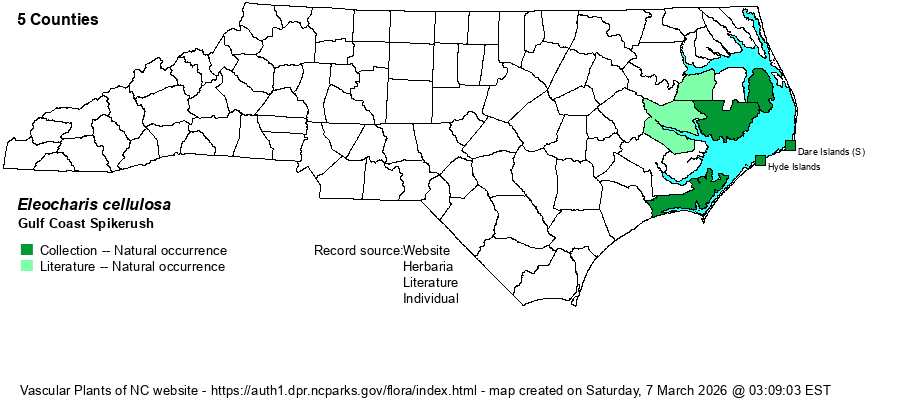
| Distribution | Outer Coastal Plain and Outer Banks, but surprisingly no records south of Carteret County so far. Brunswick County specimens at many herbaria labeled as this species actually are E. elongata.
Coastal Plain, NC to southern FL and TX; Bermuda, West Indies, Mex., Nicaragua. | |
| Abundance | Rare to locally uncommon. Individual populations are highly variable, from uncommon to abundant. One population in Dare County numbers over a million culms! This was a State Endangered species, oddly enough, despite numerous records; presumably it was listed at that status as it was essentially a long-distance northward disjunct from FL, but recent discoveries from SC and GA are filling in this large gap. In May 2021, the status was downgraded to State Threatened. | |
| Habitat | Brackish to fresh marshes, interdune marshes, lagoon borders. |
| Phenology | Flowering and fruiting July October. | |
| Identification | This is one of the five spikerushes in NC whose spikes are not obviously wider than the stems. In E. cellulosa the stem does not have internal cross-partitions (also termed nodose-septate); the stems are not 4-sided (as in E. quadrangulata); and the stems are 3-5 mm thick (vs. 1-2 mm thick in E. robbinsii and E. elongata). | |
| Taxonomic Comments | None
The genus Eleocharis, the spikerushes, are unusual members of the sedge family in that the culms (flowering stems) are round or oval (rarely triangular) in cross-section, rather than triangular in the great majority of our sedges. In addition, leaf blades are absent; just 1-2 basal sheaths are present at the base of the culm. There is a single, cylindrical or narrowly ovoid, spikelet of florets at the culm summit. Details of achene (seed) shape, color, ornamentation, bristle length, and beak (tubercle) shape and size, are critical ID factors. | |
| Other Common Name(s) | None | |
| State Rank | S2 | |
| Global Rank | G4G5 | |
| State Status | T | |
| US Status | | |
| USACE-agcp | OBL link |
| USACE-emp | | |