| Author | (Michaux) Vahl | |
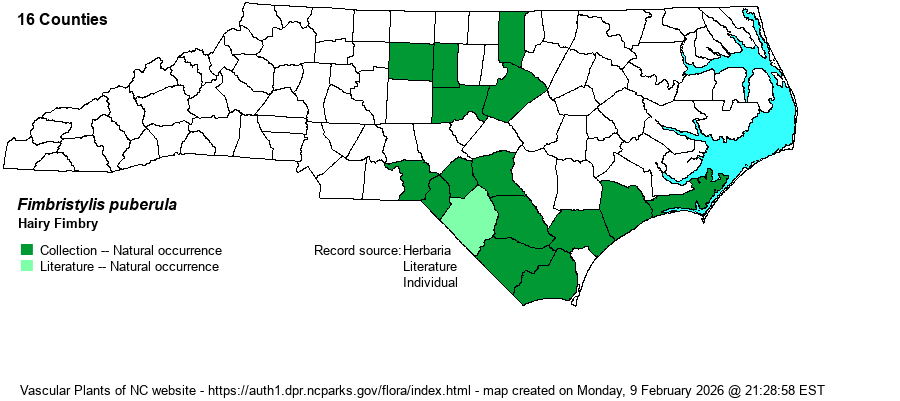
| Distribution | Southern Coastal Plain, Sandhills, and lower Piedmont. A large gap in the central and northern Coastal Plain is hard to explain, especially as the species ranges far north of the state.
NY to southern Ont., MI, and NE, south to FL and TX. | |
| Abundance | Uncommon to infrequent in the southern Coastal Plain and Sandhills. Uncommon in the northeastern Piedmont. The website editors suggest a State Rank of S3S4. | |
| Habitat | Pine savannas and flatwoods, glades, prairie-like openings, the soils generally moist or mesic. | |
| Phenology | Flowering and fruiting July-September. | |
| Identification | One of two "intermediate-sized" fimbries, the stems are 1-2 feet tall and grow from a hard knotty base. The other is F. tomentosa, an alien that differs in being annual with a soft base, and leaves are 2-4 mm wide (vs. 1-2 mm wide in F. puberula). | |
| Taxonomic Comments | The nominate variety is the only one present in NC.
Plants of the the genus Fimbristylis are very small to tall (3+ feet), with most leaves in a basal tuft, and an open, branched, terminal inflorescence. The spikelets are various shades of rufous, chestnut, or brown (due to the color of the scales) and resemble tiny pinecones. Important key characters include size, shape, and ornamentation of the achenes (seeds); see also other characters used by Weakley et al. (2025). Godfrey & Wooten (1979) have excellent drawings and descriptions. | |
| Other Common Name(s) | Chestnut Sedge | |
| State Rank | [S3S4] | |
| Global Rank | G5 | |
| State Status | | |
| US Status | | |
| USACE-agcp | OBL link |
| USACE-emp | OBL link |