| Author | A. Gray | |
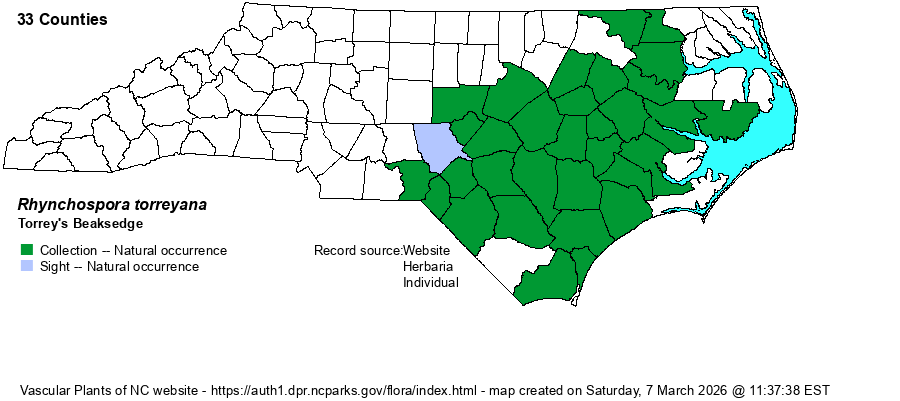
| Distribution | Throughout the Coastal Plain (except for the northeastern corner) and the Sandhills; a few records from the lower Piedmont.
Coastal Plain, MA to northern FL and southern AL. | |
| Abundance | Fairly common to frequent in the Sandhills and much of the southern and central Coastal Plain, except rare in the Piedmont and the far eastern and northeastern Coastal Plain. The State Rank should be S4, and not "S3?". | |
| Habitat | Moist pine savannas and flatwoods, often in slight depressions. Also the margins of sinkhole ponds. Locally in disturbed areas and clearings. | |
| Phenology | Flowering and fruiting July-September. | |
| Identification | The stems grow 2-3 feet tall, the upper portion and inflorescence usually arching. Inflorescences are rusty brown or light chestnut brown; the seeds are 4-6 mm long, flat on both faces, with bristles less than half the body length. | |
| Taxonomic Comments | None
Members of the genus Rhynchospora -- mainly called beaksedges but also called beakrushes -- are mostly Coastal Plain in distribution and are important members of our longleaf pine savannas, flatwoods, streamheads, depression ponds, Carolina bays, and beaver ponds. They vary from small and wiry to large and coarse. Keys concentrate on features of the achenes (seeds) and the shape and arrangement of the flower clusters (spikelets). The seeds may or not have bristles at their base; bristle number, length, and toothing are critical characters. Size and shape of the seed beaks is also critical. The drawings in Godfrey & Wooten (1979) are extremely helpful, as is the key by LeBlond in Weakley et al. (2025). The genus now includes Dichromena, the white-topped sedges. McMillan (2007) published a superb technical monograph of all eastern U.S. species, complete with specimen images. | |
| Other Common Name(s) | None | |
| State Rank | S3? [S4] | |
| Global Rank | G4 | |
| State Status | | |
| US Status | | |
| USACE-agcp | OBL link |
| USACE-emp | FACW link |