| Author | Muhlenberg ex Willdenow | |
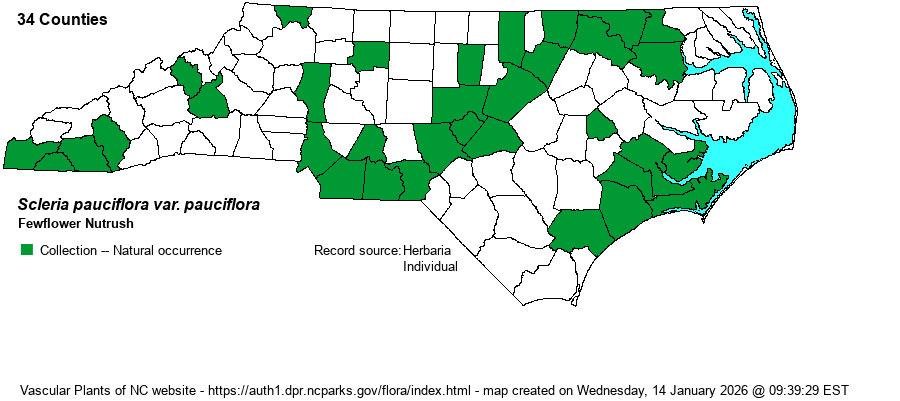
| Distribution | More-or-less throughout the state, but with gaps as shown on map. Some of these gaps will close with additional collecting.
NJ to southern Ont. and northern IL, south to central FL and southeastern TX. | |
| Abundance | Uncommon, perhaps frequent, in the Coastal Plain and lower Piedmont; uncommon to rare westward. | |
| Habitat | Dry to mesic pine savannas and flatwoods, pine-oak-hickory woodlands, clearings, powerlines. | |
| Phenology | Flowering and fruiting June-September. | |
| Identification | Both varieties of this species grow from tough, knotty, horizontal rhizomes; the stems grow 10 inches to 1.5 feet tall. Inflorescences usually are tinged a cinnamon color, sometimes strongly so (vs. green or slightly cinnamon in S. ciliata and S. elliottii. The base of the seed has 6 tubercles (vs. 3 in the just-named species). From var. caroliniana, told by glabrous or sparsely hairy stems, leaves, and bracts (vs. densely short hairy). | |
| Taxonomic Comments | Some authors do not recognize this variety, but lump it into an expanded S. pauciflora. A very reasonable action, in our opinion.
The genus Scleria, named as nutrushes, is a group of sedges notable for the white, often glossy, achenes (seeds) and tough, knotty, horizontal rhizomes (absent in S. verticillata, S. muehlenbergii, and S. reticularis). Stems are 1-many per plant, terminated by inflorescences of 1-several spikelets, subtended by leafy bracts. In some species there are also inflorescences produced from upper and middle stem leaf axils, these usually on long arching stalks. A dissecting scope is necessary to examine the achene for shape, ornamentation (bumps, pits, ridges), and hairs. Just as important are features of the hypogonium, upon which the achene tightly sits: present or not, how many lobes, and ornamentation (bumps, sharp points, etc.). | |
| Other Common Name(s) | | |
| State Rank | S4? * | |
| Global Rank | G5T5? | |
| State Status | | |
| US Status | | |
| USACE-agcp | | |
| USACE-emp | | |