| Author | (Swartz) Gould & Clark | |
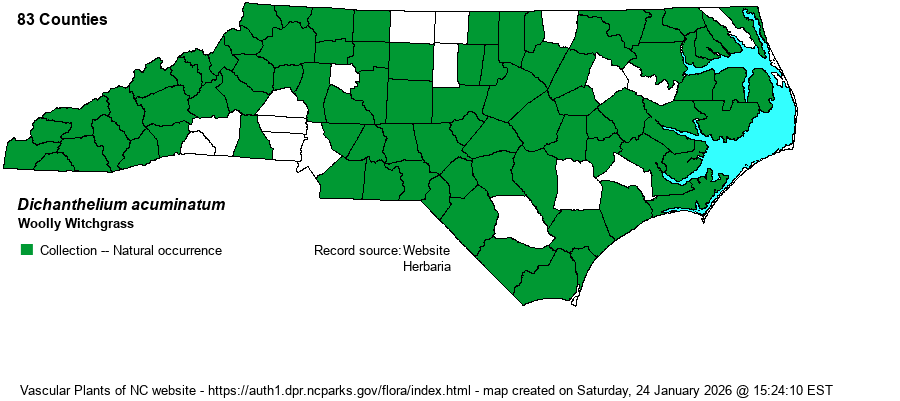
| Distribution | This species account includes data from all three varieties. Statewide, and certainly occurs in all counties.
Newf. to B.C. south to FL and CA. | |
| Abundance | Frequent to common across the state. | |
| Habitat | Dry to moist sandy or clayey soils of pine-hardwoods, open woodlands, clearings, roadsides, powerlines. Will tolerate temporary inundation. |
| Phenology | Flowering and fruiting May-October. | |
| Identification | Woolly Witchgrass grows about 1 foot tall (or less) and has abundant long soft hairs on the leaves and stems. D. villosissimum may appear similar in the field, but it has longer spikelets (2.1-2.5 mm vs. 1.6-1.9 mm). | |
| Taxonomic Comments | In older texts (and botanists' heads) named as Panicum auburne. RAB (1968) had it named as Panicum lanuginosum.
A note about Dichanthelium: This genus is not impossible to identify to species! But it takes applied effort over a period of time in order to learn the various species and what their morphological limits are. We strongly recommend that you read the introduction to the treatment in Weakley et al. (2025), written by Richard LeBlond. LeBlond has made order out of near chaos, and his keys work very well for our plants. Most Dichanthelium taxa ("Dichs") do not grow everywhere indiscrimminately, but prefer certain well-defined habitats. Note that most species produce flowers/fruits twice a year -- a vernal period and an autumnal period -- and that measurements of spikelets and achenes are taken from vernal plants. Some species also have a third, or summer, period. In the vernal period there is a single inflorescence at the tip of the stem. In the autumnal period, plants produce elongate branches with bunched (congested) leaves and so look very different from vernal plants--inflorescences are produced in leaf axils as well as at the tips of branches. NOTE: Older texts had these species essentially all within the very large genus Panicum. "Dich" species are typically named as "Witchgrass" and Panicum species named as "Panicgrass". | |
| Other Common Name(s) | Tapered Rosette Grass (used by several websites but a very awkward name), Woolly Panicgrass, Hairy Rosette-panicgrass (another messy name) | |
| State Rank | S5 | |
| Global Rank | G5 | |
| State Status | | |
| US Status | | |
| USACE-agcp | FAC link |
| USACE-emp | FAC link |