| Author | (L.) Gould | |
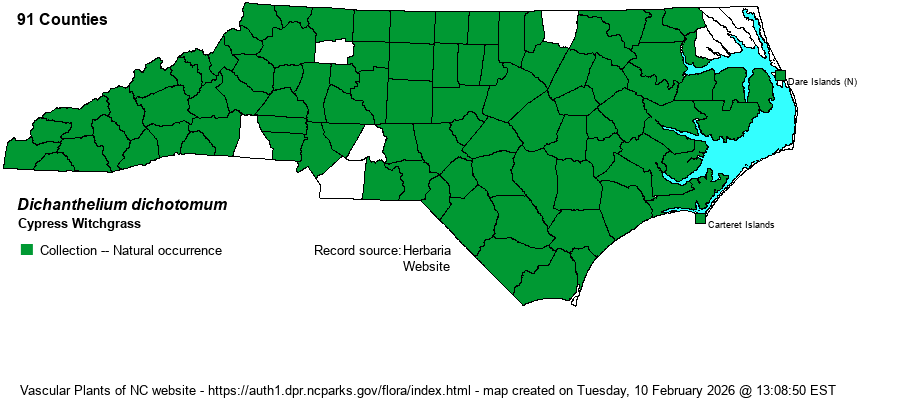
| Distribution | Collectively, this species is composed of 2 recognized varieties and is found throughout the state. It is among the most widespread plants in our flora, probably occurring in every county, but population sizes are not particularly large.
ME, Ont, and MI south to FL and TX. | |
| Abundance | Common to frequent throughout. | |
| Habitat | Dry to mesic pine-hardwoods and hardwoods, the soils variable and sandy to loamy to rocky. Often found at the bases of trees, along trails, and in small openings. Variety nitidum 0ccurs in wet soils of streamsides, marshes, etc. | |
| Phenology | Flowering and fruiting May-October. | |
| Identification | Cypress Witchgrass is a small and "tidy" species, with smooth (glabrous) stems 6 inches to one foot tall, well-spaced and rather short leaves, and spikelets 1.8-2.3 mm long. Its supposed relatives include var. nitidum and D. microcarpon, D. mattamuskeetense, D. roanokense, D. yadkinense, and D. lucidum. All but the last of these are much taller (1-2.5 feet) and with broader and longer leaves; they look very much different in the field. D. lucidum occurs in wet streamhead ecotones, swamp margins, and wet savannas, its lazy stems grow in dense patches, and has papillose fertile lemmas. | |
| Taxonomic Comments | In older texts, the species dichotomum included many taxa that were simply swept under the rug; for example see Panicum dichotomum in RAB (1968). This made a big mess of things and hid a lot of interesting variation and taxonomy. Since the late 1970s, students of the genus have made sense (more-or-less) out of chaos by making careful observations in the field as well as in herbaria.
A note about Dichanthelium: This genus is not impossible to identify to species! But it takes applied effort over a period of time in order to learn the various species and what their morphological limits are. We strongly recommend that you read the introduction to the treatment in Weakley et al. (2025), written by Richard LeBlond. LeBlond has made order out of near chaos, and his keys work very well for our plants. Most Dichanthelium taxa ("Dichs") do not grow everywhere indiscrimminately, but prefer certain well-defined habitats. Note that most species produce flowers/fruits twice a year -- a vernal period and an autumnal period -- and that measurements of spikelets and achenes are taken from vernal plants. Some species also have a third, or summer, period. In the vernal period there is a single inflorescence at the tip of the stem. In the autumnal period, plants produce elongate branches with bunched (congested) leaves and so look very different from vernal plants--inflorescences are produced in leaf axils as well as at the tips of branches. NOTE: Older texts had these species essentially all within the very large genus Panicum. "Dich" species are typically named as "Witchgrass" and Panicum species named as "Panicgrass". | |
| Other Common Name(s) | Forked Panicgrass, Cypress Panicgrass, and a few other names | |
| State Rank | S5 | |
| Global Rank | G5 | |
| State Status | | |
| US Status | | |
| USACE-agcp | FAC link |
| USACE-emp | FAC link |