Vascular Plants of North Carolina
Account for Eaton's Witchgrass - Dichanthelium spretum   (J.A. Schultes) Freckmann
Members of Poaceae:
Members of Dichanthelium with account distribution info or public map:
Flora of SE USGoogle Images
Section 5 » Order Cyperales » Family Poaceae
Show/Hide Synonym
Author(J.A. Schultes) Freckmann
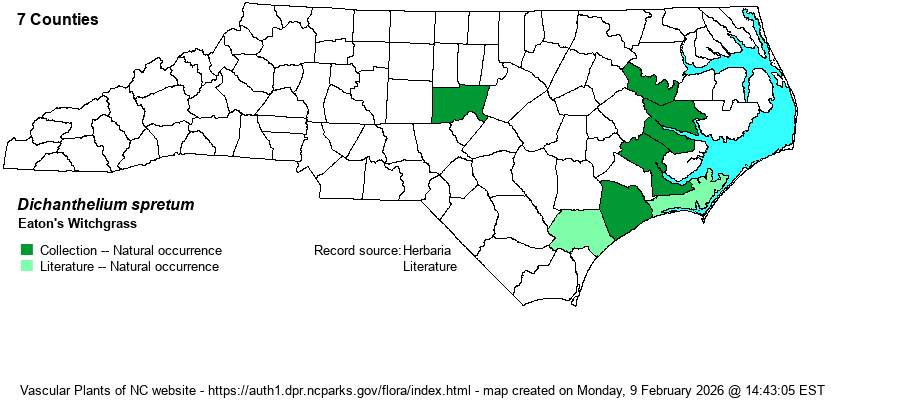
DistributionOuter Coastal Plain; disjunct to Chatham County in the eastern Piedmont.

ME to northern FL and TX; inland to TN and MO.
AbundanceRare in the lower Coastal Plain, seemingly just one or at most two sites in any county; very rare west into the eastern Piedmont. This is a State Endangered species.
HabitatSeasonally ponded natural depressions, powerlines through wet savannas, wet meadow (Chatham County), alluvial woods (Beaufort County).
PhenologyFlowering and fruiting May-September.
IdentificationIn the South, Eaton's Witchgrass is a bit of a moving target and easily mistaken for D. longiligulatum. The two species may actually occur together, as at the Martin County site ("Parmele", no habitat given). From D. spretum, D. longiligulatum is told by the more open inflorescence (vs. rather tight in D. spretum) and the shorter spikelets (1.1-1.5 mm long vs. 1.4-1.9 mm long in D. spretum).
Taxonomic CommentsNone, other than being named as Panicum spretum in older references.

A note about Dichanthelium: This genus is not impossible to identify to species! But it takes applied effort over a period of time in order to learn the various species and what their morphological limits are. We strongly recommend that you read the introduction to the treatment in Weakley et al. (2025), written by Richard LeBlond. LeBlond has made order out of near chaos, and his keys work very well for our plants. Most Dichanthelium taxa ("Dichs") do not grow everywhere indiscrimminately, but prefer certain well-defined habitats. Note that most species produce flowers/fruits twice a year -- a vernal period and an autumnal period -- and that measurements of spikelets and achenes are taken from vernal plants. Some species also have a third, or summer, period. In the vernal period there is a single inflorescence at the tip of the stem. In the autumnal period, plants produce elongate branches with bunched (congested) leaves and so look very different from vernal plants--inflorescences are produced in leaf axils as well as at the tips of branches. NOTE: Older texts had these species essentially all within the very large genus Panicum. "Dich" species are typically named as "Witchgrass" and Panicum species named as "Panicgrass".
Other Common Name(s)Eaton's Rosette-grass
State RankS1
Global RankG5
State StatusE
US Status
USACE-agcp
USACE-emp
County Map - click on a county to view source of record.
Photo Gallery
photographercommentsphoto_linkcountyobsType
B.A. SorriePhoto taken 1991 in small drawdown pond, Taunton, MA. Vernal stage. Photo_non_NCPhoto_non_NC
B.A. Sorriesame data, but autumnal stage. Photo_non_NCPhoto_non_NC
Select a source
AllHerbaria
Individual
Literature
Select an occurrence type
AllCollection_naturalLiterature_naturalPhoto_non_NC