| Author | (Schrank) Y. Schouten & Veldkamp | |
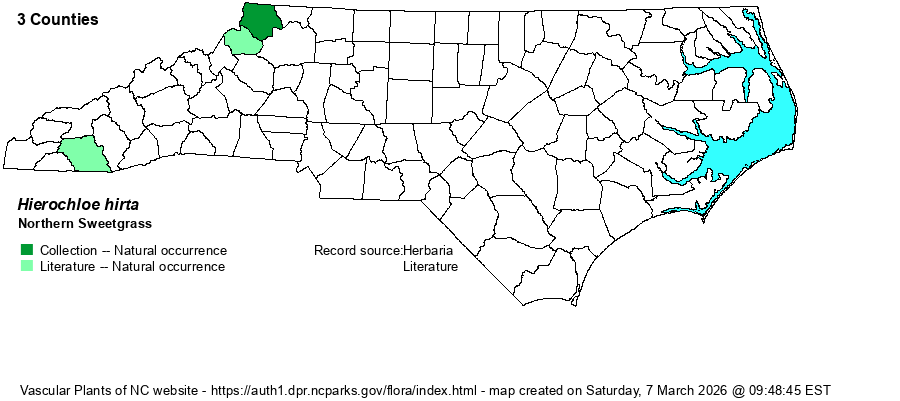
| Distribution | Mountains only, known from just 3 counties, last collected in 1994. There is a wide gap between Watauga County and Macon County.
Circumboreal, south in the U.S. to PA, CO, and CA; disjunct to the southern Appalachians in VA and NC. | |
| Abundance | Very rare and restricted in habitat; the NCNHP database lists only 3 records, but considers the species as historical, as all records are at least 30 years old. This is a Significantly Rare species, though considering that it is a disjunct far to the south in NC, and is extremely rare and in danger of extirpation, it should be State listed as Endangered or Threatened. | |
| Habitat | Bogs and fens, at medium to high elevations; in some parts of its range it is restricted to calcareous wetlands, but in NC apparently not so. |
| Phenology | Flowers and fruits May-August. | |
| Identification | The plants grow to about 1.5-2.5 feet tall. The open inflorescence is triangular in outline, with arching branches and drooping spikelets that are tawny at maturity. From the alien Anthoxanthum odorata it differs in its glumes of equal length (vs. definitely unequal in that species) and open inflorescence (vs. tight and cylindrical in A. odorata). | |
| Taxonomic Comments | A synonym, long used by botanists in North America is Hierochloe odorata. Another is H. odorata ssp. hirta. Another is Anthoxanthum hirtum.
| |
| Other Common Name(s) | Sweetgrass, Hairy Sweetgrass, Hairy Holygrass | |
| State Rank | SH | |
| Global Rank | G5 | |
| State Status | SR-D | |
| US Status | | |
| USACE-agcp | | |
| USACE-emp | | |