| Author | Lam. | |
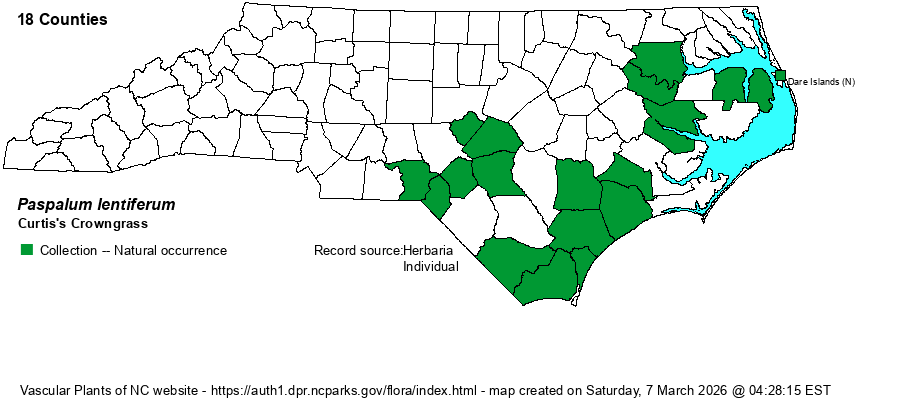
| Distribution | Outer Coastal Plain; rare on Outer Banks and in Sandhills. RAB mapped it in 9 outer Coastal Plain counties, plus Lee County in the Sandhills. Sorrie has collected it in Cumberland, Harnett, Hoke, Richmond, and Scotland counties. It would be well for someone to double-check the ID of all NC specimens.
Coastal Plain, NC to southern FL and eastern TX. | |
| Abundance | Uncommon. This is a Watch List species (as of 2024). | |
| Habitat | Moist to wet soils of pine savannas and flatwoods, pitcher-plant seepages, blackwater streamhead ecotones. Well-adapted to recurring fires. | |
| Phenology | Flowering and fruiting June-October. RAB (1968) and Weakley indicate a different flowering period for P. praecox of May-July. Specimens need to be checked to verify these data. | |
| Identification | This handsome, perennial grass grows mostly 2-4 feet tall, with pallid green or yellow-green spikelets. Note the specialized habitats. From P. praecox it differs in having hairy lower leaf sheaths (vs. smooth or sparsely short pubescent) and longer spikelets (2.6-3.5 mm vs. 2.2-2.8). Some specimens will not key cleanly, and the two taxa share virtually the same range, suggesting that it may best to accord them varietal status rather than full species. | |
| Taxonomic Comments | Included here are plants originally determined as Paspalum lentiferum. Some authors, such as FNA, Blomquist (1948), and Weakley et al. (2012, Flora of Virginia) lump this variety (P. praecox var. curtisianum), due to very similar habitats and range. However, in 2023, Weakley moved the former variety back to a full species, as P. lentiferum, although admitting that differences between the two are not strong. It may be best to treat them as varieties of P. praecox.
Paspalum is a genus of more than 300 species, found mostly in the New World. The genus is quite easily identified by the neat row of spikelets along each side of a flattened rachis (inflorescence branch), and also by the hemispherical outline of each spikelet. In some species there are only 2 such inflorescence branches, paired at the stem summit; in most of our species there are 3-4 branches; and in a few there may be many. Keys ask whether spikelets are paired or not -- that is, at each node on each side of the rachis there are pairs of spikelets on tiny stalks. Care must be taken with a hand lens to make sure there are 2 stalks at each node, as frequently one of the two spikelets will not grow. Non-paired or single spikelets will clearly have only a single stalk per node. | |
| Other Common Name(s) | | |
| State Rank | S1S2 | |
| Global Rank | G4 | |
| State Status | W7 | |
| US Status | | |
| USACE-agcp | | |
| USACE-emp | | |