| Author | (L.) Barbera et al. | |
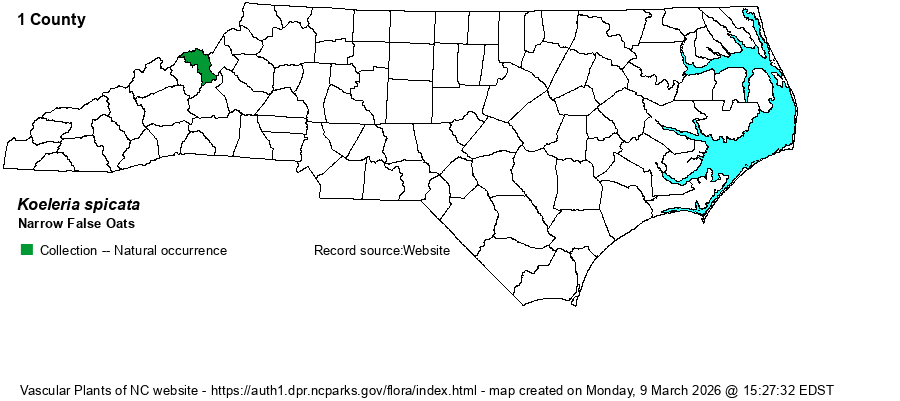
| Distribution | Mountains only. Known from a single site: Roan Mountain in Mitchell County, presumably at high elevation. First discovered by S.B. Buckley in the mid-1800s (specimen at NY); last collected by F. Scribner in 1889 (specimen at MO).
Circumboreal, south in N.A. to CT, NY, and PA (and AZ and NM in the west); disjunct to Page County, VA, and Mitchell County, NC. | |
| Abundance | Formerly very rare. As the last record was in 1889, and as the only known VA site is in the northern Mountains (still extant), it seems best to treat this species as extirpated (SX). It is State listed as Special Concern - Historical. | |
| Habitat | Elsewhere in the range it occurs on montane cliffs, outcrops, exposed ridges, etc. | |
| Phenology | Flowering and fruiting June-August. | |
| Identification | The stems grow several (or many) together from a tuft and grow about a foot tall, with relatively few leaves. The inflorescence is a dense spike 2.5-4.5 cm long (FNA is too long by 10 times!), each floret with a projecting awn. | |
| Taxonomic Comments | North American plants previously went by the name Trisetum spicatum, including a few named varieties. Weakley (2025) transferred it to the genus Koeleria, following a paper by Barbera et al. in 2019.
| |
| Other Common Name(s) | Spike Trisetum, Narrow False Oat | |
| State Rank | SX | |
| Global Rank | G5 | |
| State Status | [SC-H] | |
| US Status | | |
| USACE-agcp | | |
| USACE-emp | | |