| Author | Walter | |
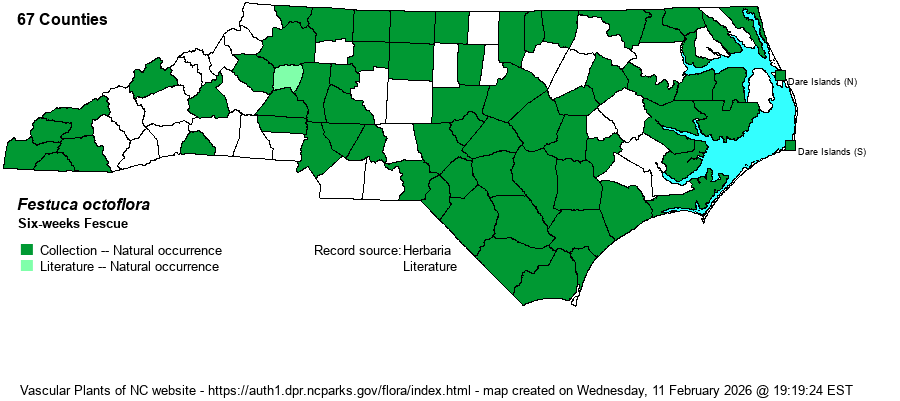
| Distribution | Throughout the state; the apparent gaps on the map will be filled with more collecting. This account treats the whole species, including the 2 varieties octoflora and tenella.
Southern NJ to MO and OK, south to FL and TX. FNA states that the species occurs northward into southern Canada. | |
| Abundance | Locally abundant in the Sandhills and southern Coastal Plain. Fairly common (at least) in most other areas of the state. | |
| Habitat | Dry to xeric sandy soil of stable dunes, maritime dry grasslands, fields, rock outcrops, roadsides, disturbed areas. | |
| Phenology | Flowering and fruiting April-June. | |
| Identification | This is one of several fescues that are annual and which have a single stamen (vs. perennial and with 3 stamens). Plants generally grow about a foot tall, with most leaves near the base and with narrow, erect inflorescences. It differs from F. myuros by the first glume greater than 1/2 the length of the second glume (vs. less than 1/2) and by much shorter awns. | |
| Taxonomic Comments | Bromus, Festuca, and Poa all can look quite similar to beginners (and even veterans!), because they all have multi-flowered spikelets. Generally speaking, Bromus has much the largest spikelets, and most Poa have a tuft of wispy hairs at the base of each floret (lacking in the other genera). Bromus and Festuca have obvious awns on the florets (absent in Poa). With field experience and careful use of keys, one can eventually handle these genera.
Our annual species of Festuca are by some authors placed in the genus Vulpia; they have a single stamen (vs. perennial and with 3 stamens). | |
| Other Common Name(s) | None | |
| State Rank | S4 [S5] | |
| Global Rank | G5 | |
| State Status | | |
| US Status | | |
| USACE-agcp | | |
| USACE-emp | | |