| Section 5 » Family Poaceae |
Show/Hide Synonym
| taxonName | relationship | relatedTaxonName | relatedTaxonRefText | relComments |
|---|
|
| Andropogon dealbatus | < | Andropogon virginicus | Radford, Ahles, and Bell (1968) | | | Andropogon dealbatus | < | Andropogon virginicus var. glaucus | Fernald (1950) | | | Andropogon dealbatus | < | Andropogon virginicus var. glaucus | Flora of North America (1993b, 1997, 2000, 2002a, 2002b, 2003a, 2004b, 2005, 2006a, 2006b, 2006c, 2007a, 2009, 2010) | | | Andropogon dealbatus | < | Andropogon virginicus var. glaucus | Wunderlin & Hansen Flora of Florida (3) | | | Andropogon dealbatus | < | Andropogon capillipes | Godfrey and Wooten (1979, 1981) | | | Andropogon dealbatus | < | Andropogon capillipes | Hitchcock & Chase (Manual of US Grasses) | | | Andropogon dealbatus | < | Andropogon capillipes | Kartesz (1999) | | | Andropogon dealbatus | < | Andropogon capillipes | Small (1933, 1938) | | | Andropogon dealbatus | = | Andropogon virginicus var. glaucus "wetlands varian | Weakley et al. (2011)=Y. Key adapted in part from Z. | | | Andropogon dealbatus | = | Andropogon virginicus var. dealbatus | | | | Source: Weakley's Flora |
|
| Author | (Mohr) Weakley & LeBlond | |
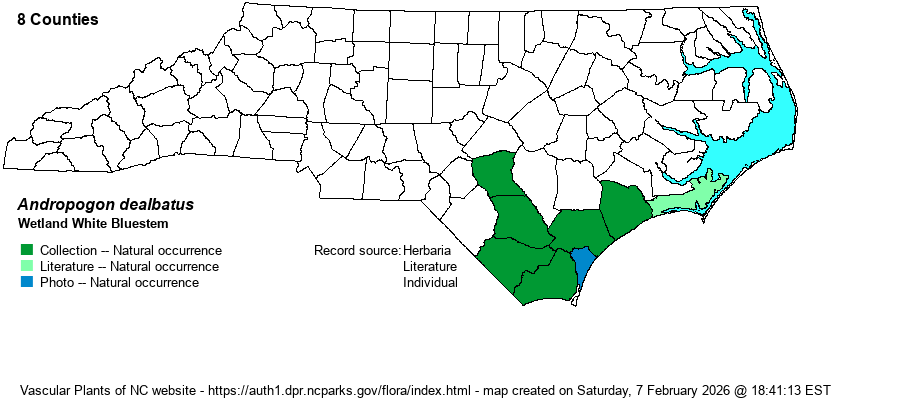
| Distribution | Mostly the outer southern Coastal Plain, ranging inland to southeastern Cumberland County and coastally north to Onslow County; reported also from Carteret County. Split off from A. capillipes in a paper by LeBlond and Weakley (2011).
Coastal Plain, NC to southern FL and eastern TX; southern NJ; Bahamas. | |
| Abundance | Uncommon. As this species was recently (2011) split from A. capillipes, there is uncertainty about its abundance level, especially as both species have similar ranges in the state. The NCNHP has added it to its Watch List (W7) in late 2022, with a State Rank of S2S4. | |
| Habitat | Exposed shores of sinkhole ponds, depression meadows, wet pine savannas -- strictly a wetland species, as opposed to capillipes, which usually occurs in uplands. | |
| Phenology | Flowering and fruiting September-October. | |
| Identification | This is one of several NC bluestems with glaucous (chalky white or bluish white) stems and leaves. It is very similar to A. capillipes, from which it has been split off. A. dealbatus differs in growing in wetter habitats, has longer spikelets (mostly 3.5-3.9 mm long vs. 3.2-3.5 mm long in A. capillipes), and has broader leaves (averaging 5.0 mm wide vs. averaging 3.5 mm wide). | |
| Taxonomic Comments | Anatherum dealbatum (Mohr ex Hackel) Weakley & LeBlond is a recent synonym (see Vorontsova et al. (2023 and JBRIT paper by Weakley and LeBlond in 2024). Formerly included within Andropogon capillipes.
While the genus Andropogon is quite easy to recognize in the field, ID of species is not so easy and there are no shortcuts. Readers are strongly advised to read the introductory paragraphs in Weakley (2025) and to use his key. Once one has successfully keyed out several species, or compared collections with verified specimens, one can learn to recognize them in the field.
In 2023 Vorontsova et al. published a paper (click on our References tab) in which they split off Anatherum from Andropogon. Most of the former are found in the Americas and Africa. For now, until the dust settles, the NCVP taxon editors will provide the new names in Anatherum as synonyms of the traditional Andropogon. | |
| Other Common Name(s) | None | |
| State Rank | S2S4 | |
| Global Rank | G5 | |
| State Status | W7 | |
| US Status | | |
| USACE-agcp | | |
| USACE-emp | | |