| Author | (J.A. Schultes) Chase | |
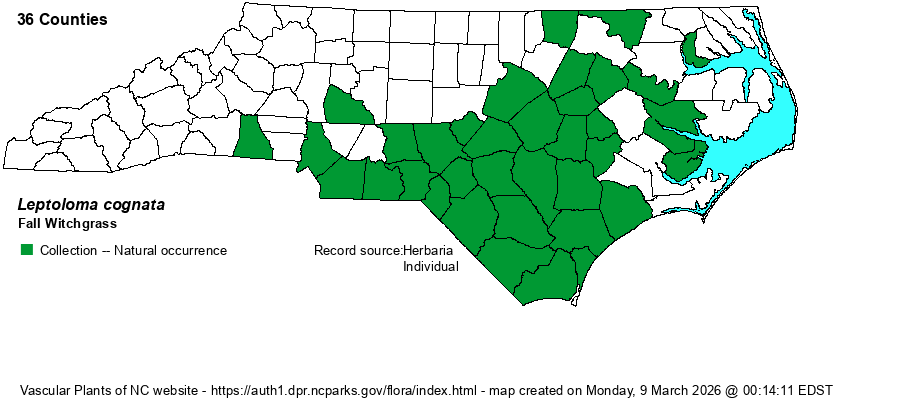
| Distribution | Coastal Plain, Sandhills, and lower and southern Piedmont. Absent from the north-central and western half of the state.
NH to MN south to FL and TX; Mex. Primarily in midwestern prairies; disjunct east of the Appalachians to the Atlantic states and perhaps adventive there. | |
| Abundance | Fairly common to frequent in the Sandhills and most of the southern and central Coastal Plain. Uncommon in the southeastern Piedmont and northern Coastal Plain. | |
| Habitat | Dry to mesic fields, roadsides, railroad margins, powerlines, etc. Its true native habitat in NC is not known with certainty, but the bulk of the populations range-wide occur in prairies. | |
| Phenology | Flowering and fruiting July-October. | |
| Identification | Fall Witchgrass has a very large, open, airy, and pale red inflorescence. It most resembles Muhlenbergia capillaris and Eragrostis spectabilis, but it has spikelets that are rounded or hemispheric in cross-section (versus flattened in those species). | |
| Taxonomic Comments | Some texts have treated it as Digitaria cognata, but Weakley (2025) follows recent molecular research that restores it to Leptoloma, a name used by RAB (1968) and most pre-1985 references.
| |
| Other Common Name(s) | Carolina Crabgrass, Fall Crabgrass | |
| State Rank | S5? [S5] | |
| Global Rank | G5 | |
| State Status | | |
| US Status | | |
| USACE-agcp | | |
| USACE-emp | | |