| Author | Torrey & A. Gray | |
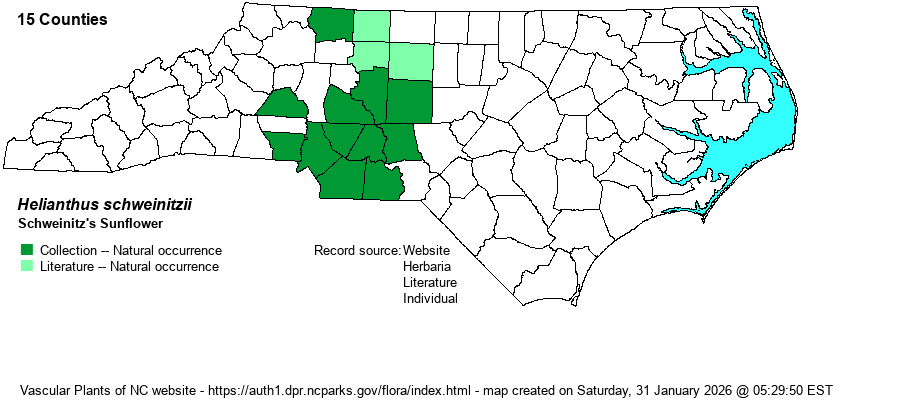
| Distribution | Piedmont only, and limited to the central and west-central portions, east only to Guilford, Randolph, and Montgomery counties. A record from Richmond County is of transplanted plants. A photograph on iNaturalist for Rockingham County appears to be correct, but that county is not mapped, as stronger confirmation is needed (i.e., close photos of the leaves, etc.).
Endemic to NC and northern SC. No records from VA. | |
| Abundance | Uncommon on the landscape; a few populations contain 1,000 or more plants. Several populations have been augmented by transplanting, others by vigorous habitat management, including fire. Most are signed as "No Mow" or restricted mow areas. The species is apparently proposed for downlisting or de-listing, as populations are quite numerous, though there is still some loss to mis-management of roadside populations. Currently, it is Federal and State Endangered, but in reality it is not endangered at the present time, as evidenced by the NCNHP's S3 State Rank. | |
| Habitat | Wooded borders, roadsides, powerline clearings; open woodlands with Blackjack Oak (Quercus marilandica), Post Oak (Q. stellata), hickories, and native grasses. Original habitats likely included prairie-like openings, probably kept open by fire (natural and Indian-set). However, reintroduced fire to some populations has not been a panacea in each case, and so it may be that some form of physical disturbance -- such as roadside mowing -- is needed. | |
| Phenology | Flowering and fruiting late August-October. | |
| Identification | This tall sunflower routinely reaches 6 feet high and sometimes 9 feet. Stems are rough-hairy. Leaves are opposite, up to 7 inches long, lance-shaped, lack teeth, margins generally curled under, very rough textured above (like sandpaper), and softly white-hairy beneath. Heads are showy, with yellow rays and disks. Giant Sunflower (H. giganteus) has a red-tinged stem (vs. green) and its leaf margins are not curled under. Make sure you take a close look and feel the leaves before identifying it and note the contrast between the sandpaper feel above and the soft tomentose feel below. | |
| Taxonomic Comments | None
| |
| Other Common Name(s) | None | |
| State Rank | S3 | |
| Global Rank | G3 | |
| State Status | E | |
| US Status | LE | |
| USACE-agcp | | |
| USACE-emp | | |