| Author | Linder | |
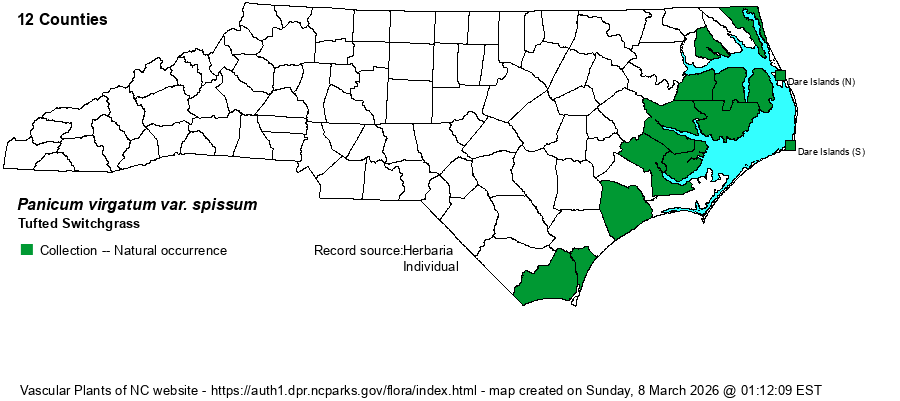
| Distribution | Outer Coastal Plain and Outer Banks. In maritime/tidewater situations only.
Mostly maritime, N.S. south to northeastern FL. | |
| Abundance | Uncommon to frequent. | |
| Habitat | Brackish marshes, fresh tidal marshes, often on slight elevations in those habitats. | |
| Phenology | Flowering and fruiting July-October. | |
| Identification | Due to unfortunate past lumping by authors, most NC botanists do not know this grass of maritime situations. It turns out that var. cubense is the form of switchgrass most often encountered in the state. The nominate var. virgatum is native only locally and has been planted widely on roadsides and even in "native grassland" restoration sites. From var. cubense, var. spissum is told by its longer spikelets (2.8-3.5 mm long vs. 3.2-5) and beak of sterile lemma exceeds the fertile lemma by 0.2-0.5 mm (vs. 0.6-1.3). In addition, plants grow from a knotty, bunched rhizome (vs. elongate rhizomes). From var. virgatum, told by knotty, bunched rhizome (vs. elongate rhizomes). | |
| Taxonomic Comments | See 2018 paper by Sorrie in Journal of the Botanical Research Institute of Texas 12: 61-62.
The genus Panicum in the broad sense was once very large, but with the split of Dichanthelium in the 1980s, it has been reduced to manageable size. In more recent decades, other genera have been split off: Coleataenia, Hymenachne, Kellochloa, and Phanopyrum, as examples. All 6 of these genera can be readily told from each other in the field with just a hand lens. For a more detailed discussion, see the introductory paragraphs in Weakley (2025). | |
| Other Common Name(s) | | |
| State Rank | [S3S4] | |
| Global Rank | G5TNR | |
| State Status | | |
| US Status | | |
| USACE-agcp | | |
| USACE-emp | | |