| Author | (Dryander ex Aiton) Stearn | |
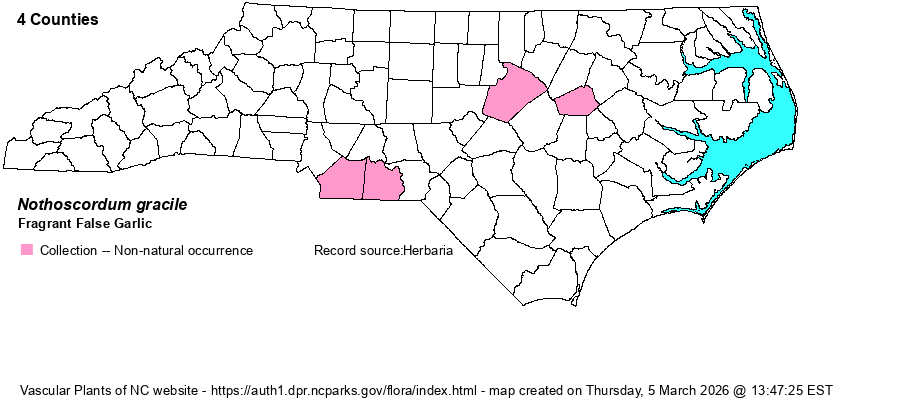
| Distribution | Known from a collection in 2022 at the Annie Louise Wilkerson Nature Preserve Park in Wake County (NCU 677479); in Anson County (NCU 446211), in Union County (NCU446625), and in Wilson County (NCU 447474) -- all in 2023. Likely to be found in additional counties in upcoming years.
Native to South America, but widely escaped. | |
| Abundance | Very rare. | |
| Habitat | Likely to be found in disturbed areas. | |
| Phenology | Presumably blooms in spring, and fruits soon thereafter. | |
| Identification | This species is somewhat similar to the native N. bivalve. However, this exotic has wider leaves (more than 4 mm wide vs. less than that in N. bivalve), has tepals connate for part of their length instead of separated to the base, and has many more flowers, giving a denser inflorescence. | |
| Taxonomic Comments | Also known as N. borbonicum.
| |
| Other Common Name(s) | Slender False Garlic, Fragrant Onion | |
| State Rank | SE | |
| Global Rank | GNR | |
| State Status | | |
| US Status | | |
| USACE-agcp | | |
| USACE-emp | | |