| Author | L. | |
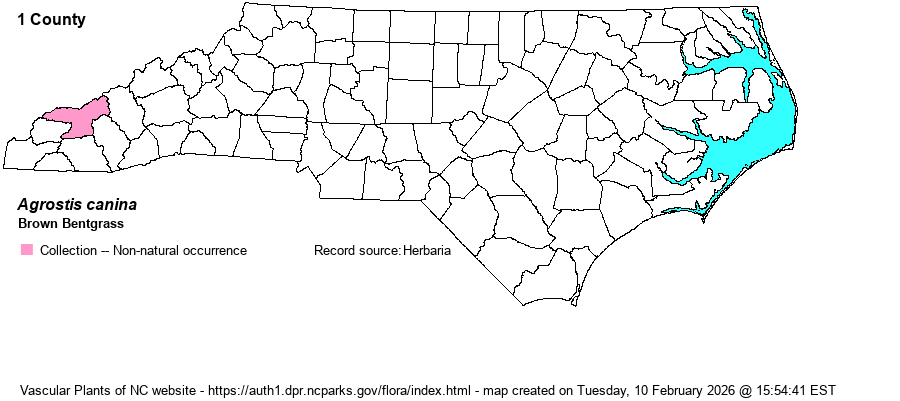
| Distribution | Collected in a vegetation plot -- Carolina Vegetation Survey -- in Swain County (Nantahala National Forest -- Little Tennessee River) -- on 22 June 1999 (NCU 696179).
"Native of Eurasia. Naturalized in North America to DE, se. PA (Rhoads & Block 2007), WV, and TN (Kartesz 1999)." (Weakley 2025). | |
| Abundance | Very rare or overlooked. | |
| Habitat | Over its Eastern U.S. range -- "Roadsides, disturbed open areas, lawns" (Weakley 2025). | |
| Phenology | May-July | |
| Identification | Each lemma has an awn 3-5 mm long and bent. The strictly high montane A. mertensii also has bent awns, but its anthers are shorter, spikelets longer, and plants densely cespitose (vs. loosely so and with stolons). Our other Agrostis lack awns or they are <3 mm long. | |
| Taxonomic Comments | Bentgrasses, genus Agrostis, in NC are usually densely cespitose (many stems and basal leaves from a central area). Most leaves are basal, rather short, and slender, often folded lengthwise or involute (rounded in cross-section). Stem leaves are few in number. The inflorescence is open and airy or wispy, with 2-several branches from well-spaced nodes; towards their ends, these branches are again branched and support the spikelets. Spikelets each contain only a single floret, with 2 glumes (outer scale-like bodies) and one lemma (inner scale-like body) and a central fruit or seed. Glumes and lemmas are sharp pointed. Lemmas may or may not have a projecting awn. In grasses, the fruit is called a caryopsis or a grain; it is composed of the seed and a tightly fitting envelope (or pericarp). | |
| Other Common Name(s) | Velvet Bentgrass | |
| State Rank | SE | |
| Global Rank | G5 | |
| State Status | | |
| US Status | | |
| USACE-agcp | | |
| USACE-emp | | |