| Author | Lacroix-Carignan, Naczi, Starr, & Lev.-Bourret | |
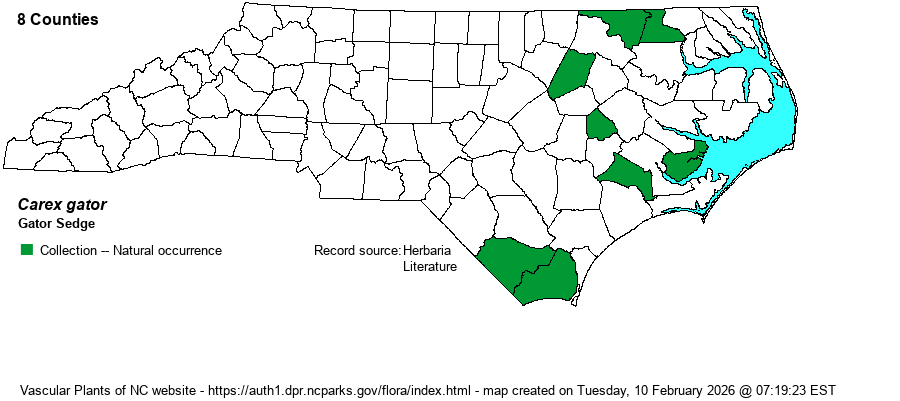
| Distribution | This species was described new to science early in 2026. In the naming publication, only specimens from Brunswick (Lockwoods Folly River) and Jones (Island Creek) counties were cited. Shortly after, specimens of Carex "gigantea" and lupuliformis examined at UNC Chapel Hill herbarium yielded records for Columbus, Greene, Hertford, Nash, Northampton, and Pamlico counties.
Primarily in peninsular FL; also scattered in FL panhandle, se GA, se SC, and se NC. | |
| Abundance | Apparently uncommon on the landscape, but directed searches in appropriate habitats will turn up additional populations. In FL, populations may consist of thousands of plants that dominate the forest floor. For now, the website editors suggest a State Rank of S1 and a Significantly Rare status. | |
| Habitat | Wet riverine Cypress-Gum swamps subject to seasonal flooding or flooding with high-rainfall events. Most sites S of NC are underlain by marl or coquina, but that is not the norm here in NC. Associated trees include Taxodium distichum, Acer rubrum, Liquidambar, Nyssa spp., and Quercus nigra. Plants occupy the floor of this habitat when water recedes. | |
| Phenology | Late spring-summer-early fall. | |
| Identification | Gator Sedge looks like a "depauperate" C. gigantea, notably its very short (1.5-2.0 cm) and relatively few-flowered spikes. Leaves are narrower (max 5.5 mm) than in gigantea, achenes are a bit smaller, and perigynia beaks are shorter. Like gigantea, Gator Sedge has a markedly sinuous or coiled lower portion of the style, and possesses knobs on the achene angles. C. lupuliformis differs in its perigynia maturing to green or with orange tinge (vs. green without orange and drying pale brown), and perygynia oriented at an acute angle upwards (vs. nearly horizontally from the rachis in C. gator. | |
| Taxonomic Comments | Can co-occur with C. lupulina, gigantea, louisianica, and lupuliformis. However, no hybrids have been detected.
The genus Carex is the largest in North America, and among the largest in the world. In temperate and boreal regions, Carex is often the dominant or co-dominant ground layer in many habitats. Seeds (achenes) are valuable food for birds and small mammals, while foliage is used by birds and mammals to make nests and as food by mammals. Species of Carex often look vastly different from one another -- spikes erect vs. drooping, tiny inflorescence vs. whopping, culms leafy vs. naked, perigynia beaked vs. beakless, stems densely bunched vs. single, etc. The genus has been divided into many sections (or groups), based on shared characters; some taxonomists have suggested that these be different genera, but that proves unworkable (so far). All Carex share the feature of a perigynium (an outer covering) which completely surrounds the achene (seed). This covering may fit tightly or loosely (like a small bladder), depending on which group or species. Details of perigynia shape, ornamentation, presence and size of beak, number of striations (or veins) are all important ID features. In recent years Rob Naczi and colleagues have stressed the importance of arrangement of perigynia -- whether spiral (3+ ranks) or distichous (2-ranked) -- and have named a number of new species as well as split off some older synonyms. Therefore, RAB's (1968) key, excellent for its time, can only be used in a general way today. Members of some sections of Carex are difficult to key out (notably Ovales, Laxiflorae, Griseae); this is in part due to variation among individuals of a species, or failings of the key. FNA has drawings of most species and some species may be found in two or more places within a key, to acount for variability. New species to NC, and new to science(!), continue to be found in NC. | |
| Other Common Name(s) | | |
| State Rank | S1 [S1] | |
| Global Rank | G5 | |
| State Status | [SR-P] | |
| US Status | | |
| USACE-agcp | | |
| USACE-emp | | |