| Author | (Small) K. Schumann | |
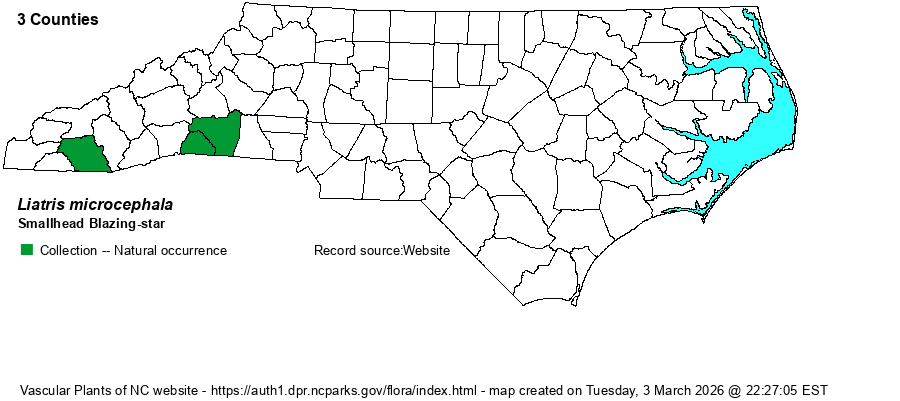
| Distribution | In NC known only from Macon, Polk, and Rutherford counties in the southern Mountains.
NC to KY, south to GA and AL. | |
| Abundance | Extremely rare, on the verge of extirpation in NC. The NCNHP database lists five records, four now considered Historical, and the other being Undetermined. It is listed as State Special Concern, but it deserves to be elevated to State Endangered. Though the NCNHP still retains a State Rank of S1, with there being no records in several decades and no photos on iNaturalist, sadly the website editors are suggesting that it indeed is now Historical and suggest a rank of SH. | |
| Habitat | Dry to xeric, acidic rock outcrops and montane ridges, "dry bank above Broad River". The habitats for the species are not infrequent at all, and thus some other factor(s) is involved with its rarity. | |
| Phenology | Flowering and fruiting August-October. | |
| Identification | Blazing-stars typically have single unbranched stems, many slender leaves, and a terminal spike-like inflorescence of disk florets only. They grow from very hard, roundish, underground corms. Smallhead Blazing-star grows 1-2 feet tall, the lower leaves lance-shaped, middle and upper leaves linear and shorter. Heads are narrow, have only 4-6 pink-purple florets, and involucral bracts have blunt to acute tips. In western NC this species may be mistaken for L. helleri; it can be told by fewer florets per head (4-6 versus 7-17). | |
| Taxonomic Comments | None
| |
| Other Common Name(s) | Appalachian Blazing-star, Dwarf Blazing-star | |
| State Rank | S1 [SH] | |
| Global Rank | G3G4 | |
| State Status | SC-V | |
| US Status | | |
| USACE-agcp | | |
| USACE-emp | | |