| Section 6 » Family Asteraceae |
Show/Hide Synonym
| taxonName | relationship | relatedTaxonName | relatedTaxonRefText | relComments |
|---|
| Liatris secunda | = | Liatris pauciflora var. secunda | Flora of North America (1993b, 1997, 2000, 2002a, 2002b, 2003a, 2004b, 2005, 2006a, 2006b, 2006c, 2007a, 2009, 2010) | | | Liatris secunda | = | Liatris pauciflora var. secunda | Wunderlin & Hansen Flora of Florida (3) | | | Liatris secunda | < | Liatris pauciflora | | | | Liatris secunda | < | Liatris pauciflora | Vascular Flora of the Southeastern States (Cronquist 1980, Isely 1990) | | |
|
| Liatris secunda | = | Laciniaria secunda | Small (1933, 1938) | | | Source: Weakley's Flora |
|
| Author | Elliott | |
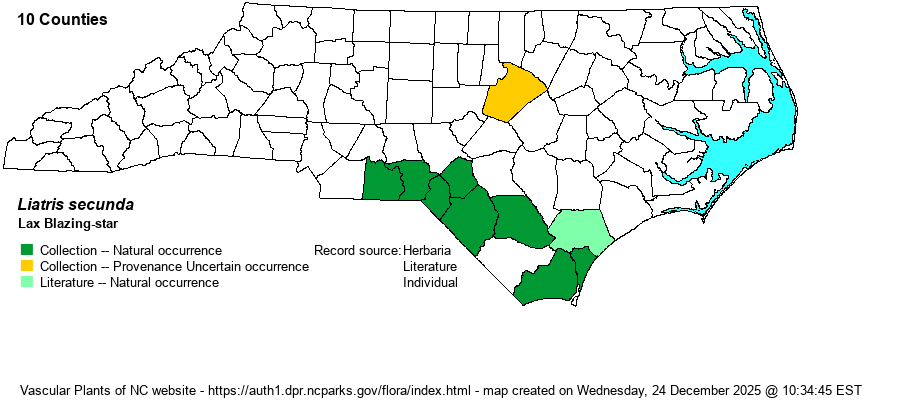
| Distribution | Sandhills and southern Coastal Plain. Collections from outside of the Sandhills proper need to be checked for ID; they may be Sandhills (Coker's) Blazing-star (L. cokeri) with secund heads. A collection from "Raleigh" in Wake County appears to be correctly identified, but its provenance is uncertain.
Coastal Plain, NC to northwestern FL and southern AL. | |
| Abundance | Rare to uncommon over its 9-county range, but can be quite numerous in a few places in the southern Sandhills Game Land (Scotland County). Absent from the northern half of the Sandhills region (i.e., no records from Moore, Harnett, or Cumberland counties). This is a Watch List species. | |
| Habitat | Xeric to dry Longleaf Pine-Wiregrass sandhills, pine-oak scrub; interdunes along the coast (Brunswick and New Hanover counties). | |
| Phenology | Flowering and fruiting August-October. | |
| Identification | Blazing-stars typically have single unbranched stems, many slender leaves, and a terminal spike-like inflorescence of disk florets only. They grow from very hard, roundish, underground corms. Lax Blazing-star grows 1-2.5 feet tall, 1-several stems from a single corm, the stems usually leaning and rather hairy (desribed as hirtellous or short pubescent). Lower leaves are lance-linear and typically without stalks; middle and upper leaves progressively narrower, shorter, and stalkless. The heads are narrow, have 3-6 white to (rarely) pink-purple florets, and are secund on the stem (occur only on one side). One of the taxon editors (Sorrie) has seen it about 10 times in the Sandhills and it always has white florets; however, plants east of the Sandhills proper may have pink to rosy ones. Sandhills Blazing-star may also have secund heads, but it has a glabrous to glabrate stem, its florets are smaller and with shorter limbs or blades, and always has pink to rosy florets. | |
| Taxonomic Comments | Some authors, such as FNA, treat it as L. pauciflora var. secunda; the two are certainly very close; see accounts in FSUS. The pink-to-rosy flowered plants of the flat portion of the Coastal Plain have been examined by Eric Ungberg; no white-flowered plants occur there and the pink ones may warrant separation from the white-flowered plants of the Sandhills proper. He has many images on iNaturalist.
| |
| Other Common Name(s) | Lax Gayfeather, Piedmont Gayfeather | |
| State Rank | S2 | |
| Global Rank | G4 | |
| State Status | W7 [W1] | |
| US Status | | |
| USACE-agcp | | |
| USACE-emp | | |