| Author | Nuttall ex de Candolle | |
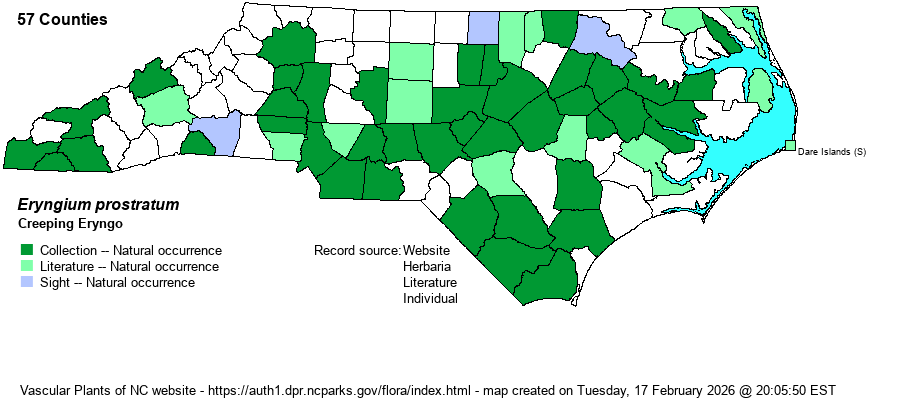
| Distribution | Scattered over much to most of the state, though clearly scarce to absent in the northwestern Piedmont and northern Mountains. Owing to numerous recent photo records on iNaturalist, the county distribution has been filling in somewhat rapidly, suggesting that the species might be adventive in more inland areas.
This is a Southern species, ranging from southern VA and southern MO south to central FL and eastern TX. The Digital Atlas of the Virginia Flora considers all records in that state to be of uncertain provenance, and Weakley (2018-2024) states: "definitely native southward, perhaps only rather recently spread to the northern parts of our area". Though certainly some of the records from NC could fall into this category, where found in lawns, for example, most SERNEC specimens are rather old and certainly appear to represent native populations. | |
| Abundance | Spreading and somewhat increasing in recent years, though perhaps somewhat adventive to lawns and other disturbed damp ground. Infrequent though widespread in the Coastal Plain and much of the Piedmont, though rather rare in the southern Mountains. Very rare to absent in the northern Mountains and far northern Piedmont. Owing to a recent spread in the range, the State Rank is clearly now S4. | |
| Habitat | This is a wetland species, but it is found more in damp ground than in truly wet places. It grows on exposed mud of lake and pond shores, low meadows, ditches, openings in bottomlands, and wet or damp roadsides or damp lawns. Most sites are in sunny places with little competing vegetation, as it is a very low-growing species. | |
| Phenology | Blooms from May to October, and fruits soon after flowering. | |
| Identification | This is a prostrate species, rooting at nodes, with numerous stems growing in different directions. From each node grow a few very small ovate to elliptical leaves on slender petioles. The blades are only about 1-1.5 inches long and about half as wide, usually toothed; a few leaves are palmately lobed. The small flower clusters are in very dense "cones", of minute bright blue flowers, and a slender stalk. This cone is only about 1/4-inch tall and somewhat narrower. No other plant even closely resembles this "belly plant" or "mat plant", especially its odd tiny balls of blue flowers practically on the ground. In fact, many biologists and nearly all laypeople have no idea the identity of this unusual plant. | |
| Taxonomic Comments | None
| |
| Other Common Name(s) | Spreading Eryngo | |
| State Rank | S3S4 [S4] | |
| Global Rank | G5 | |
| State Status | | |
| US Status | | |
| USACE-agcp | FACW link |
| USACE-emp | OBL link |