Moths of North Carolina
Home Page
Recent Entries
Recent Account Updates
County Searches
General Search
Submit a Public Record
Larval Hosts
References
Maps
Draft Checklists
Family Photo Gallery
Family PDFs
NC Biodiversity Project
Comments
Significant Contributors
Scientific Name:
Common Name:
Family (Alpha):
Choose a Family
ACROLEPIIDAE-False Diamondback Moths
ADELIDAE-Fairy moths
ALUCITIDAE-Many-plumed Moths
AMPHISBATIDAE-
ARGYRESTHIIDAE-Shiny Head-standing Moths
AUTOSTICHIDAE-Autostichid Moths
BATRACHEDRIDAE-Batrachedrid Moths
BEDELLIIDAE-Bedelliid Moths
BLASTOBASIDAE-Blastobasid Moths
BOMBYCIDAE-Silkworm Moths
BUCCULATRICIDAE-Ribbed Cocoon-maker Moths
CARPOSINIDAE-Fruitworm Moths
CHOREUTIDAE-Metalmark Moths
COLEOPHORIDAE-Casebearer Moths and Relatives
COSMOPTERIGIDAE-Cosmopterigid Moths
COSSIDAE-Carpenter Moths, Goat Moths
CRAMBIDAE-Grass Moths, Snout Moths
DEPRESSARIIDAE-
DREPANIDAE-Hook-tips and Thyatirid Moths
DRYADAULIDAE-
ELACHISTIDAE-Grassminer Moths and Relatives
EPERMENIIDAE-Fringe-tufted Moths
EPIPYROPIDAE-Planthopper Parasite Moths
EREBIDAE-Erebid Moths
ERIOCRANIIDAE-Eriocraniid Moths
EUTELIIDAE-Euteliid Moths
GALACTICIDAE-Galacticid Moths
GELECHIIDAE-Gelechiid Moths; Twirler Moths
GEOMETRIDAE-Geometer Moths, Loopers
GLYPHIDOCERIDAE-Glyphidocerid Moths
GLYPHIPTERIGIDAE-Sedge Moths
GRACILLARIIDAE-Leafblotch miner moths
HELIOZELIDAE-Shield bearer moths
HEPIALIDAE-Ghost or Swift Moths
HYBLAEIDAE-
INCURVARIIDAE-Leafcutter Moths
LASIOCAMPIDAE-Tent Caterpillar Moths, Lappet Moths
LECITHOCERIDAE-Long-horned Moths
LIMACODIDAE-Slug Caterpillar Moths
LIMOCODIDAE-
LYONETIIDAE-Lyonetiid Moths
MEGALOPYGIDAE-Flannel Moths
MICROPTERIGIDAE-Mandibulate Moths
MIMALLONIDAE-
MOMPHIDAE-Mompha Moths
NEPTICULIDAE-Minute leaf miners
NOCTUIDAE-Owlet Moths
NOLIDAE-
NOTODONTIDAE-Prominents
OECOPHORIDAE-Oecophorid Moths
OPOSTEGIDAE-
PELEOPODIDAE-
PLUTELLIDAE-Diamondback Moths
PRODOXIDAE-Yucca Moths
PSYCHIDAE-Bagworm Moths
PTEROPHORIDAE-Plume Moths
PYRALIDAE-Pyralid Moths, Snout Moths
SATURNIIDAE-Giant Silkworm Moths
SCHRECKENSTEINIIDAE-Schreckensteiniid Moths
SCYTHRIDIDAE-
SESIIDAE-Clearwing Moths
SPHINGIDAE-Sphinx Moths
THYATIRIDAE-
THYRIDIDAE-Window-winged Moths
TINEIDAE-Clothes moths
TISCHERIIDAE-Tischerid Moths
TORTRICIDAE-Leafroller Moths
URANIIDAE-
URODIDAE-Urodid Moths
XYLORYCTIDAE-
YPONOMEUTIDAE-Ermine Moths
YPSOLOPHIDAE-Ypsolophid Moths
ZYGAENIDAE-
«
Home
»
View
PDF
Depressariidae Members:
Agonopterix alstroemeriana
Agonopterix argillacea
Agonopterix atrodorsella
Agonopterix canadensis
Agonopterix clemensella
Agonopterix curvilineella
Agonopterix eupatoriiella
Agonopterix flavicomella
Agonopterix hyperella
Agonopterix lythrella
Agonopterix pulvipennella
Agonopterix robiniella
Agonopterix senicionella
Agonopterix thelmae
Agonopterix unidentified species
Agonopterix walsinghamella
Antaeotricha albulella
Antaeotricha decorosella
Antaeotricha humilis
Antaeotricha leucillana
Antaeotricha osseella
Antaeotricha schlaegeri
Antaeotricha unidentified species
Bibarrambla allenella
Ethmia longimaculella
Ethmia trifurcella
Ethmia zelleriella
Eupragia hospita
Gonioterma mistrella
Machimia tentoriferella
Menesta melanella
Menesta tortriciformella
Nites maculatella
Nites ostryella
Pseuderotis obiterella
Psilocorsis cryptolechiella
Psilocorsis quercicella
Psilocorsis reflexella
Rectiostoma xanthobasis
Scythropiodes issikii
Semioscopis aurorella
Semioscopis merriccella
Semioscopis packardella
Pseuderotis
Members:
Pseuderotis obiterella
6 NC Records
Pseuderotis obiterella
(Busck, 1908) - No Common Name
view caption
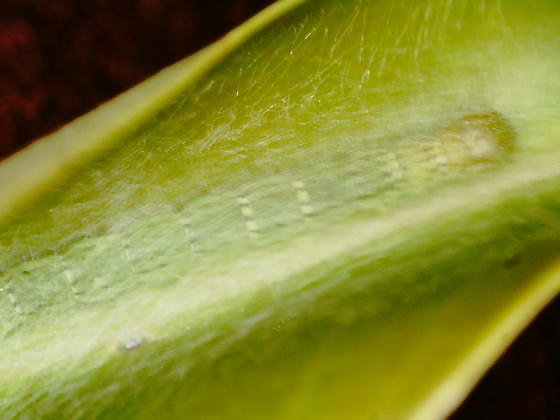
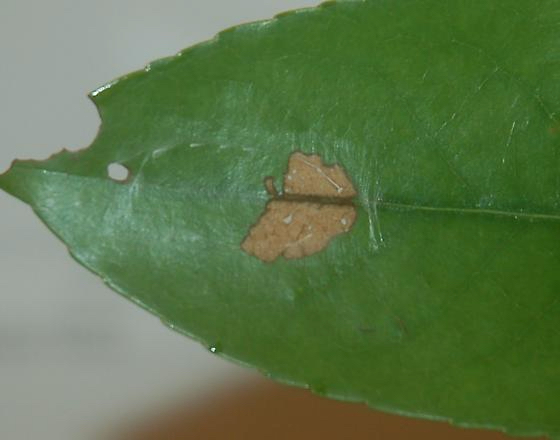
A larva beneath a silt shelter.
Taxonomy
Superfamily:
Gelechioidea
Family:
Depressariidae
Subfamily:
[Peleopodinae]
Tribe:
[Peleopodini]
P3 Number:
59a0222
MONA Number:
1009.00
Identification
Field Guide Descriptions:
Online Resources:
MPG
,
BugGuide
,
iNaturalist
,
Google
,
BAMONA
,
GBIF
,
BOLD
Technical Description, Adults:
Hodges (1974)
Adult Markings:
Pseuderotis obiterella
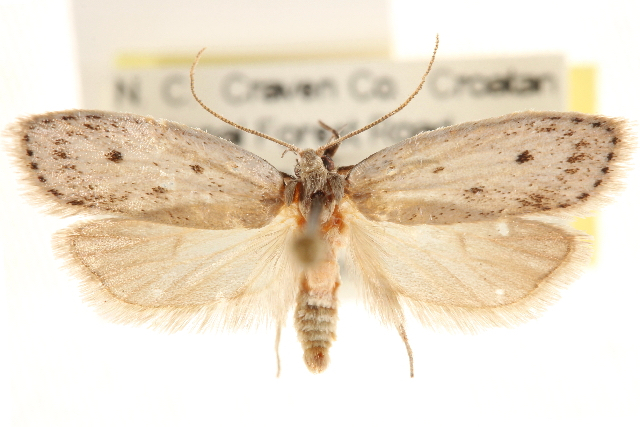
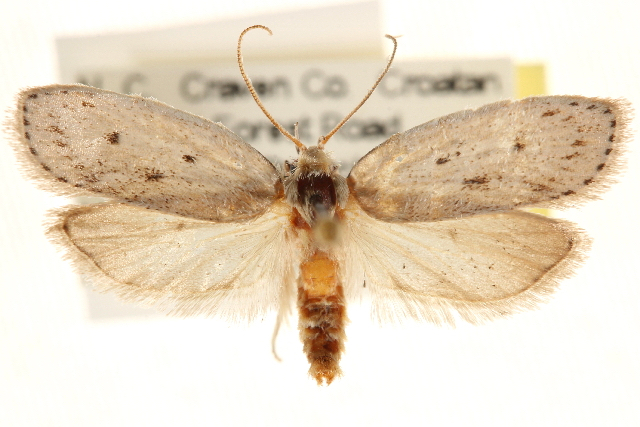
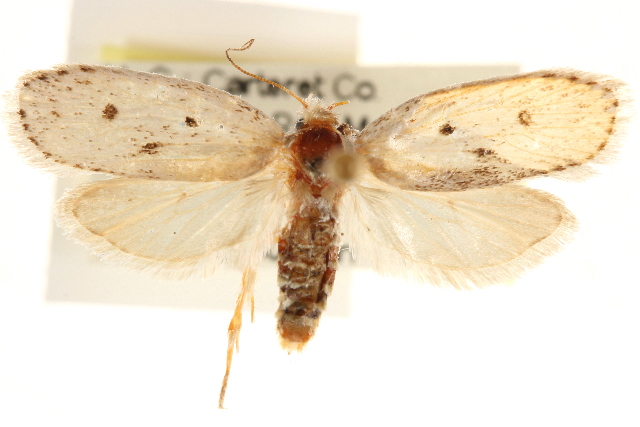
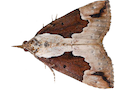
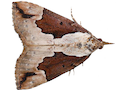
has a flattened shape, and an overall pale straw to tan color that is often finely peppered with darker scales in fresh specimens. The head, thorax and the slender, smooth-scaled palps are all concolorous with the ground color of the forewings. The antenna is similar, but often with a bit of a golden suffusion. The primary marks include two black spots near the middle of the forewing at around two-fifth and three-fifth the wing length, and a more diffuse dark spot between these two that is displaced towards the inner margin. There are two rows of dark dots, with one along the outer margin, and a second that parallels the first at around three-fourths the wing length. When an individual is viewed from above while resting, the larger black spots produce a square-like pattern in the middle of the wings, particularly since the third spot is often hidden by the folded wings. The hindwings and fringe are uniformly pale straw to tan, except for a bit of dark dusting near the outer margin, and the legs are predominantly light to medium brown.
Pseuderotis obiterella
can be confused with
Inga cretacea
, but the latter has blackish legs, a chalky-white ground color, and lacks the second row of dark dots at three-fourths that parallels the one along the outer margin.
Wingspan:
15.0-15.5 mm (Busck 1903).
Adult Structural Features:
Hodges (1974) has descriptions and illustrations of the male and female genitalia.
Adult ID Requirements:
Identifiable from good quality photos of unworn specimens.
Immatures and Development:
The larval life history is poorly documented. Tracy Feldman reared an adult from a larva that was feeding beneath a silk shelter on a leaf of Loblolly Bay (
Gordonia lasianthus
). The larva fed by skeletonized the leaf along the midrib and had an amber-colored head and prothoracic shield, a light greenish abdomen with a series of irregular, fine, longitudinal lines, and a transverse row of white dots along each abdominal segment. A recent iNat record (2025; Ashley Bosarge) also shows a larva beneath a silt shelter that was feeding on a
Nyssa
sp.
Larvae ID Requirements:
Identifiable from good quality photos, especially where associated with known host plants.
Distribution in North Carolina
Distribution:
Pseuderotis obiterella
is largely restricted to the southeastern US, where the range extends from North Carolina southward and westward to South Carolina, Georgia, northern Florida, Alabama, Mississippi and Louisiana. As of 2035, our records are all from the Coastal Plain, including the Sandhills and Lower Coastal Plain.
County Map:
Clicking on a county returns the records for the species in that county.
Flight Dates:
High Mountains (HM) ≥ 4,000 ft.
Low Mountains (LM) < 4,000 ft.
Piedmont (Pd)
Coastal Plain (CP)
Click on graph to enlarge
Immature Dates:
High Mountains (HM) ≥ 4,000 ft.
Low Mountains (LM) < 4,000 ft.
Piedmont (Pd)
Coastal Plain (CP)
Click on graph to enlarge
Habitats and Life History
Habitats:
Recorded habitats in North Carolina include pocosins in the Outer Coastal Plain and streamhead pocosins in the Sandhills.
Larval Host Plants:
The host plants are poorly documented, but Tracy Feldman reared a larva from Loblolly Bay (
Gordonia lasianthus
) in North Carolina (BugGuide, 2021), and there is a recent rearing record for a species of
Nyssa
(iNat; Ashley Bosarge). -
View
Observation Methods:
The adults are attracted to lights. Much more information is needed on the host plants and larval life history of this species.
Wikipedia
See also Habitat Account for
Coastal Plain Wet Acidic Shrublands
Status in North Carolina
Natural Heritage Program Status:
Natural Heritage Program Ranks:
[GNR] S2S3
State Protection:
Has no legal protection, although permits are required to collect it on state parks and other public lands.
Comments:
Hodges (1974) described this species as rarely collected. It appears to be in decline, with only six iNat records recorded as of 2025.
Photo Gallery for
Pseuderotis obiterella
- None
Photos: 5
Recorded by: Tracy Feldman on 2021-06-16
Tyrrell Co.
Comment: A larva beneath a silt shelter on Gordonia lasianthus.
Recorded by: Tracy Feldman on 2021-06-16
Tyrrell Co.
Comment: Skeletonized leaf tissue on Gordonia lasianthus.
Recorded by: J.B. Sullivan on 1999-08-08
Carteret Co.
Comment: BOLD specimen; in USNM.
Recorded by: J.B. Sullivan on 1999-03-24
Craven Co.
Comment: BOLD specimen; in USNM.
Recorded by: J.B. Sullivan on 1999-03-24
Craven Co.
Comment: BOLD specimen; in USNM.
 »
»