Moths of North Carolina
Home Page
Recent Entries
Recent Account Updates
County Searches
General Search
Submit a Public Record
Larval Hosts
References
Maps
Draft Checklists
Family Photo Gallery
Family PDFs
NC Biodiversity Project
Comments
Significant Contributors
Scientific Name:
Common Name:
Family (Alpha):
Choose a Family
ACROLEPIIDAE-False Diamondback Moths
ADELIDAE-Fairy moths
ALUCITIDAE-Many-plumed Moths
AMPHISBATIDAE-
ARGYRESTHIIDAE-Shiny Head-standing Moths
AUTOSTICHIDAE-Autostichid Moths
BATRACHEDRIDAE-Batrachedrid Moths
BEDELLIIDAE-Bedelliid Moths
BLASTOBASIDAE-Blastobasid Moths
BOMBYCIDAE-Silkworm Moths
BUCCULATRICIDAE-Ribbed Cocoon-maker Moths
CARPOSINIDAE-Fruitworm Moths
CHOREUTIDAE-Metalmark Moths
COLEOPHORIDAE-Casebearer Moths and Relatives
COSMOPTERIGIDAE-Cosmopterigid Moths
COSSIDAE-Carpenter Moths, Goat Moths
CRAMBIDAE-Grass Moths, Snout Moths
DEPRESSARIIDAE-
DREPANIDAE-Hook-tips and Thyatirid Moths
DRYADAULIDAE-
ELACHISTIDAE-Grassminer Moths and Relatives
EPERMENIIDAE-Fringe-tufted Moths
EPIPYROPIDAE-Planthopper Parasite Moths
EREBIDAE-Erebid Moths
ERIOCRANIIDAE-Eriocraniid Moths
EUTELIIDAE-Euteliid Moths
GALACTICIDAE-Galacticid Moths
GELECHIIDAE-Gelechiid Moths; Twirler Moths
GEOMETRIDAE-Geometer Moths, Loopers
GLYPHIDOCERIDAE-Glyphidocerid Moths
GLYPHIPTERIGIDAE-Sedge Moths
GRACILLARIIDAE-Leafblotch miner moths
HELIOZELIDAE-Shield bearer moths
HEPIALIDAE-Ghost or Swift Moths
HYBLAEIDAE-
INCURVARIIDAE-Leafcutter Moths
LASIOCAMPIDAE-Tent Caterpillar Moths, Lappet Moths
LECITHOCERIDAE-Long-horned Moths
LIMACODIDAE-Slug Caterpillar Moths
LIMOCODIDAE-
LYONETIIDAE-Lyonetiid Moths
MEGALOPYGIDAE-Flannel Moths
MICROPTERIGIDAE-Mandibulate Moths
MIMALLONIDAE-
MOMPHIDAE-Mompha Moths
NEPTICULIDAE-Minute leaf miners
NOCTUIDAE-Owlet Moths
NOLIDAE-
NOTODONTIDAE-Prominents
OECOPHORIDAE-Oecophorid Moths
OPOSTEGIDAE-
PELEOPODIDAE-
PLUTELLIDAE-Diamondback Moths
PRODOXIDAE-Yucca Moths
PSYCHIDAE-Bagworm Moths
PTEROPHORIDAE-Plume Moths
PYRALIDAE-Pyralid Moths, Snout Moths
SATURNIIDAE-Giant Silkworm Moths
SCHRECKENSTEINIIDAE-Schreckensteiniid Moths
SCYTHRIDIDAE-
SESIIDAE-Clearwing Moths
SPHINGIDAE-Sphinx Moths
THYATIRIDAE-
THYRIDIDAE-Window-winged Moths
TINEIDAE-Clothes moths
TISCHERIIDAE-Tischerid Moths
TORTRICIDAE-Leafroller Moths
URANIIDAE-
URODIDAE-Urodid Moths
XYLORYCTIDAE-
YPONOMEUTIDAE-Ermine Moths
YPSOLOPHIDAE-Ypsolophid Moths
ZYGAENIDAE-
«
Home
»
View
PDF
Oecophoridae Members:
Callima argenticinctella
Carolana ascriptella
Decantha boreasella
Decantha stecia
Eido trimaculella
Fabiola edithella
Fabiola shaleriella
Fabiola tecta
Idioglossa miraculosa
Inga cretacea
Inga sparsiciliella
Mathildana flipria
Mathildana newmanella
Polix coloradella
Promalactis suzukiella
Stathmopoda aenea
Stathmopoda elyella
Ymeldia janae
Stathmopoda
Members:
Stathmopoda aenea
Stathmopoda elyella
2 NC Records
Stathmopoda aenea
(Braun, 1918) - No Common Name
Taxonomy
Superfamily:
Gelechioidea
Family:
Oecophoridae
Subfamily:
Stathmopodinae
Tribe:
[Stathmopodinae]
P3 Number:
59a1732.5
MONA Number:
1070.10
Species Status:
Only two native species of
Stathmopoda
occur in North America, and both are present in North Carolina. They typically rest with their very large hind legs elevated above the substrate, and the larvae have an unusual diet that consists primarily of fern spores.
Identification
Field Guide Descriptions:
Online Resources:
MPG
,
BugGuide
,
iNaturalist
,
Google
,
BAMONA
,
GBIF
,
BOLD
Technical Description, Adults:
Braun (1918)
Technical Description, Immature Stages:
Braun (1918)
Adult Markings:
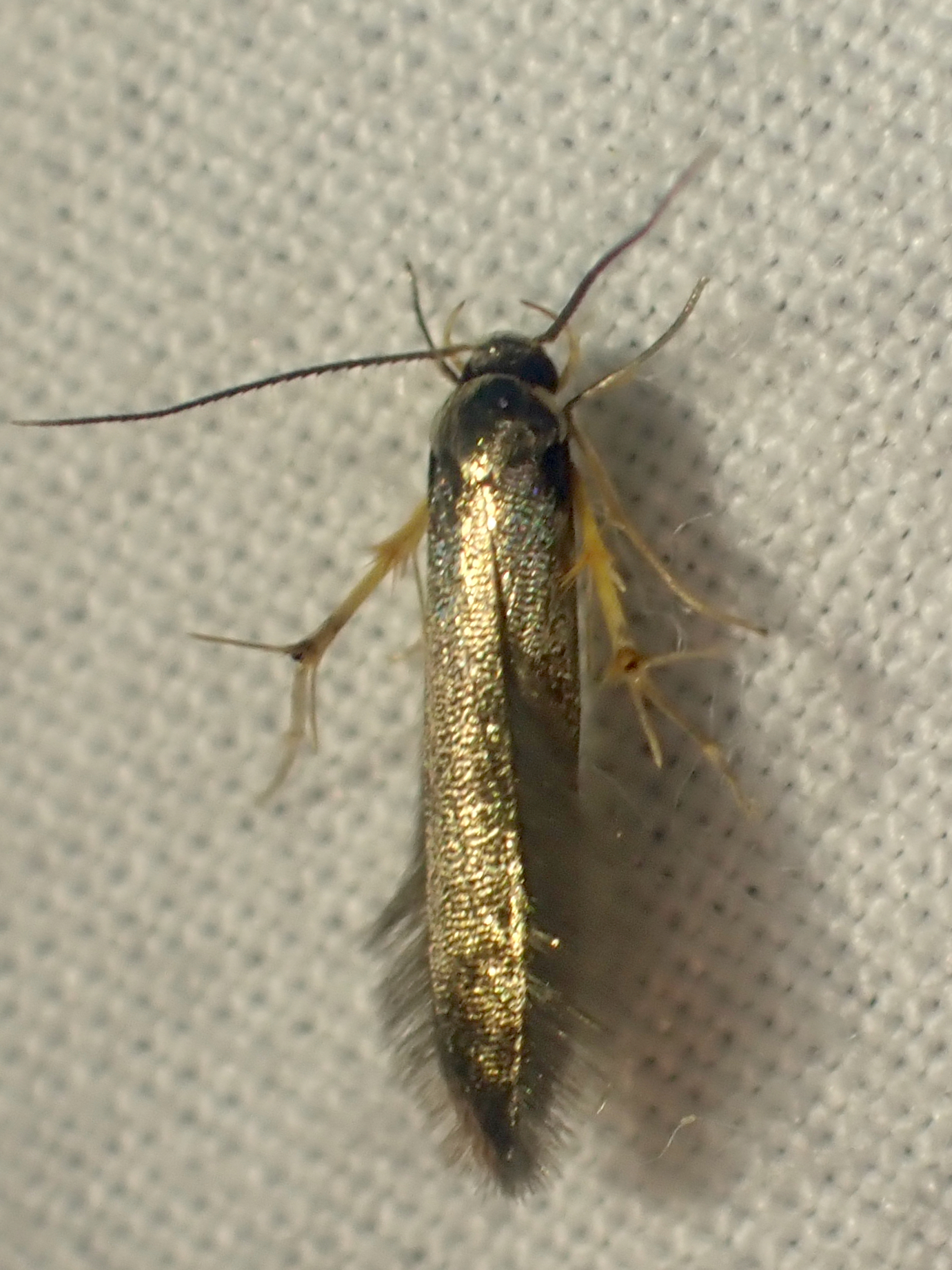
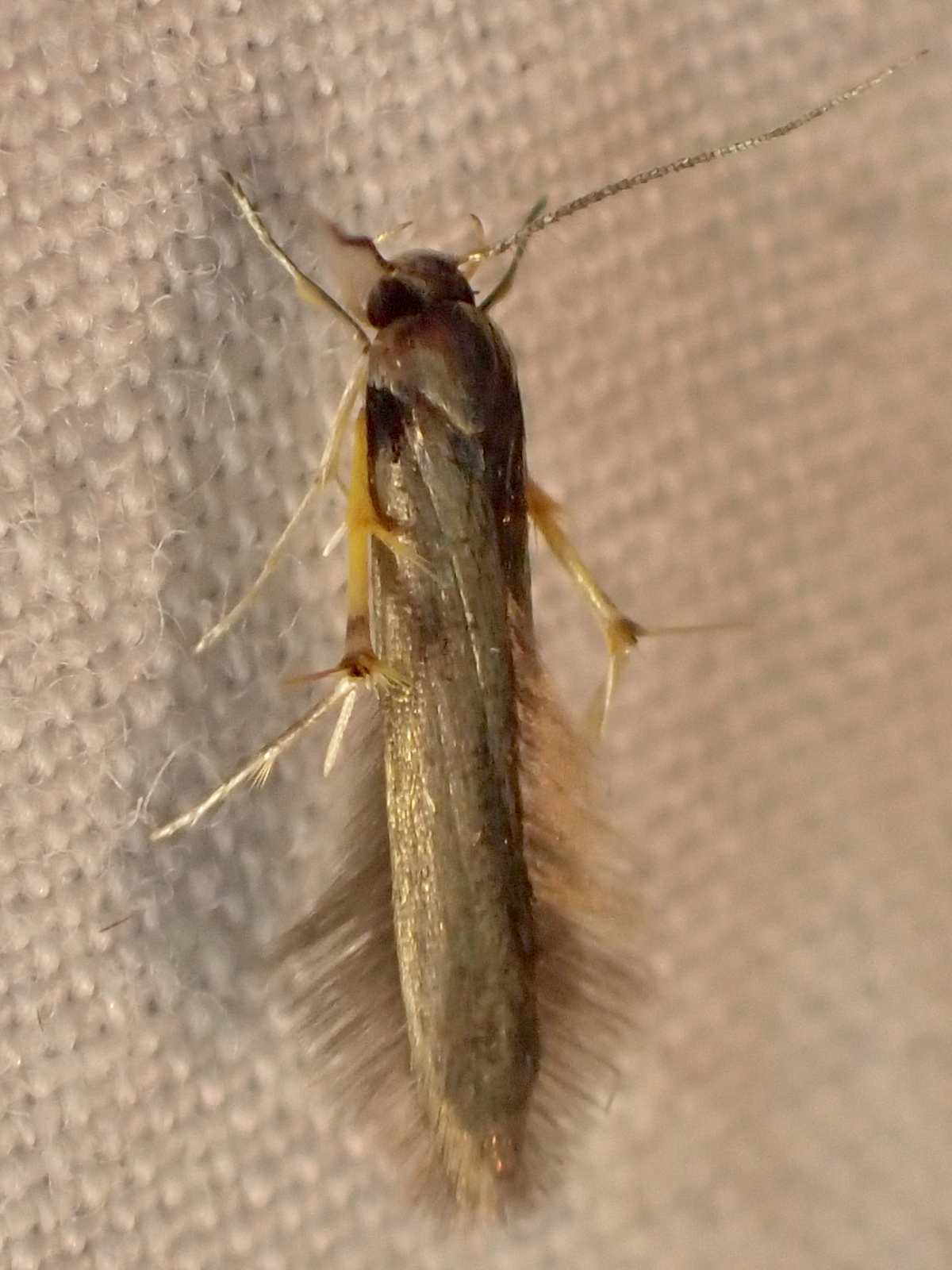
This is a small moth with a white-tipped antenna and a golden-brassy forewing with a dark spot at the base. The following description is based on that of Braun (1918), who collected specimens from the Cincinnati area. The labial palp and face are pale buff, while the head is yellowish, but slightly purplish opalescent or brownish in the female. The basal segment of the antenna is yellowish and the stalk dark brown, except for the last six or seven segments that are white. The antenna of the male has long, sparse cilia in the basal half, with short cilia in the apical half. The thorax is purplish opalescent, and the forewing dark golden-brassy, but darker towards the apex. A velvety dark-brown spot is present at the base of costa that is surrounded by opalescent purple, which gradually fades into the ground color. The purplish opalescence is less noticeable in the female. The hindwing is brownish brassy. The hind tibia is bright yellow, with the upper edge and spines orange-tinged, and the apex black, while the hind tarsi is blackish above, with whorls of yellowish spines. The abdomen is concolorous with the hindwing at the base, but becomes dark-brown towards the tip. The anal tuft of the male is yellowish.
Stathmopoda aenea
is superficially similar to
S. elyella
, but has a larger brown spot at the base of the wing, a white-tipped antenna (uniformly yellowish-brown in the latter), and lacks a conspicuous dark brown to light fuscous longitudinal streak on the forewing.
Wingspan:
8-9 mm (Braun, 1918).
Adult ID Requirements:
Identifiable from good quality photos of unworn specimens.
Immatures and Development:
The larvae feed on the spores and the reproductive structures of several species of ferns. Braun (1918) described the life history of larvae that fed on the Glade Fern (
Diplaziopsis pycnocarpa
=
Homalosorus pycnocarpos
) and the Silvery Spleenwort (
Deparia acrostichoides
) in southern Ohio, and the following is a summary of her account.
The larva spins a protective web on the underside of a leaflet (pinna) that has sori and expands it with time. The early instars mine into the sorus and eat most of the spores, but leave the indusium hollow. As the larva grows, it become too large to mine the spores, and consumes the entire sorus except for the annuli of the sporangia. In addition to the webbed shelter, the larva constructs a circular opening that leads to the upper side of the leaflet near the beginning of the web, and surrounds this with a tubular web that protects the opening on the upper side. In addition, both the tubular web -- and the web on the underside of the leaf near the opening -- are decorated with the numerous rejected annuli of the sporangia. The upper tube is also used as a safe retreat if the larva is disturbed or attacked from below. The younger instars vary from yellowish-white to greenish-yellow, with slightly darker heads and prothoracic shields. The larvae darken with age and eventually become bright vermilion orange just before pupating either inside or outside of the web. Before pupating, the larva spins a double cocoon of very fine, white silk that is broadly oval, with the inner cocoon more elongate than the outer one (see Microleps.com and BugTracks for excellent illustrations of the larval life history stages).
Larvae ID Requirements:
Identifiable only through rearing to adulthood.
Distribution in North Carolina
Distribution:
Stathmopoda aenea
is found in eastern North America where it has been found in southern Canada (Ontario, Quebec, New Brunswick, Nova Scotia, Newfoundland) and in the US in New Hampshire, Massachusetts, Maryland, Pennsylvania, southern Ohio, northern Michigan, West Virginia and North Carolina. As of 2025, we have only two records and both are from the Blue Ridge.
County Map:
Clicking on a county returns the records for the species in that county.
Flight Dates:
High Mountains (HM) ≥ 4,000 ft.
Low Mountains (LM) < 4,000 ft.
Piedmont (Pd)
Coastal Plain (CP)
Click on graph to enlarge
Flight Comments:
The adults have ben found from April through September in different areas of the range, with a seasonal peak commonly in June and July. As of 2025, our two records are from late-May and mid-July.
Habitats and Life History
Habitats:
Local populations are associated with fern-rich woodlands.
Larval Host Plants:
The larvae feed on the sori and spores of ferns (Braun (1918; Microleps.org). The reported hosts include the New York Fern (
Amauropelta noveboracensis
), Lady Fern (
Athyrium filix-femina
), Silvery Spleenwort (
Deparia acrostichoides
) and Glade Fern (
Diplaziopsis pycnocarpa
=
Homalosorus pycnocarpos
). Larvae have also been found using Christmas Fern (
Polystichum acrostichoides
), but the unusual phenology for the adult emergence suggests that this could be an undescribed species (Microleps.org). -
View
Observation Methods:
The adults are attracted to lights and the larvae can be found feeding on fern sori.
Wikipedia
See also Habitat Account for
General Montane Fernlands
Status in North Carolina
Natural Heritage Program Status:
Natural Heritage Program Ranks:
GNR [S2S3]
State Protection:
Has no legal protection, although permits are required to collect it on state parks and other public lands.
Comments:
This appears to be an uncommon species that is relatively rare in North Carolina where it appears to be disjunct from the main range farther north. It appears to reach its southernmost range limit in the southern Appalachians.
Photo Gallery for
Stathmopoda aenea
- No common name
Photos: 2
Recorded by: tom ward on 2022-05-23
Buncombe Co.
Comment:
Recorded by: tom ward on 2022-05-23
Buncombe Co.
Comment:
 »
»