Moths of North Carolina
Home Page
Recent Entries
Recent Account Updates
County Searches
General Search
Submit a Public Record
Larval Hosts
References
Maps
Draft Checklists
Family Photo Gallery
Family PDFs
NC Biodiversity Project
Comments
Significant Contributors
Scientific Name:
Common Name:
Family (Alpha):
Choose a Family
ACROLEPIIDAE-False Diamondback Moths
ADELIDAE-Fairy moths
ALUCITIDAE-Many-plumed Moths
AMPHISBATIDAE-
ARGYRESTHIIDAE-Shiny Head-standing Moths
AUTOSTICHIDAE-Autostichid Moths
BATRACHEDRIDAE-Batrachedrid Moths
BEDELLIIDAE-Bedelliid Moths
BLASTOBASIDAE-Blastobasid Moths
BOMBYCIDAE-Silkworm Moths
BUCCULATRICIDAE-Ribbed Cocoon-maker Moths
CARPOSINIDAE-Fruitworm Moths
CHOREUTIDAE-Metalmark Moths
COLEOPHORIDAE-Casebearer Moths and Relatives
COSMOPTERIGIDAE-Cosmopterigid Moths
COSSIDAE-Carpenter Moths, Goat Moths
CRAMBIDAE-Grass Moths, Snout Moths
DEPRESSARIIDAE-
DREPANIDAE-Hook-tips and Thyatirid Moths
DRYADAULIDAE-
ELACHISTIDAE-Grassminer Moths and Relatives
EPERMENIIDAE-Fringe-tufted Moths
EPIPYROPIDAE-Planthopper Parasite Moths
EREBIDAE-Erebid Moths
ERIOCRANIIDAE-Eriocraniid Moths
EUTELIIDAE-Euteliid Moths
GALACTICIDAE-Galacticid Moths
GELECHIIDAE-Gelechiid Moths; Twirler Moths
GEOMETRIDAE-Geometer Moths, Loopers
GLYPHIDOCERIDAE-Glyphidocerid Moths
GLYPHIPTERIGIDAE-Sedge Moths
GRACILLARIIDAE-Leafblotch miner moths
HELIOZELIDAE-Shield bearer moths
HEPIALIDAE-Ghost or Swift Moths
HYBLAEIDAE-
INCURVARIIDAE-Leafcutter Moths
LASIOCAMPIDAE-Tent Caterpillar Moths, Lappet Moths
LECITHOCERIDAE-Long-horned Moths
LIMACODIDAE-Slug Caterpillar Moths
LIMOCODIDAE-
LYONETIIDAE-Lyonetiid Moths
MEGALOPYGIDAE-Flannel Moths
MICROPTERIGIDAE-Mandibulate Moths
MIMALLONIDAE-
MOMPHIDAE-Mompha Moths
NEPTICULIDAE-Minute leaf miners
NOCTUIDAE-Owlet Moths
NOLIDAE-
NOTODONTIDAE-Prominents
OECOPHORIDAE-Oecophorid Moths
OPOSTEGIDAE-
PELEOPODIDAE-
PLUTELLIDAE-Diamondback Moths
PRODOXIDAE-Yucca Moths
PSYCHIDAE-Bagworm Moths
PTEROPHORIDAE-Plume Moths
PYRALIDAE-Pyralid Moths, Snout Moths
SATURNIIDAE-Giant Silkworm Moths
SCHRECKENSTEINIIDAE-Schreckensteiniid Moths
SCYTHRIDIDAE-
SESIIDAE-Clearwing Moths
SPHINGIDAE-Sphinx Moths
THYATIRIDAE-
THYRIDIDAE-Window-winged Moths
TINEIDAE-Clothes moths
TISCHERIIDAE-Tischerid Moths
TORTRICIDAE-Leafroller Moths
URANIIDAE-
URODIDAE-Urodid Moths
XYLORYCTIDAE-
YPONOMEUTIDAE-Ermine Moths
YPSOLOPHIDAE-Ypsolophid Moths
ZYGAENIDAE-
«
Home
»
View
PDF
Pterolonchidae Members:
Homaledra heptathalama
Homaledra knudsoni
Homaledra octagonella
Homaledra sabalella
Homaledra
Members:
Homaledra heptathalama
Homaledra knudsoni
Homaledra octagonella
Homaledra sabalella
2 NC Records
Homaledra knudsoni
Hayden, 2021 - No Common Name
Taxonomy
Family:
Pterolonchidae
P3 Number:
59a1352.54
MONA Number:
1422.10
Comments:
Homaledra
is a small genus with only six recognized species that are found in the New World, including two species that were recently described from Florida (Hayden, 2021).
Identification
Field Guide Descriptions:
Online Resources:
MPG
,
BugGuide
,
iNaturalist
,
Google
,
BAMONA
,
GBIF
,
BOLD
Technical Description, Adults:
Hayden (2021)
Technical Description, Immature Stages:
Hayden (2021)
Adult Markings:
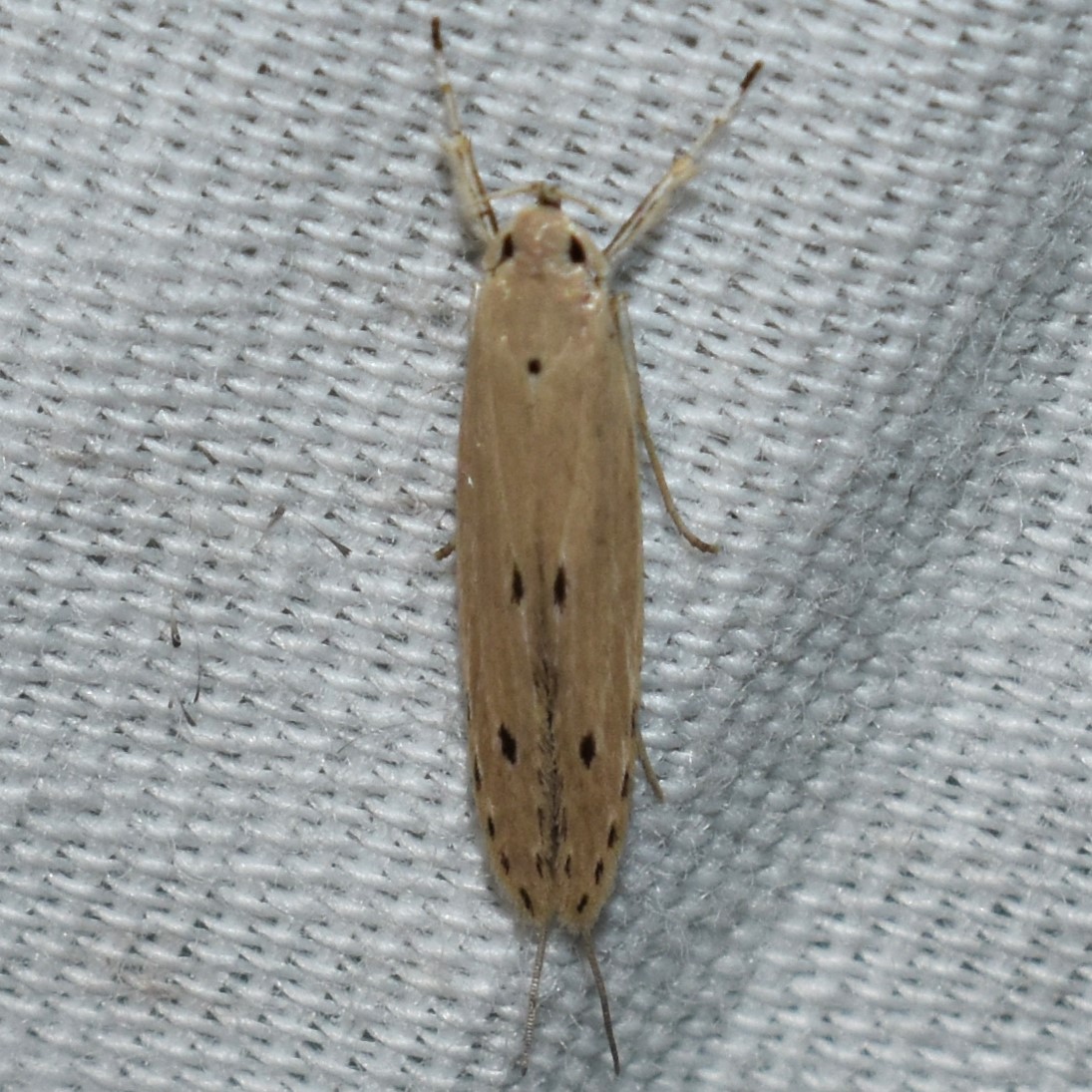
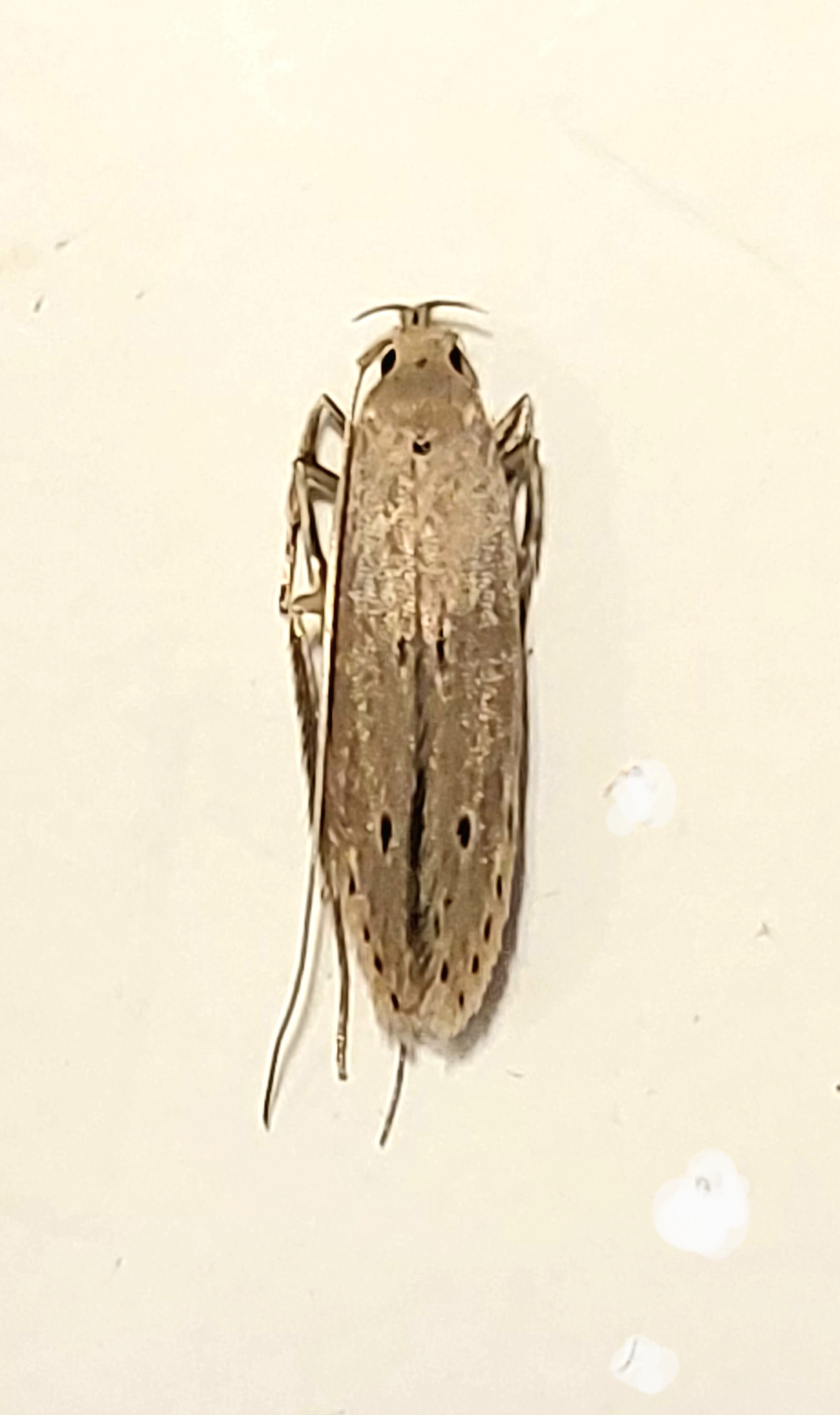
Homaledra knudsoni
is a palm-feeding species that was described recently (Hayden, 2021) and closely resembles
H. sabalella
. The head, thorax and ground color of the forewing are all beige. The antenna is distinctly longer than the forewing, and is similar in color except for becoming gray towards the tip. Most specimens also have a well-developed pecten on the scape at the base of the antenna. The thorax has a black spot at the tip, and the forewing has white scales on the veins, especially along the radial veins that are located at around one-half the wing length. The black spots on the forewing include a small, elongated spot just below the inner margin at around two-fifths from the wing base, a similar spot at around three-fourths that is more centrally located, and a line of black dashes that extends along the outer fringe and terminates on the costa near the second black spot. The hindwing is dark gray.
Homaledra knudsoni
closely resembles
H. sabalella
. Both species occur in North Carolina and are similar in having a beige-colored forewing with black spots. They are most easily separated by the length and color of the antennae. For
H. knudsoni
, the antennae are longer than the forewing and grayish at the tip, while in
H. sabalella
they are shorter than the forewing and uniformly tan-colored.
Homaledra knudsoni
also has a pecten at the base of the antenna, and the veins of the forewing have whitish scales (absent in
H. sabalella
). Finally, the line of terminal black dashes is more prominent and extends farther basally in
H. knudsoni
.
Forewing Length:
6.0-9.0 mm, but usually > 7.0 mm (Hayden, 2021).
Adult Structural Features:
Hayden (2021) has detailed descriptions and illustrations of the male and female genitalia, along with other structural features.
Adult ID Requirements:
Identifiable from good quality photos of unworn specimens.
Immatures and Development:
Hayden (2021) reported that the larvae coexist in large numbers in local clusters, with each living in a frass-covered silken tube on a protected part of the leaf. The tubes are usually constructed on the lower leaf surface, but occasionally on the upper surface along the rachis when the leaf is deeply folded. The tunnels are as wide as the larvae, and they wind randomly across the leaf surface in large patches. During the day, the larvae often hide in sections of the tubes near the base of the leaf and can be difficult to observe. However, active damage can be recognized by the leading ends of frass tubes having fresh, greenish frass that extends onto the nearby undamaged epidermis. The larvae do not bind leaf sections with thick mats of silk, as does
H. sabalella
. The later instars have a mostly white body with two irregular, red, longitudinal stripes on each side on the abdomen that continues onto the thorax. The head capsule is light yellowish-white and unmarked, and the legs are white (Hayden, 2021).
Larvae ID Requirements:
Identifiable from good quality photos, especially where associated with known host plants.
Distribution in North Carolina
Distribution:
This species has subtropical affinities, with specimens known from southern Texas, Mexico (Yucatan Peninsula), and peninsular Florida (Hayden, 2021). As of 2025, isolated records are also known from a coastal site in southeastern South Carolina, along with two records from North Carolina from New Hanover County and Brunswick County. Hayden (2021) noted that the range likely expanded within the last few decades, with the species moving into Florida from Texas.
County Map:
Clicking on a county returns the records for the species in that county.
Flight Dates:
High Mountains (HM) ≥ 4,000 ft.
Low Mountains (LM) < 4,000 ft.
Piedmont (Pd)
Coastal Plain (CP)
Click on graph to enlarge
Flight Comments:
As of 2025, adults have been observed from March through October in different areas of the range, and likely produce two or more broods annually. As of 2025, our two records are from late-May and late-September.
Habitats and Life History
Habitats:
Local populations are generally associated with either residential neighborhoods where ornamental palms are planted, or natural communities with Cabbage Palmetto.
Larval Host Plants:
The larvae feed on palms (Hayden, 2021), with Cabbage Palmetto (
Sabal palmetto
) being the most frequently reported host in Florida. Other hosts in Florida include Jelly Palm (
Butia capitata
), Chinese Fan Palm (
Livistona chinensis
), Saw palmetto (
Serenoa repens
), a cultivated
Trachycarpus
species and Mexican Fan Palm (
Washingtonia robusta
). -
View
Observation Methods:
The adults are attracted to lights and the feeding damage and frass tubes are easy to observe on the host plants.
Wikipedia
Status in North Carolina
Natural Heritage Program Status:
Natural Heritage Program Ranks:
GNR [S1S2]
State Protection:
Comments:
As of 2025 we have only two records, and both are from the southern Coastal Plain where there appears to be a northern disjunct population.
Photo Gallery for
Homaledra knudsoni
- None
Photos: 2
Recorded by: Mark Basinger on 2025-09-21
Brunswick Co.
Comment:
Recorded by: David George, Jeff Niznik, Rich Teper on 2023-05-21
New Hanover Co.
Comment:
 »
»