Moths of North Carolina
Scientific Name:
Common Name:
Family (Alpha):
« Home »
View PDFScythrididae Members: Scythris Members: 12 NC Records

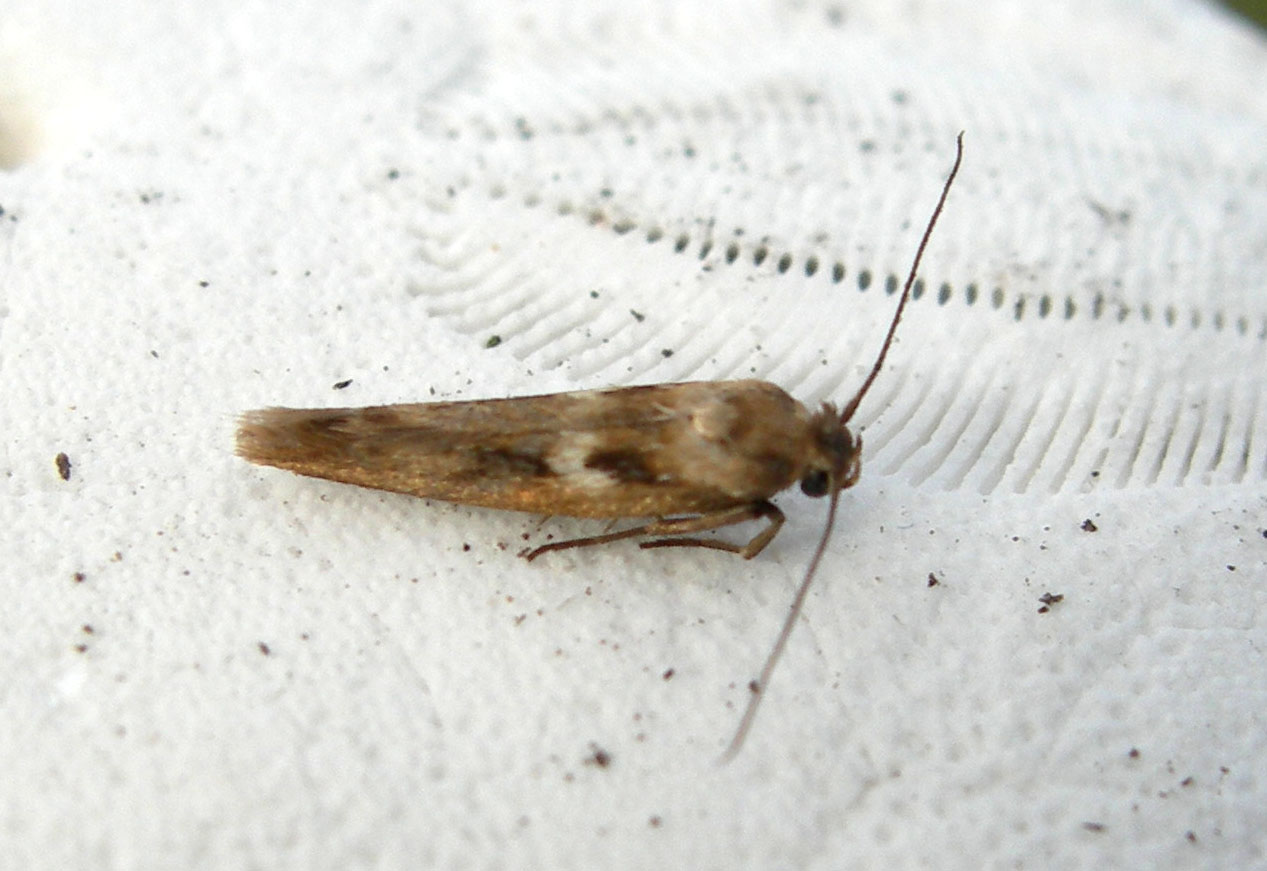
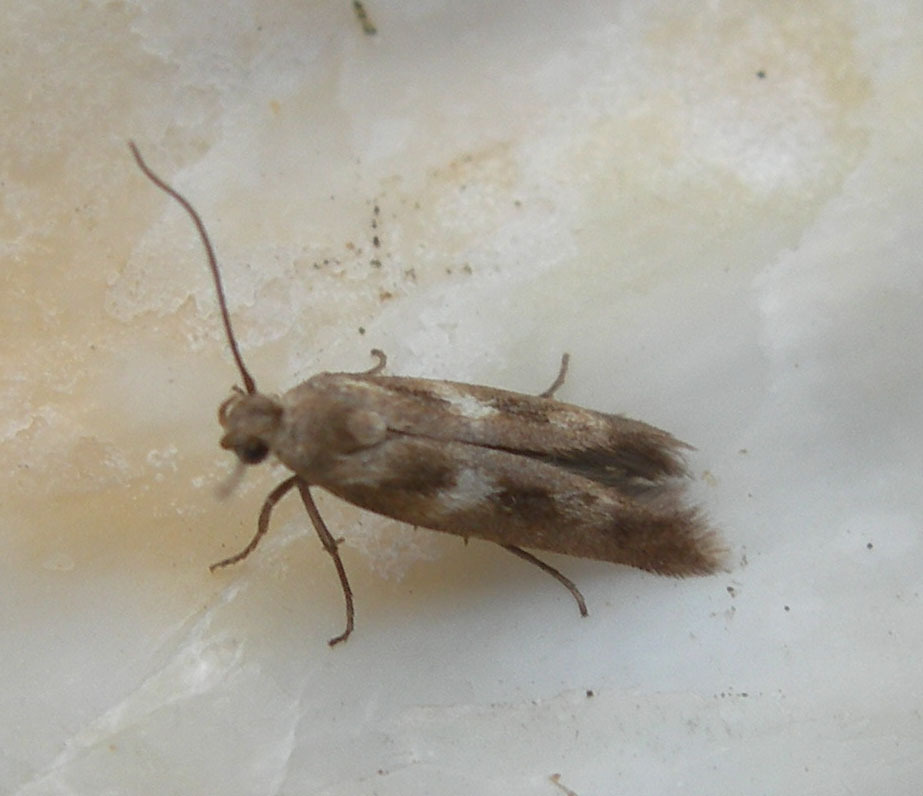
Scythris trivinctella (Zeller, 1873) - Banded Scythris


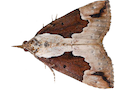
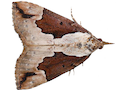
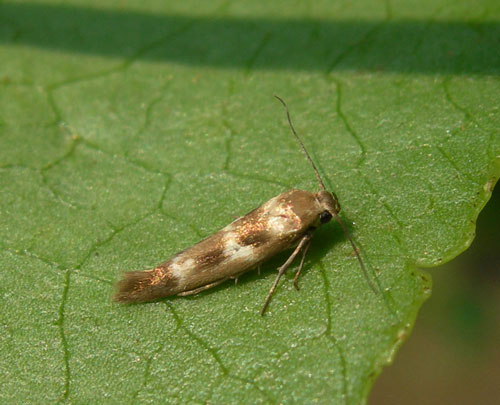
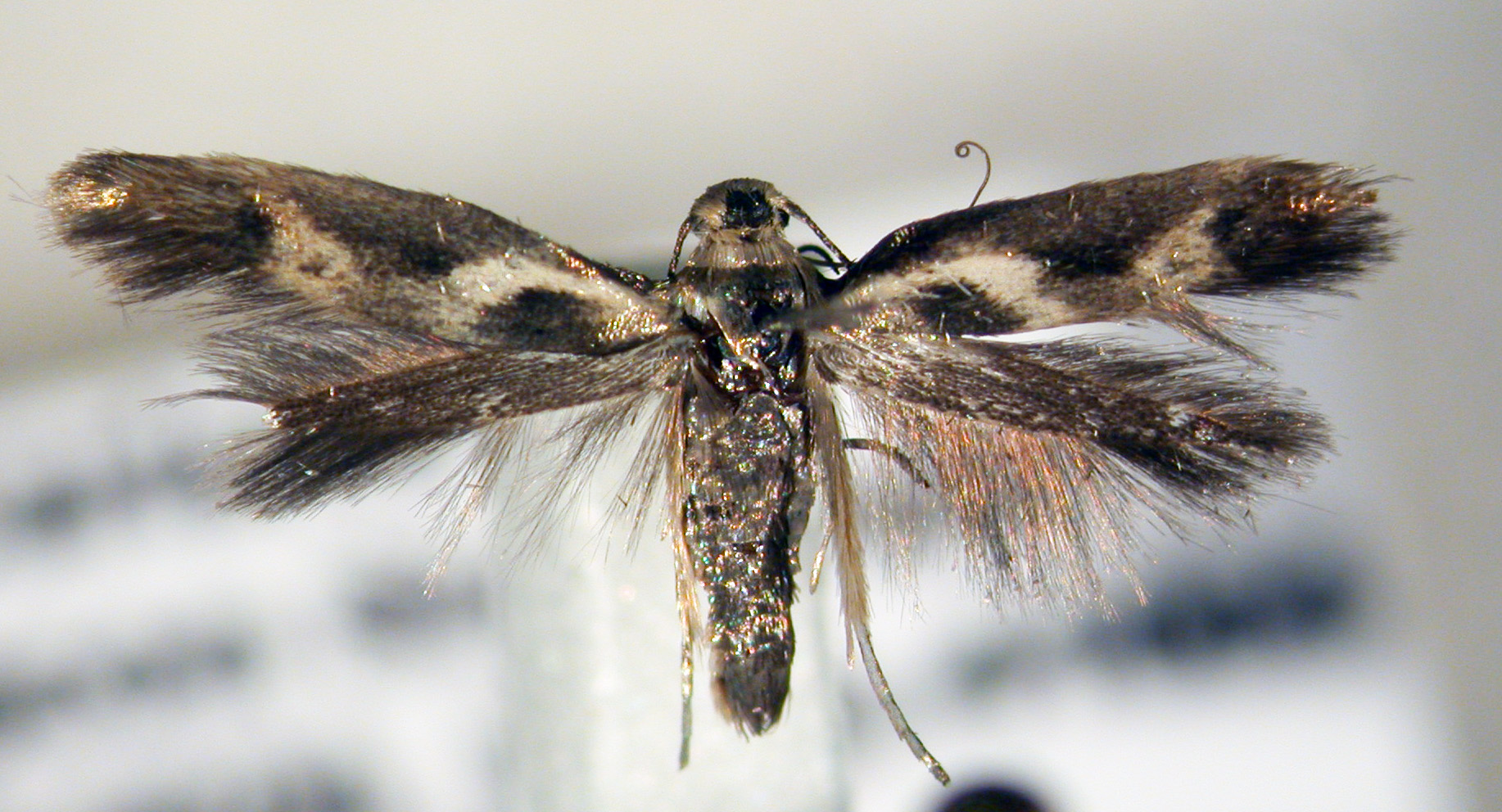
Scythris trivinctellaScythris trivinctellaScythris trivinctellaScythris trivinctella
Taxonomy
Superfamily:
Gelechioidea
Family:
Scythrididae
Subfamily:
Scythridinae
Tribe:
[Scythridini]
P3 Number:
59a1713
MONA Number:
1678.00
Comments: The genus Scythris is a member of the Family Scythrididae, whose members display a diversity of genital structures that is probably unsurpassed within any other family in the Lepidoptera (Landry, 1991). The extraordinarily diversity in genital morphology in the males of many taxa reaches such extremes that it is easy to recognize species, but difficult to delineate higher taxa. There are around 44 currently recognized species for the Nearctic region. North America has 14 described species, including 10 species of Scythris. Most are drably colored moths that superficially resemble one another. Landry (1991) found at least 300 undescribed species in North American collections alone based on genitalic differences, and estimated that there could be as many as 400 and 500 species of scythridids In North America. Many of these are in arid regions of the US. Landry (1991) treated Scythris trivinctella as a member of a compact group of species that comprises three described species (one of which is extralimital) and five undescribed species. Members of the group are distinguished in the males by the twisted apex of the distal arm of the gnathos, which terminates into a small warped plate, and in the females by the protruded membranous lobe of the posterior margin of 57. The described species include S. trivinctella and S. ypsilon from North America, and S. fluvialis from Colombia.
Identification
Field Guide Descriptions: Online Resources: MPG, BugGuide, iNaturalist, Google, BAMONA, GBIF, BOLD                                                                                 
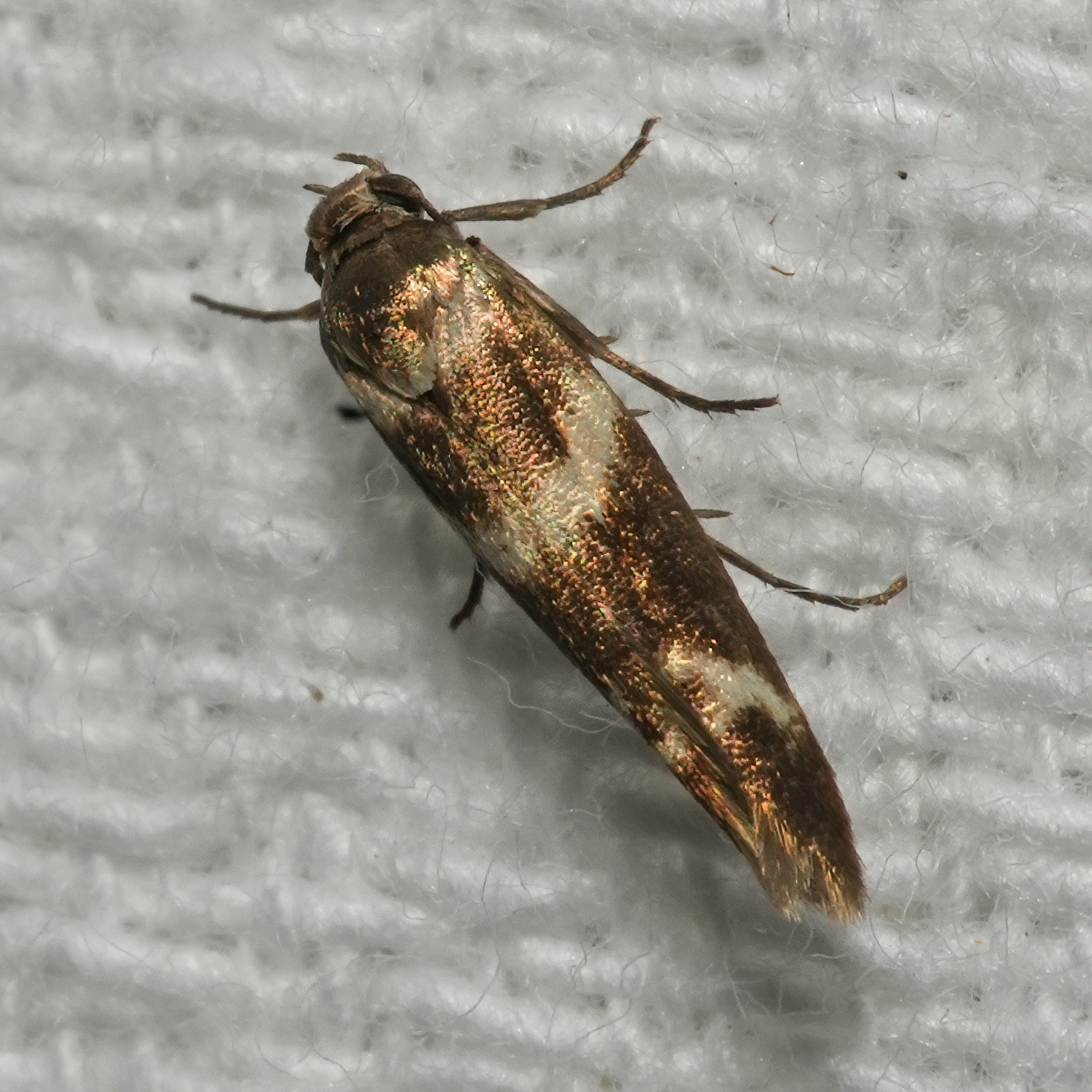
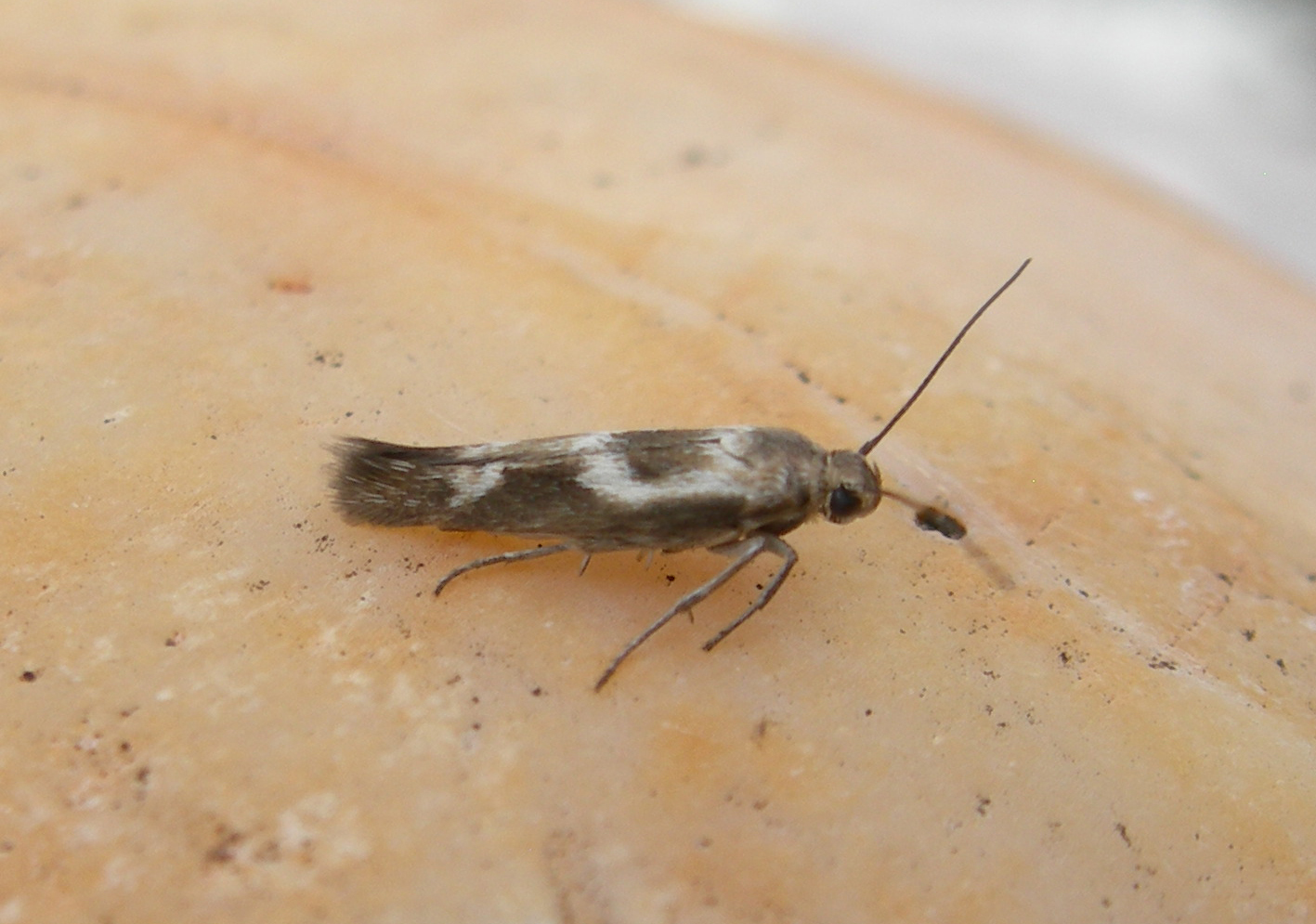
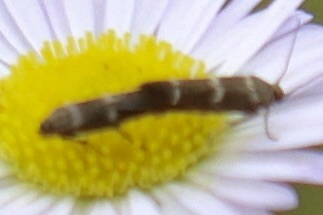
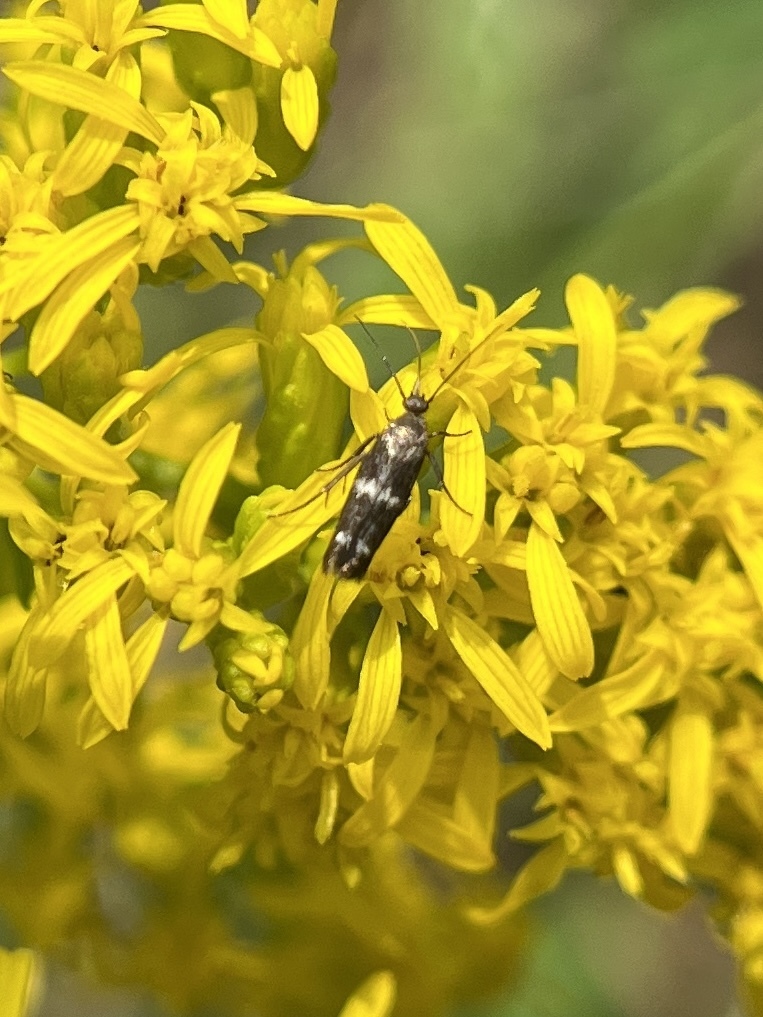
Adult Markings: Scythris trivinctella is a medium to medium-small scythridid with three conspicuous fasciae on the forewing on a ground color that varies from olive-brown or beige (Landry, 1991). Most specimens have 1) a small, basal fascia at the very base along the anal margin, 2) a more elongated, transverse fascia at one-third, and 3) another transverse fascia at about two-thirds. Both the medial and distal fasciae typically extend from the costa to the inner margin; however, the distal facia of North Carolina specimens sometimes terminates just before reaching the inner margin. The medial fascia is outwardly oblique towards the inner margin, and the distal one inwardly oblique towards the inner margin. The latter is broader toward the inner margin and appears shortly bifurcate in many specimens. Landry (1991) noted that in some specimens the basal and medial fasciae are joined by a longitudinal white fascia, as is the case for certain specimens from coastal regions of North Carolina. Other specimens from the coast and Piedmont lack the longitudinal white fascia and have three well-separated fasciae as described above. The hindwing in most specimens is beige or olive-brown, but in a few specimens it is dark-brown.
Forewing Length: Males 4.2-6.4 mm; females 5.0-6.3 (Landry, 1991).
Adult Structural Features: Landry (1991) has detailed descriptions and illustrations of the genitalia and other structural features. Also, see images below for North Carolina specimens.
Genitalia and other structural photos
Distribution in North Carolina
Distribution: Scythris trivinctella has a very broad distribution across much of the non-arid regions of the US. Landry (1991) documented clusters of populations from the Midwest southward to southern Texas and Louisiana, in Florida, in coastal areas of the Northeast, in central and southern California southward into Mexico, in the northern Rockies and in British Columbia. As of 2025, all of our records are from the Piedmont and Coastal Plain.
County Map: Clicking on a county returns the records for the species in that county.
Scythris trivinctellaAlamance Alexander Alleghany Anson Ashe Avery Beaufort Bertie Bladen Brunswick Buncombe Burke Cabarrus Caldwell Camden Carteret Caswell Catawba Chatham Cherokee Chowan Clay Cleveland Columbus Craven Cumberland Currituck Dare Davidson Davie Duplin Durham Edgecombe Forsyth Franklin Gaston Gates Graham Granville Greene Guilford Halifax Harnett Haywood Henderson Hertford Hoke Hyde Iredell Jackson Johnston Jones Lee Lenoir Lincoln Macon Madison Martin McDowell Mecklenburg Mitchell Montgomery Moore Nash New Hanover Northampton Onslow Orange Pamlico Pasquotank Pender Perquimans Person Pitt Polk Randolph Richmond Robeson Rockingham Rowan Rutherford Sampson Scotland Stanly Stokes Surry Swain Transylvania Tyrrell Union Vance Wake Warren Washington Watauga Wayne Wilkes Wilson Yadkin Yancey
Flight Dates:
High Mountains (HM) ≥ 4,000 ft.
Low Mountains (LM) < 4,000 ft.
Piedmont (Pd)
Coastal Plain (CP)

Click on graph to enlarge
Image showing flight dates by month for High Mountains greater than 4,000 feet, Low Mountains, Piedmont, and Coastal Plain: adults.
Flight Comments: The adults of this wide-ranging species have been observed during every month of the year in different areas of the range. As of 2025, all but one of our records (31 December) are from mid-July through late-September.
Habitats and Life History
Habitats: Our records from the Coastal Plain come from the Sandhills and a barrier island with extensive areas of sandy beach, dune grasslands, maritime scrub, and brackish marsh habitats. The Piedmont records are from fragmented residential areas with a mixture of woods, fields and other disturbed habitats.
Larval Host Plants: Larvae have been recorded on Amaranthus species, including Smooth Pigweed (A. hybridus) and Redroot Amaranth (A. retroflexus) (Landry, 1991; Robinson et al., 2010). In North Carolina, several species of Amaranthus occur along the edges of coastal marshes, including Saltmarsh Water-hemp (A. cannabinus), Southern Water-hemp (A. australis), and the very rare Seabeach Amaranth (A. pumilus) is restricted to ocean beaches and sand flats. Of these species, A. cannabinus has a range that best corresponds to that of Scythris trivinctella. - View
Observation Methods: The adults are attracted to lights, and are often seen foraging on wildflowers during the day.
Wikipedia
Status in North Carolina
Natural Heritage Program Status:
Natural Heritage Program Ranks: GNR S2S3
State Protection: Has no legal protection, although permits are required to collect it on state parks and other public lands.
Comments: This species appears be uncommon in North Carolina, with only five widely-scattered site records as of 2025.

 Photo Gallery for Scythris trivinctella - Banded Scythris

Photos: 10
Scythris trivinctella
Recorded by: R. Newman on 2025-07-12
Carteret Co.
Comment:
Scythris trivinctella
iNaturalist
Recorded by: kevinemetcalf - Kevin Metcalf on 2025-06-08
Richmond Co.
Comment: iNat record - https://www.inaturalist.org/observations/288610369***(c) Kevin Metcalf, some rights reserved (CC BY-NC)| Public Positional Accuracy=229 m Elevation=364.7 feet
Scythris trivinctella
iNaturalist
Recorded by: harrier on 2024-07-27
Halifax Co.
Comment: iNat record - https://www.inaturalist.org/observations/232287279***(c) harrier, some rights reserved (CC BY)| Public Positional Accuracy=150 m Elevation=289.4 feet
Scythris trivinctella
Recorded by: J.B. Sullivan on 2023-09-30
Carteret Co.
Comment: A female.
Scythris trivinctella
Recorded by: R. Newman on 2023-08-03
Carteret Co.
Comment:
Scythris trivinctella
Recorded by: Chuck Smith on 2023-07-22
Davidson Co.
Comment:
Scythris trivinctella
Recorded by: R. Newman on 2022-09-01
Carteret Co.
Comment:
Scythris trivinctella
Recorded by: R. Newman on 2022-08-28
Carteret Co.
Comment:
Scythris trivinctella
Recorded by: R. Newman on 2022-08-28
Carteret Co.
Comment:
Scythris trivinctella
Recorded by: R. Newman on 1996-12-31
Carteret Co.
Comment: