Moths of North Carolina
Scientific Name:
Common Name:
Family (Alpha):
« Home »
View PDFGelechiidae Members: Aroga Members: 1 NC Records

Aroga epigaeella (Chambers, 1881) - No Common Name


Aroga epigaeella
Taxonomy
Superfamily:
Gelechioidea
Family:
Gelechiidae
Subfamily:
Gelechiinae
Tribe:
Gelechiini
P3 Number:
59a1143
MONA Number:
2189.00
Identification
Field Guide Descriptions: Online Resources: MPG, BugGuide, iNaturalist, Google, BAMONA, GBIF, BOLD                                                                                 
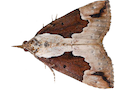
Adult Markings: The external coloration and patterning of Aroga epigaeella is essentially identical to that of A. argutiola and A. trialbamaculella, and all three of these species are best distinguished using dissected genitalia. The following description is based on the description of A. argutiola by Hodges (1974a) and should also apply A. epigaeella. The maxillary palp is gray. The outer surface of the first segment and base of the second segment of the labial palp are gray, while the inner surface of the first and second segments are mainly white. The scale brush on the second segment is pale orange to red-orange, while the third segment is mainly dark gray with yellowish-white scales at the base, anterior margin, apex, and sometimes elsewhere. The frons is white with a row of gray-brown scales in front of the eye, and the vertex and occiput are gray. The antenna is dark gray. The dorsal surfaces of the thorax, tegula, and forewing are dark gray. There is a patch of white scales on the costa at three-fourths the wing length, and often one on the posterior margin at three-fourths the wing length. A few white scales are often present on the fold, just before and just beyond one-half the length of the fold. A few white scales are also present at two-thirds to three-fourths the length of the cell, and at the end of the cell. The fringe is mainly pale gray. The hindwing is mainly pale yellowish gray above, with yellow more intense on the outer third of the wing. The legs are mainly dark gray, with off-white to whitish markings.
Adult ID Requirements: Identifiable only by close inspection of structural features or by DNA analysis.
Immatures and Development: The larval life history is poorly documented. Chambers (1881) received specimens from a colleague that were overwintering under a silken web on the undersides of Trailing Arbutus (Epigaea repens). They presumably resume feeding with the spring warm-up and leaf-out. When feeding, the side of the leaf was either curled over, or several leaves were tied together to form a shelter. Chambers (1881) described the larvae as having a straw-colored head and prothoracic shield, with the anterior margin of the head more reddish-brown, and the posterior margin of the prothoracic shield dark-brown with a dark-brown spot on each side. The remaining regions of the body were yellowish-white or whitish and striped longitudinally to varying degrees with pink or reddish stripes. Tubercular spots were present on the abdomen.
Larvae ID Requirements: Identifiable only through rearing to adulthood.
Distribution in North Carolina
Distribution: Aroga epigaeella is found in eastern North America, but its distribution and range is poorly documented due to the need to examine the male genitalia for accurate identification. As of 2025, we have only one record for the state.
County Map: Clicking on a county returns the records for the species in that county.
Aroga epigaeellaAlamance Alexander Alleghany Anson Ashe Avery Beaufort Bertie Bladen Brunswick Buncombe Burke Cabarrus Caldwell Camden Carteret Caswell Catawba Chatham Cherokee Chowan Clay Cleveland Columbus Craven Cumberland Currituck Dare Davidson Davie Duplin Durham Edgecombe Forsyth Franklin Gaston Gates Graham Granville Greene Guilford Halifax Harnett Haywood Henderson Hertford Hoke Hyde Iredell Jackson Johnston Jones Lee Lenoir Lincoln Macon Madison Martin McDowell Mecklenburg Mitchell Montgomery Moore Nash New Hanover Northampton Onslow Orange Pamlico Pasquotank Pender Perquimans Person Pitt Polk Randolph Richmond Robeson Rockingham Rowan Rutherford Sampson Scotland Stanly Stokes Surry Swain Transylvania Tyrrell Union Vance Wake Warren Washington Watauga Wayne Wilkes Wilson Yadkin Yancey
Flight Dates:
High Mountains (HM) ≥ 4,000 ft.
Low Mountains (LM) < 4,000 ft.
Piedmont (Pd)
Coastal Plain (CP)

Click on graph to enlarge
Image showing flight dates by month for High Mountains greater than 4,000 feet, Low Mountains, Piedmont, and Coastal Plain: adults.
Habitats and Life History
Habitats:
Larval Host Plants: The larvae appear to use more than one genus of host plants, with the known hosts including Trailing Arbutus (Epigaea repens; Chambers, 1881) and blueberries (Vaccinium spp.). Our one record for this species was reared from a larva on blueberry. Reports of the species feeding on Eriogonum (Shropshire and Tallamy, 2025) are questionable and may reflect misidentified specimens. - View
Wikipedia
Status in North Carolina
Natural Heritage Program Status:
Natural Heritage Program Ranks:
State Protection: Has no legal protection, although permits are required to collect it on state parks and other public lands.
Comments:

 Photo Gallery for Aroga epigaeella - None

Photos: 1
Aroga epigaeella
Recorded by: unknown collector on 1960-08-09
Moore Co.
Comment: BOLD specimen LNAUW3442-18: Genitalia Slide by R.W.H. USNM 2926|NC-8 With Assoc Larvae reared from Vaccinium sp.; in USNM