Identification
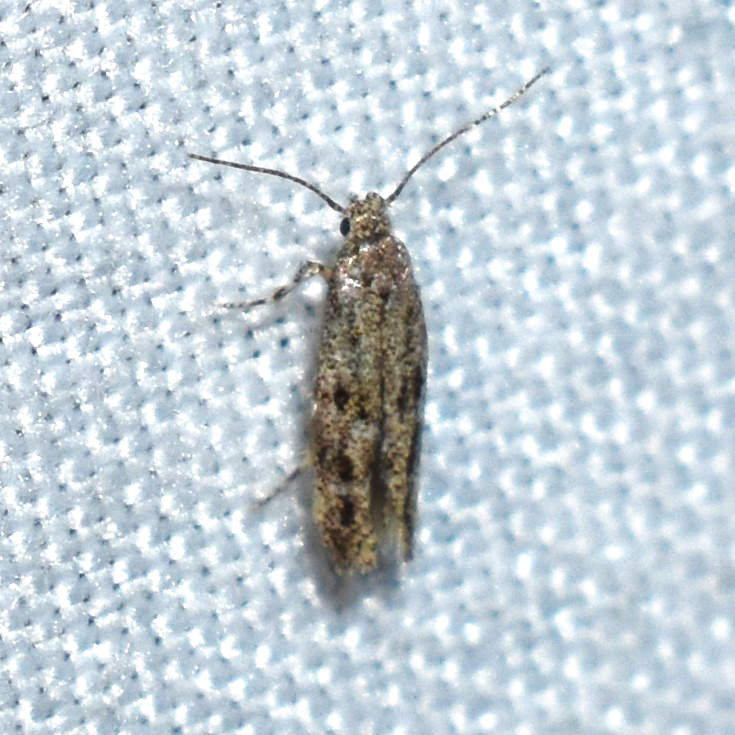
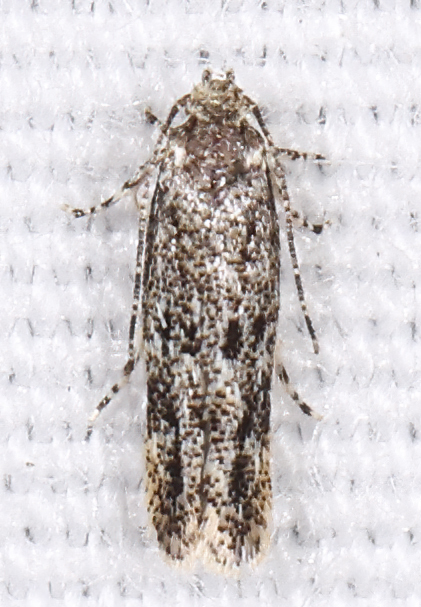
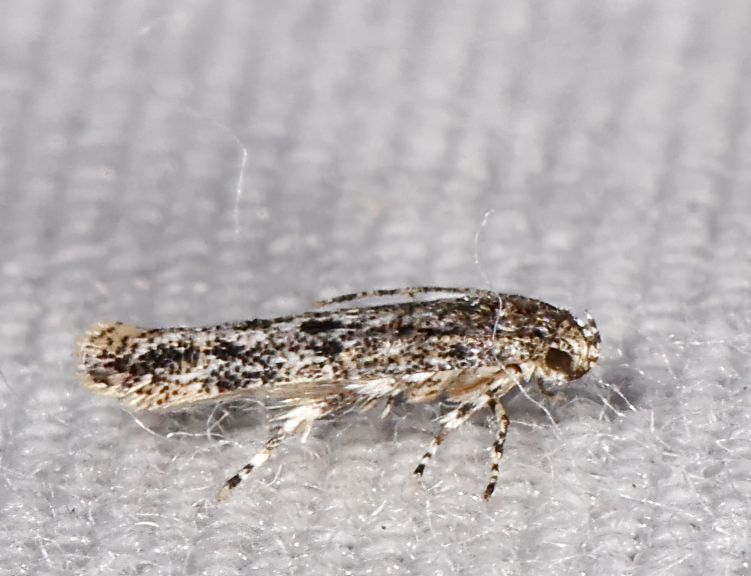
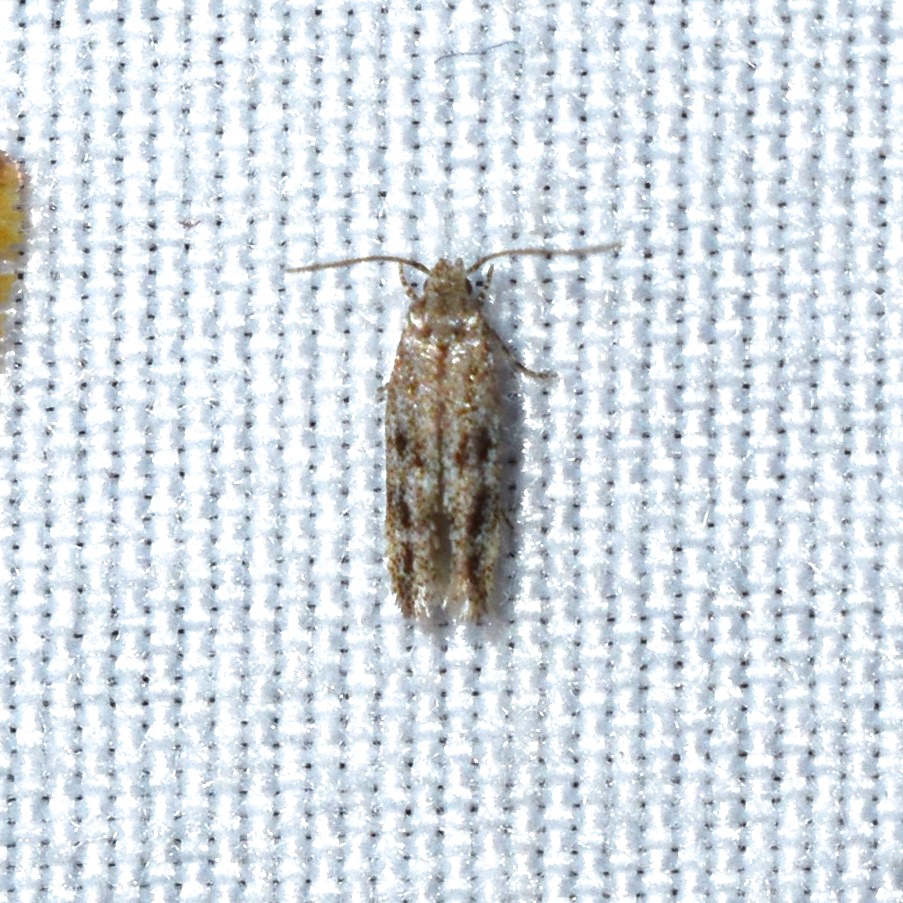
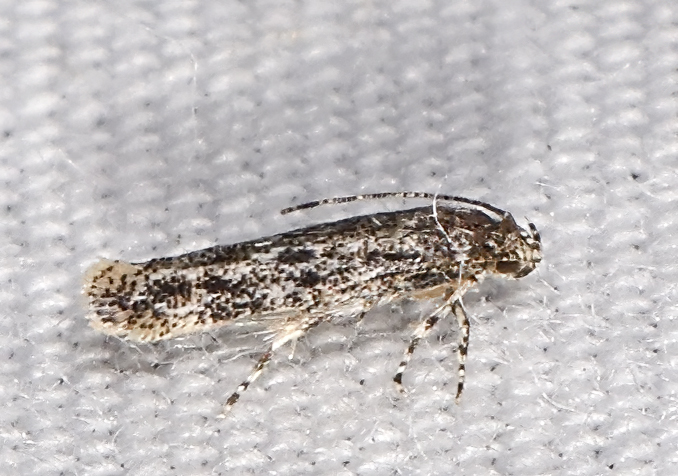
Adult Markings: Ymeldia janae is a small, mostly brownish moth with a forewing that is heavily peppered with dark-brown and orangish-brown dots, and has a series of dark streaks near the middle of the wing. The following description is based mostly on that of Hodges (1965), who described specimens from Florida. The labial palp is slightly recurved, with an acute apex that just reaches the vertex. The second segment is slightly longer than the third, and has a broad black band on the basal half and a narrow black band below the apex. The third segment has a black band at one-fifth, three-fifths, and at the apex. The frons is white with dark-gray tipped scales, and the vertex grayish-brown. The antenna has an orangish shaft with black on the basal half of many segments. There are three black bands of two segments each between the two-thirds and the apex ,with the latter being orangish-white. The thorax is brownish-gray, with three diffuse, faint, dark spots on the posterior end.
The forewing ground is white and heavily peppered with a mixture of brownish-gray, orange and orangish-brown scales. The most conspicuous dark marks are a pair of thick, black, longitudinal dashes or spots at around two-fifths the wing length and located near the center of the wing, and a similar and often more elongated dash at around two-thirds, and in line with the more costal dash of the first pair. A diffuse dark blotch is present at the apex. Scattered streaks of orange scales are also present over the wing, and the hindwing is grayish-red. The legs are white, with the metathoracic tibia having an oblique black streak on the outer surface at one-fifth, and another streak on the outer surface from one-half to near the apex. The first tarsal segment has a broad black band at the middle, while the second and fourth have a basal black band. The third segment is black on the dorsal and outer surfaces, and the fifth segment is white.
Specimens from North Carolina deviate substantially from the description above, with the most obvious difference being the antenna shaft that has three elongated dark bands on the apical third. Hodges (1965) described these as consisting of two segments, while North Carolina specimens have around five segments in each band (also see MPG and iNaturalist specimens that are similar). Another difference is that North Carolina specimens have greatly reduced orange scaling on the forewing compared with those examined and described by Hodges (1965) from a single site in Florida. Specimens with the elongated bars on the antennae and reduced orange scaling are common in Florida and the Gulf Coast states. We are uncertain if these represent an undescribed species, or perhaps simply geographic variation in patterning and coloration. The former seems more likely, but more study is needed to resolve the issue.