Moths of North Carolina
Home Page
Recent Entries
Recent Account Updates
County Searches
General Search
Submit a Public Record
Larval Hosts
References
Maps
Draft Checklists
Family Photo Gallery
Family PDFs
NC Biodiversity Project
Comments
Significant Contributors
Scientific Name:
Common Name:
Family (Alpha):
Choose a Family
ACROLEPIIDAE-False Diamondback Moths
ADELIDAE-Fairy moths
ALUCITIDAE-Many-plumed Moths
AMPHISBATIDAE-
ARGYRESTHIIDAE-Shiny Head-standing Moths
AUTOSTICHIDAE-Autostichid Moths
BATRACHEDRIDAE-Batrachedrid Moths
BEDELLIIDAE-Bedelliid Moths
BLASTOBASIDAE-Blastobasid Moths
BOMBYCIDAE-Silkworm Moths
BUCCULATRICIDAE-Ribbed Cocoon-maker Moths
CARPOSINIDAE-Fruitworm Moths
CHOREUTIDAE-Metalmark Moths
COLEOPHORIDAE-Casebearer Moths and Relatives
COSMOPTERIGIDAE-Cosmopterigid Moths
COSSIDAE-Carpenter Moths, Goat Moths
CRAMBIDAE-Grass Moths, Snout Moths
DEPRESSARIIDAE-
DREPANIDAE-Hook-tips and Thyatirid Moths
DRYADAULIDAE-
ELACHISTIDAE-Grassminer Moths and Relatives
EPERMENIIDAE-Fringe-tufted Moths
EPIPYROPIDAE-Planthopper Parasite Moths
EREBIDAE-Erebid Moths
ERIOCRANIIDAE-Eriocraniid Moths
EUTELIIDAE-Euteliid Moths
GALACTICIDAE-Galacticid Moths
GELECHIIDAE-Gelechiid Moths; Twirler Moths
GEOMETRIDAE-Geometer Moths, Loopers
GLYPHIDOCERIDAE-Glyphidocerid Moths
GLYPHIPTERIGIDAE-Sedge Moths
GRACILLARIIDAE-Leafblotch miner moths
HELIOZELIDAE-Shield bearer moths
HEPIALIDAE-Ghost or Swift Moths
HYBLAEIDAE-
INCURVARIIDAE-Leafcutter Moths
LASIOCAMPIDAE-Tent Caterpillar Moths, Lappet Moths
LECITHOCERIDAE-Long-horned Moths
LIMACODIDAE-Slug Caterpillar Moths
LIMOCODIDAE-
LYONETIIDAE-Lyonetiid Moths
MEGALOPYGIDAE-Flannel Moths
MICROPTERIGIDAE-Mandibulate Moths
MIMALLONIDAE-
MOMPHIDAE-Mompha Moths
NEPTICULIDAE-Minute leaf miners
NOCTUIDAE-Owlet Moths
NOLIDAE-
NOTODONTIDAE-Prominents
OECOPHORIDAE-Oecophorid Moths
OPOSTEGIDAE-
PELEOPODIDAE-
PLUTELLIDAE-Diamondback Moths
PRODOXIDAE-Yucca Moths
PSYCHIDAE-Bagworm Moths
PTEROPHORIDAE-Plume Moths
PYRALIDAE-Pyralid Moths, Snout Moths
SATURNIIDAE-Giant Silkworm Moths
SCHRECKENSTEINIIDAE-Schreckensteiniid Moths
SCYTHRIDIDAE-
SESIIDAE-Clearwing Moths
SPHINGIDAE-Sphinx Moths
THYATIRIDAE-
THYRIDIDAE-Window-winged Moths
TINEIDAE-Clothes moths
TISCHERIIDAE-Tischerid Moths
TORTRICIDAE-Leafroller Moths
URANIIDAE-
URODIDAE-Urodid Moths
XYLORYCTIDAE-
YPONOMEUTIDAE-Ermine Moths
YPSOLOPHIDAE-Ypsolophid Moths
ZYGAENIDAE-
«
Home
»
View
PDF
Gelechiidae Members:
Agnippe prunifoliella
Anacampsini new genus new species
Anacampsis agrimoniella
Anacampsis conclusella
Anacampsis consonella
Anacampsis coverdalella
Anacampsis fragariella
Anacampsis levipedella
Anacampsis lupinella
Anacampsis New Species one
Anacampsis rhoifructella
Anacampsis tristrigella
Anacampsis unidentified species
Anarsia lineatella
Aproaerema unidentified species
Arcutelphusa talladega
Aristotelia callirrhoda
Aristotelia fungivorella
Aristotelia isopelta
Aristotelia ivae
Aristotelia lespedezae
Aristotelia monilella
Aristotelia pudibundella
Aristotelia roseosuffusella
Aristotelia rubidella
Aristotelia unidentified species
Aroga argutiola
Aroga compositella
Aroga epigaeella
Aroga trialbamaculella
Aroga trialbamaculella complex
Aroga unidentified species
Arogalea cristifasciella
Arogalea unidentified species
Battaristis concinnusella
Battaristis new species
Battaristis nigratomella
Battaristis unidentified species
Battaristis vittella
Besciva n. sp.
Bryotropha unidentified species
Caryocolum pullatella
Chionodes adamas
Chionodes baro
Chionodes bicostomaculella
Chionodes cacula
Chionodes continuella
Chionodes dentella
Chionodes discoocellella
Chionodes emptor
Chionodes fondella
Chionodes formosella
Chionodes fuscomaculella
Chionodes hibiscella
Chionodes imber
Chionodes lactans
Chionodes mediofuscella
Chionodes new species 2
Chionodes obscurusella
Chionodes pereyra
Chionodes pseudofondella
Chionodes rabula
Chionodes rectifex
Chionodes sevir
Chionodes soter
Chionodes suasor
Chionodes tarmes
Chionodes thoraceochrella
Chionodes unidentified species
Coleotechnites albicostata
Coleotechnites apicitripunctella
Coleotechnites atrupictella
Coleotechnites canusella
Coleotechnites carbonaria
Coleotechnites citriella
Coleotechnites coniferella
Coleotechnites florae
Coleotechnites macleodi
Coleotechnites new species
Coleotechnites nigra
Coleotechnites obliquistrigella
Coleotechnites piceaella
Coleotechnites quercivorella
Coleotechnites unidentified species
Coleotechnites variiella
Deltophora sella
Dichomeris aglaia
Dichomeris agonia
Dichomeris bilobella
Dichomeris bipunctellus
Dichomeris bolize
Dichomeris caia
Dichomeris citrifoliella
Dichomeris costarufoella
Dichomeris crepida
Dichomeris fistuca
Dichomeris flavocostella
Dichomeris furia
Dichomeris georgiella
Dichomeris glenni
Dichomeris heriguronis
Dichomeris inserrata
Dichomeris inversella
Dichomeris juncidella
Dichomeris kimballi
Dichomeris laetitia
Dichomeris ligulella
Dichomeris marginella
Dichomeris nenia
Dichomeris new species 2
Dichomeris new species 4
Dichomeris nonstrigella
Dichomeris ochripalpella
Dichomeris offula
Dichomeris pelta
Dichomeris punctidiscellus
Dichomeris punctipennella
Dichomeris purpureofusca
Dichomeris setosella
Dichomeris siren
Dichomeris unidentified species
Dichomeris vacciniella
Dichomeris ventrellus
Dichomeris vindex
Dichomeris washingtoniella
Dichomeris xanthoa
Enchrysa dissectella
Exoteleia anomala
Exoteleia pinifoliella complex
Fascista bimaculella
Fascista cercerisella
Fascista quinella
Filatima ornatifimbriella
Filatima persicaeella
Filatima pseudacaciella
Filatima serotinella
Filatima unidentified species
Filatima xanthuris
Frumenta nundinella
Gelechia albisparsella
Gelechiidae unidentified species
Glauce pectenalaeella
Gnorimoschema gallaeasterella
Gnorimoschema gallaesolidaginis
Gnorimoschema terracottella
Gnorimoschema unidentified species
Gnorimoschemini unidentified species
Helcystogramma hystricella
Helcystogramma melanocarpa
Helcystogramma melantherella
Holophysis emblemella
Isophrictis anteliella
Isophrictis new species 1
Isophrictis rudbeckiella
Isophrictis unidentified species
Keiferia inconspicuella
Keiferia lycopersicella
Keiferia unidentified species
Mesophleps adustipennis
Metzneria lappella
Monochroa disconotella
Monochroa gilvolinella
Monochroa monactis
Monochroa pullusella
Monochroa quinquepunctella
Monochroa unidentified species
Neotelphusa sequax
Phthorimaea operculella
Polyhymno luteostrigella
Prostomeus brunneus
Pseudochelaria pennsylvanica
Pseudochelaria walsinghami
Pseudotelphusa fuscopunctella
Pseudotelphusa palliderosacella
Pseudotelphusa quercinigracella
Pseudotelphusa unidentified species
Pubitelphusa latifasciella
Sinoe chambersi
Sinoe kwakae
Sinoe robiniella
Sinoe unidentified species
Sitotroga cerealella
Stegasta bosqueella
Stereomita andropogonis
Strobisia iridipennella
Symmetrischema capsica
Symmetrischema pallidochrella
Symmetrischema striatella
Symmetrischema unidentified species
Taygete attributella
Taygete gallaegenitella
Telphusa longifasciella
Telphusa perspicua
Theisoa constrictella
Trypanisma prudens
Untomia albistrigella
Xenolechia aethiops
Xenolechia ontariensis
Dichomeris
Members:
Dichomeris aglaia
Dichomeris agonia
Dichomeris bilobella
Dichomeris bipunctellus
Dichomeris bolize
Dichomeris caia
Dichomeris citrifoliella
Dichomeris costarufoella
Dichomeris crepida
Dichomeris fistuca
Dichomeris flavocostella
Dichomeris furia
Dichomeris georgiella
Dichomeris glenni
Dichomeris heriguronis
Dichomeris inserrata
Dichomeris inversella
Dichomeris juncidella
Dichomeris kimballi
Dichomeris laetitia
Dichomeris ligulella
Dichomeris marginella
Dichomeris nenia
Dichomeris new species 2
Dichomeris new species 4
Dichomeris nonstrigella
Dichomeris ochripalpella
Dichomeris offula
Dichomeris pelta
Dichomeris punctidiscellus
Dichomeris punctipennella
Dichomeris purpureofusca
Dichomeris setosella
Dichomeris siren
Dichomeris unidentified species
Dichomeris vacciniella
Dichomeris ventrellus
Dichomeris vindex
Dichomeris washingtoniella
Dichomeris xanthoa
10 NC Records
Dichomeris vacciniella
Busck, 1915 - No Common Name
Taxonomy
Superfamily:
Gelechioidea
Family:
Gelechiidae
Subfamily:
Dichomeridinae
P3 Number:
59a0535
MONA Number:
2286.00
Identification
Field Guide Descriptions:
Online Resources:
MPG
,
BugGuide
,
iNaturalist
,
Google
,
BAMONA
,
GBIF
,
BOLD
Technical Description, Adults:
Hodges (1986)
Technical Description, Immature Stages:
Darlington (1952)
Adult Markings:
Dichomeris vacciniella
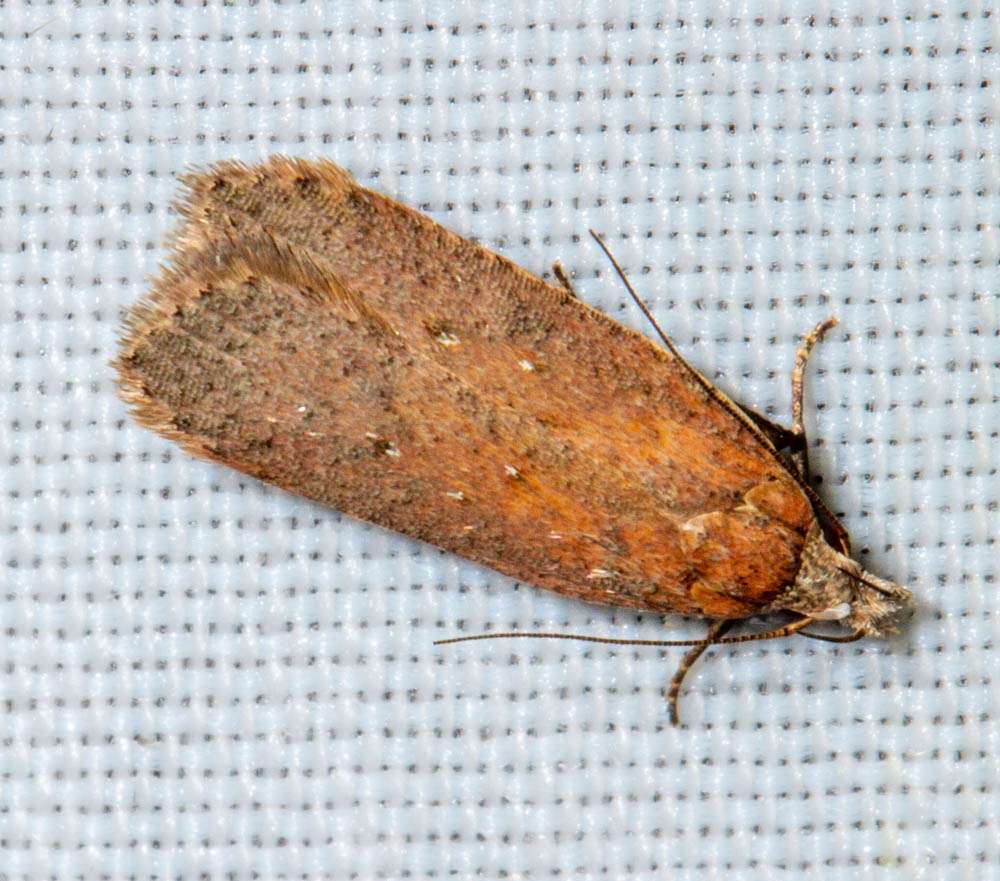
is conspicuously flattened, with the forewings varying from dark-brown to shining reddish-brown or russet. The forewing has numerous dark flecks, and there is a series of parallel, antemedial, median and postmedial dark dots. When paired, the dot closer to the inner margin is displaced more basally relative to the other dot. The median pair is margined with a few white scales on the distal margin, while the post-medial dot is margined with white scales either on the proximal margin or both margins. The antemedial dots are often missing or masked by a diffuse, blackish, diagonal band that terminates near the center of the wing, while the postmedial typically consists of a single dot. The wing is often heavily dusted with blackish scales in the subterminal region and in the region just posterior to the postmedial dot. The hindwings are grayish and broadly darker along the margins and at the base of the fringe (Darlington, 1952; Hodges, 1986). The labial palps, frons and head are mainly dark brownish-gray when view from above and are noticeably darker than the ground color of the thorax and forewings. The antenna shaft has pale-brown bands that alternate with dark-brown bands, while the legs are mostly black with yellowish tarsal annulations.
Dichomeris vacciniella
can be confused with
D. ventrellus
, but in the latter the head and labial palps are about the same color as the thorax and forewing, versus being noticeable darker in
D. vacciniella
.
Dichomeris ventrellus
also lacks the heavy blackish dusting in the subterminal region of the forewing, and usually does not have a diffuse, dark, diagonal, antemedial band near the wing base. Specimens of
D. vacciniella
are occasionally found that lack the heavy dark dusting and are best identified by the noticeable darker head and palps.
Wingspan:
18 mm (Darlington, 1952).
Forewing Length:
7.0- 8.8 mm (Hodges, 1986).
Adult Structural Features:
Hodges (1986) has descriptions and illustrations of the male and female genitalia. Also, see images below for North Carolina specimens.
Genitalia and other structural photos
Male genitalia; North Carolina; J.B. Sullivan.
Aedeagus; North Carolina; J.B. Sullivan.
Male genitalia; North Carolina; J.B. Sullivan.
Aedeagus; North Carolina; J.B. Sullivan.
Female genitalia; Craven County; J.B. Sullivan.
Palp, inner surface; Craven County; J.B. Sullivan.
Adult ID Requirements:
Identifiable from good quality photos of unworn specimens.
Immatures and Development:
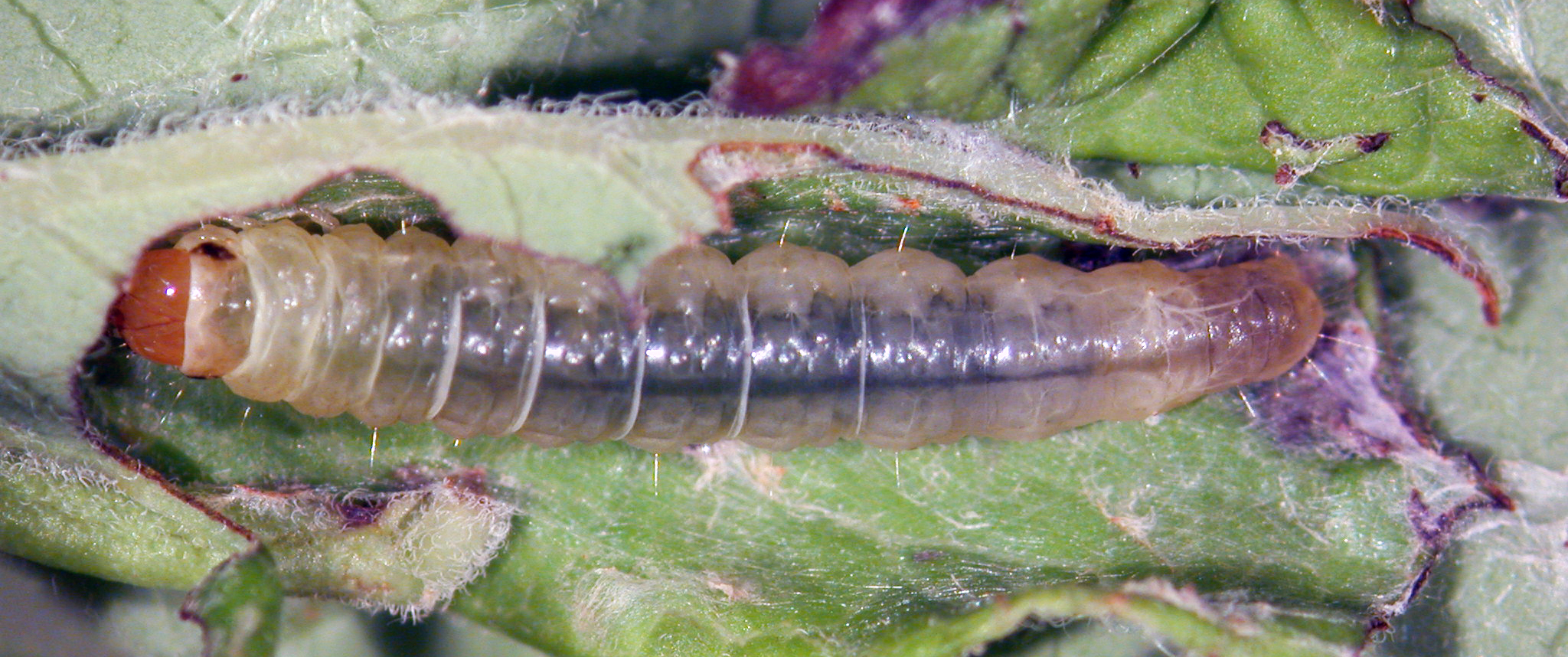
The larvae tie or fold the leaves of blueberries. Darlington (1952) studied this species in New Jersey and reported that the larvae live within a cylindrically folded leaf or between two cupped leaves. The top of the cylinder or cup remains slightly open, which allows the larva to escape from predators and feed on the the leaf tissue outside of the shelter. Pupation typically occurred in a cluster of dead leaves, and most commonly around the base of the plant where the leaves accumulate. The older larvae are a dull, translucent green with the head and prothoracic shield black. They frequently turn red just before leaving the plant to pupate. Local populations appear to mostly be univoltine, with the adults overwintering and laying eggs soon after the spring leaf-out.
Larvae ID Requirements:
Identifiable from good quality photos, especially where associated with known host plants.
Distribution in North Carolina
Distribution:
Dichomeris vacciniella
occurs in Nova Scotia, southern Quebec and Ontario, and in a substantial portion of the eastern US where specimens have been documented from Maine southwestward through the Appalachian region to eastern Tennessee, then continuing on to Alabama, Mississippi, Louisiana, southeastern Texas, western Tennessee, western Arkansas and Missouri. A second cluster of populations occurs in the Coastal Plain from central Florida northward to North Carolina, Maryland and New Jersey. There are also scattered records from northern Michigan and Wisconsin. This species appears to be absent from much of the area between the Appalachians and the Atlantic Coast from Virginia southward. As of 2025, our records are all from the Coastal Plain, including the Sandhills and communities near the coast.
County Map:
Clicking on a county returns the records for the species in that county.
Flight Dates:
High Mountains (HM) ≥ 4,000 ft.
Low Mountains (LM) < 4,000 ft.
Piedmont (Pd)
Coastal Plain (CP)
Click on graph to enlarge
Immature Dates:
High Mountains (HM) ≥ 4,000 ft.
Low Mountains (LM) < 4,000 ft.
Piedmont (Pd)
Coastal Plain (CP)
Click on graph to enlarge
Flight Comments:
The adults have been observed during most months of the year in different areas of the range, with the seasonal peak in March through May, and another from July through October. Populations in most areas appear to be univoltine, with the first peak likely reflecting overwintering adults. As of 2025, our records are from mid-March to late-June, with a cluster in mid-March to early April that likely reflect overwintering adults, followed by a second in late-May to late-June that presumably represent adults emerging from the first brood.
Habitats and Life History
Habitats:
Local populations are generally found in areas where native blueberries are well-represented in local communities. Our records come from both peatland and Sandhills habitats in the Coastal Plain. This species is apparently absent from the Blue Ridge, even though blueberries are often locally abundant in many areas.
Larval Host Plants:
The larvae feed on blueberries (
Vaccinium
spp.; Darlington, 1952; Hodges, 1986). As of 2025, we have one feeding and rearing record for North Carolina. -
View
Observation Methods:
The adults are attracted to light to some extent, but many of the museum records are for rearing records from blueberries (Hodges, 1986).
Wikipedia
See also Habitat Account for
Coastal Plain Wet-Dry Heath Thickets
Status in North Carolina
Natural Heritage Program Status:
Natural Heritage Program Ranks:
GNR S3S4
State Protection:
Comments:
Photo Gallery for
Dichomeris vacciniella
- None
Photos: 3
Recorded by: J.B. Sullivan on 2023-04-29
Jones Co.
Comment:
Recorded by: Steve Hall and Bo Sullivan on 2021-06-07
Moore Co.
Comment:
Recorded by: Ed Corey on 2018-06-14
Onslow Co.
Comment:
 »
»