Moths of North Carolina
Scientific Name:
Common Name:
Family (Alpha):
« Home »
View PDFGelechiidae Members: Dichomeris Members: 1 NC Records

Dichomeris purpureofusca (Walsingham, 1882) - No Common Name


Dichomeris purpureofusca
Taxonomy
Family:
Gelechiidae
Subfamily:
Dichomeridinae
P3 Number:
59a0552
MONA Number:
2308.00
Identification
Field Guide Descriptions: Online Resources: MPG, BugGuide, iNaturalist, Google, BAMONA, GBIF, BOLDTechnical Description, Adults: Hodges (1986).Technical Description, Immature Stages: Loeffler (1994)                                                                                 
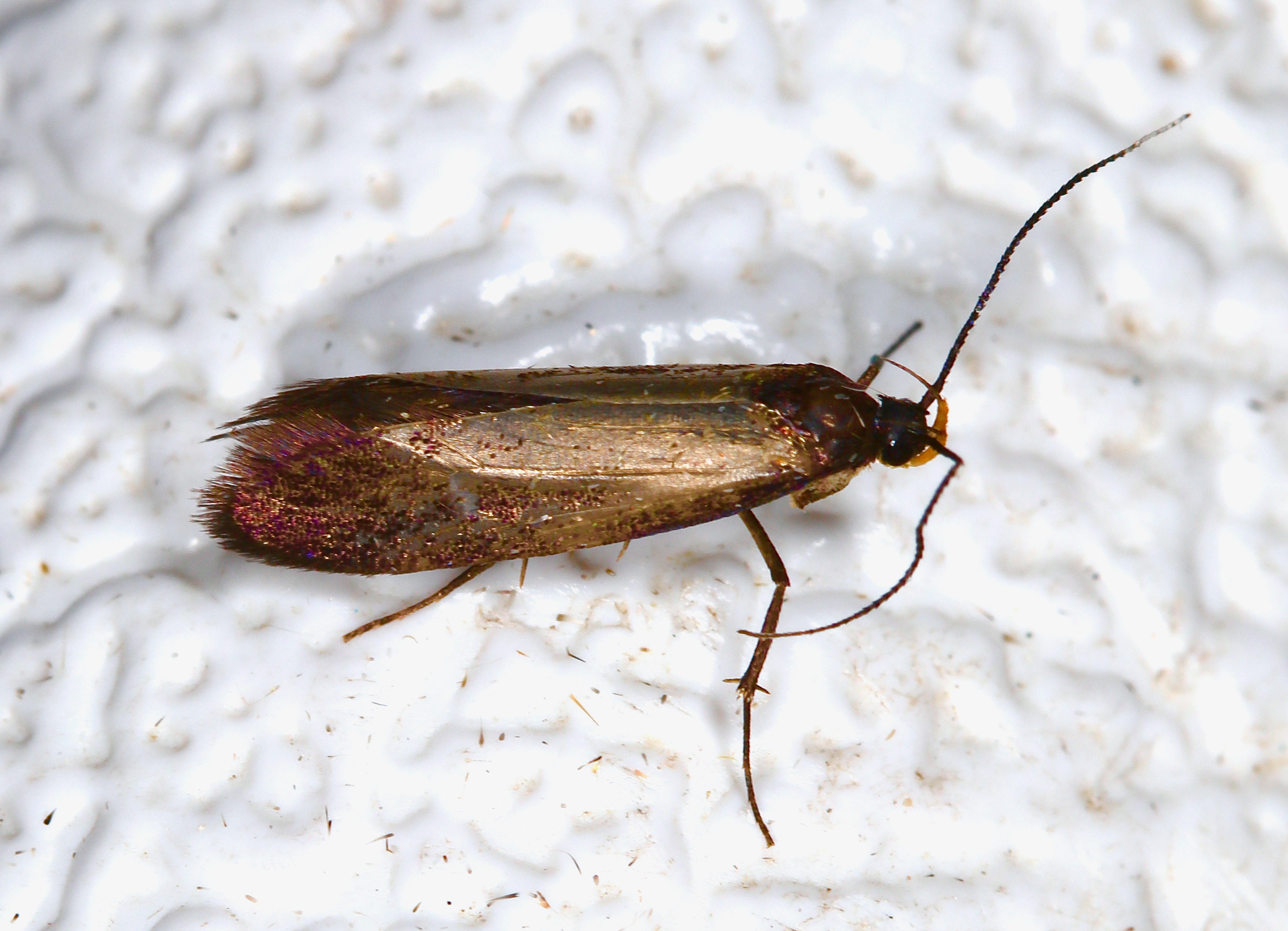
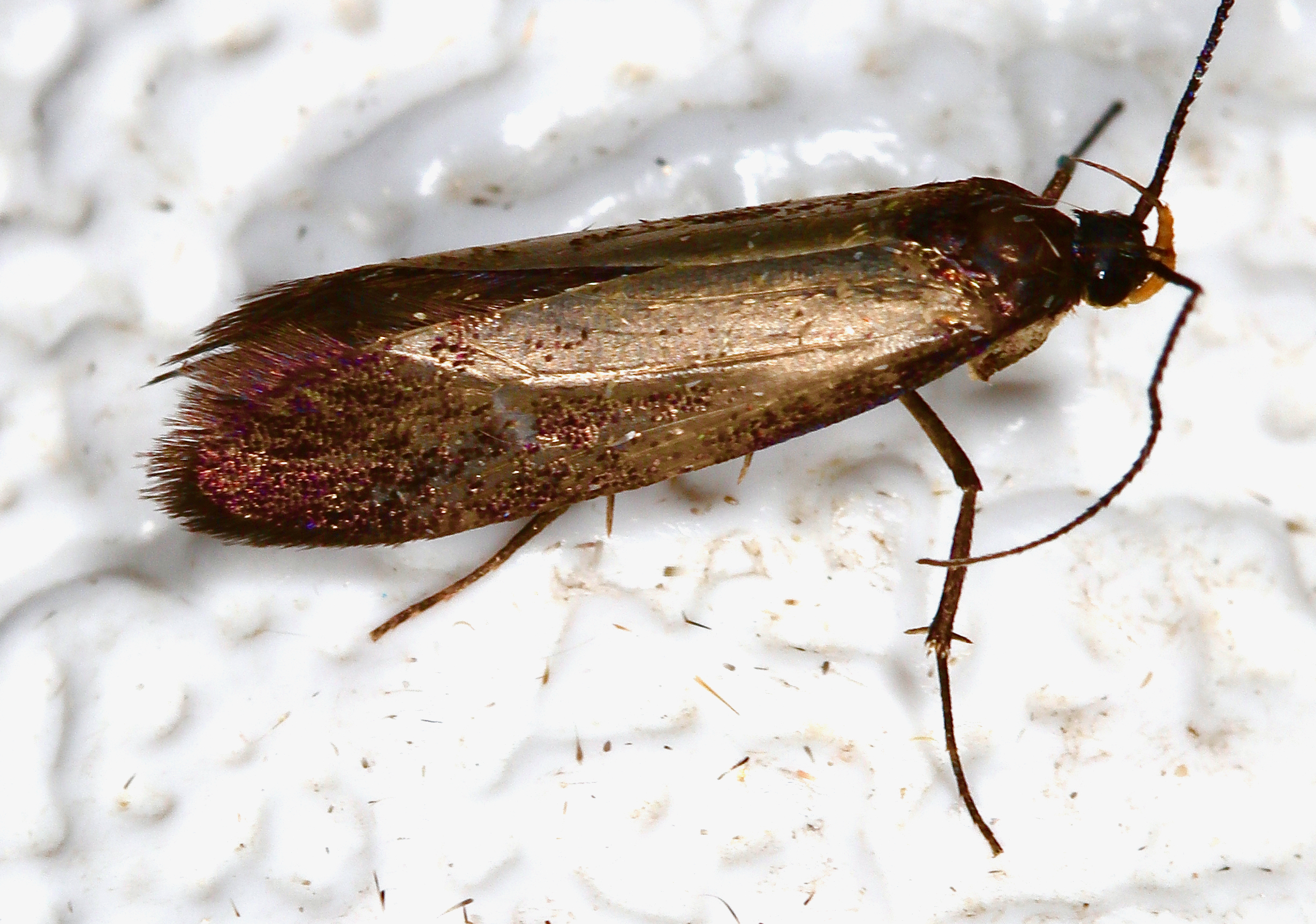
Adult Markings: Dichomeris purpureofusca is distinctive in having a uniformly dark violet-brown forewing that is immaculate, an orange labial palp, and an antenna that is uniformly slender throughout its length. The antennae, legs and thorax are dark grayish-brown, and often have yellow and purple reflections (Hodges, 1986). The females are much smaller than males and are greatly outnumbered by males in collections. Dichomeris purpureofusca is very similar to D. nonstrigella, but can be easily distinguished by the antenna. It is slender throughout its entire length in D. purpureofusca, but conspicuously thicker on the basal two-thirds in D. nonstrigella (Hodges, 1986).
Forewing Length: 6.8-10.1 mm (Hodges, 1986).
Adult ID Requirements: Identifiable from photos showing hindwings, abdomen, or other specialized views [e.g., frons, palps, antennae, undersides].
Immatures and Development: The larvae feed on the leaves of goldenrods and asters and live within loose leaf folds. Loeffler (1994) found that the adults eclose in June in central New York and lay eggs shortly thereafter. Females lay eggs singly on the undersides of leaves, and the hatchings grow slowly over the summer and reach the penultimate instar when > 6 mm long by October. They then drop to the ground and overwinter in the litter. They emerge in late-April or early-May and climb onto fresh shoots where they resume feeding. The final instar is attained by early- to mid-May, and the pupal stage lasted about two weeks.

The final-instar larvae have a dark chocolate-brown ground color with brownish black stripes that run down the length of the abdomen. The head and prothoracic shield are black, and white spots are present on both the meso- and metathorax. The final instars are 13.5-15.5 mm long (Loeffler, 1994).
Larvae ID Requirements: Identifiable from good quality photos, especially where associated with known host plants.
Distribution in North Carolina
Distribution: Dichomeris purpureofusca is found in North America where it has northern affinities. Scattered records are known from the West from the Northwest Territories, Alberta, Manitoba, South Dakota and Montana. The great majority of records are from the East, where the range extends from Ontario eastward to Nova Scotia and Prince Edwards Island, and the US from Minnesota eastward to Maine, and southward through the Appalachian region where there appear to be isolated populations in southeastern Kentucky and western North Carolina. As of 2025, our only record is from a middle-elevation site (3,877') in Madison County.
County Map: Clicking on a county returns the records for the species in that county.
Dichomeris purpureofuscaAlamance Alexander Alleghany Anson Ashe Avery Beaufort Bertie Bladen Brunswick Buncombe Burke Cabarrus Caldwell Camden Carteret Caswell Catawba Chatham Cherokee Chowan Clay Cleveland Columbus Craven Cumberland Currituck Dare Davidson Davie Duplin Durham Edgecombe Forsyth Franklin Gaston Gates Graham Granville Greene Guilford Halifax Harnett Haywood Henderson Hertford Hoke Hyde Iredell Jackson Johnston Jones Lee Lenoir Lincoln Macon Madison Martin McDowell Mecklenburg Mitchell Montgomery Moore Nash New Hanover Northampton Onslow Orange Pamlico Pasquotank Pender Perquimans Person Pitt Polk Randolph Richmond Robeson Rockingham Rowan Rutherford Sampson Scotland Stanly Stokes Surry Swain Transylvania Tyrrell Union Vance Wake Warren Washington Watauga Wayne Wilkes Wilson Yadkin Yancey
Flight Dates:
 High Mountains (HM) ≥ 4,000 ft.
 Low Mountains (LM) < 4,000 ft.
 Piedmont (Pd)
 Coastal Plain (CP)

Click on graph to enlarge
Image showing flight dates by month for High Mountains greater than 4,000 feet, Low Mountains, Piedmont, and Coastal Plain: adults.
Flight Comments: Local populations are univoltine. The adults fly fromMay through August, with a peak flight in June. AS of 2025, out one record from North Carolina was from early-June.
Habitats and Life History
Habitats: Local populations are generally associated with open habitats such as fields, woodland openings, and road corridors that support goldenrods, particularly Tall Goldenrod.
Larval Host Plants: Very few lava have been collected for this species and the only host that has been reported is Tall Goldenrod (Solidago altissima; Loeffler, 1994). As of 2025, we have no host records for North Carolina.
Observation Methods: The adults are attracted to lights and the larvae can be found on tall goldenrods.
Wikipedia
Status in North Carolina
Natural Heritage Program Status:
Natural Heritage Program Ranks:
State Protection:
Comments:

 Photo Gallery for Dichomeris purpureofusca - None

Photos: 2
Dichomeris purpureofusca
Recorded by: Jim Petranka and Becky Elkin on 2024-06-04
Madison Co.
Comment: Specimen was dentified as this species based on the uniformly dark forewing that lacks markings, orangish palps, and narrow antenna that is not wider on the basal half.
Dichomeris purpureofusca
Recorded by: Jim Petranka and Becky Elkin on 2024-06-04
Madison Co.
Comment: Specimen was identified as this species based on the uniformly dark forewing that lacks markings, orangish palps, and narrow antenna that is not wider on the basal half.