Moths of North Carolina
Home Page
Recent Entries
Recent Account Updates
County Searches
General Search
Submit a Public Record
Larval Hosts
References
Maps
Draft Checklists
Family Photo Gallery
Family PDFs
NC Biodiversity Project
Comments
Significant Contributors
Scientific Name:
Common Name:
Family (Alpha):
Choose a Family
ACROLEPIIDAE-False Diamondback Moths
ADELIDAE-Fairy moths
ALUCITIDAE-Many-plumed Moths
AMPHISBATIDAE-
ARGYRESTHIIDAE-Shiny Head-standing Moths
AUTOSTICHIDAE-Autostichid Moths
BATRACHEDRIDAE-Batrachedrid Moths
BEDELLIIDAE-Bedelliid Moths
BLASTOBASIDAE-Blastobasid Moths
BOMBYCIDAE-Silkworm Moths
BUCCULATRICIDAE-Ribbed Cocoon-maker Moths
CARPOSINIDAE-Fruitworm Moths
CHOREUTIDAE-Metalmark Moths
COLEOPHORIDAE-Casebearer Moths and Relatives
COSMOPTERIGIDAE-Cosmopterigid Moths
COSSIDAE-Carpenter Moths, Goat Moths
CRAMBIDAE-Grass Moths, Snout Moths
DEPRESSARIIDAE-
DREPANIDAE-Hook-tips and Thyatirid Moths
DRYADAULIDAE-
ELACHISTIDAE-Grassminer Moths and Relatives
EPERMENIIDAE-Fringe-tufted Moths
EPIPYROPIDAE-Planthopper Parasite Moths
EREBIDAE-Erebid Moths
ERIOCRANIIDAE-Eriocraniid Moths
EUTELIIDAE-Euteliid Moths
GALACTICIDAE-Galacticid Moths
GELECHIIDAE-Gelechiid Moths; Twirler Moths
GEOMETRIDAE-Geometer Moths, Loopers
GLYPHIDOCERIDAE-Glyphidocerid Moths
GLYPHIPTERIGIDAE-Sedge Moths
GRACILLARIIDAE-Leafblotch miner moths
HELIOZELIDAE-Shield bearer moths
HEPIALIDAE-Ghost or Swift Moths
HYBLAEIDAE-
INCURVARIIDAE-Leafcutter Moths
LASIOCAMPIDAE-Tent Caterpillar Moths, Lappet Moths
LECITHOCERIDAE-Long-horned Moths
LIMACODIDAE-Slug Caterpillar Moths
LIMOCODIDAE-
LYONETIIDAE-Lyonetiid Moths
MEGALOPYGIDAE-Flannel Moths
MICROPTERIGIDAE-Mandibulate Moths
MIMALLONIDAE-
MOMPHIDAE-Mompha Moths
NEPTICULIDAE-Minute leaf miners
NOCTUIDAE-Owlet Moths
NOLIDAE-
NOTODONTIDAE-Prominents
OECOPHORIDAE-Oecophorid Moths
OPOSTEGIDAE-
PELEOPODIDAE-
PLUTELLIDAE-Diamondback Moths
PRODOXIDAE-Yucca Moths
PSYCHIDAE-Bagworm Moths
PTEROPHORIDAE-Plume Moths
PYRALIDAE-Pyralid Moths, Snout Moths
SATURNIIDAE-Giant Silkworm Moths
SCHRECKENSTEINIIDAE-Schreckensteiniid Moths
SCYTHRIDIDAE-
SESIIDAE-Clearwing Moths
SPHINGIDAE-Sphinx Moths
THYATIRIDAE-
THYRIDIDAE-Window-winged Moths
TINEIDAE-Clothes moths
TISCHERIIDAE-Tischerid Moths
TORTRICIDAE-Leafroller Moths
URANIIDAE-
URODIDAE-Urodid Moths
XYLORYCTIDAE-
YPONOMEUTIDAE-Ermine Moths
YPSOLOPHIDAE-Ypsolophid Moths
ZYGAENIDAE-
«
Home
»
View
PDF
Yponomeutidae Members:
Atteva aurea
Euhyponomeutoides gracilariella
Swammerdamia caesiella
Yponomeuta multipunctella
Zelleria haimbachi
Zelleria retiniella
Zelleria
Members:
Zelleria haimbachi
Zelleria retiniella
1 NC Records
Zelleria haimbachi
Busck, 1915 - Pine Needle Sheathminer Moth
Taxonomy
Superfamily:
Yponomeutoidea
Family:
Yponomeutidae
Subfamily:
Yponomeutinae
Tribe:
[Yponomeutinae]
P3 Number:
36a0129
MONA Number:
2427.00
Comments:
Zelleria haimbachi
is very broadly distributed across North America and may be a sibling species complex, with populations from the Rocky Mountains westward constituting a separate BIN from those in eastern North America. Here, we mainly focus on the eastern populations.
Identification
Field Guide Descriptions:
Beadle and Leckie (2012)
Online Resources:
MPG
,
BugGuide
,
iNaturalist
,
Google
,
BAMONA
,
GBIF
,
BOLD
Technical Description, Adults:
Busck (1915); Forbes (1923)
Adult Markings:
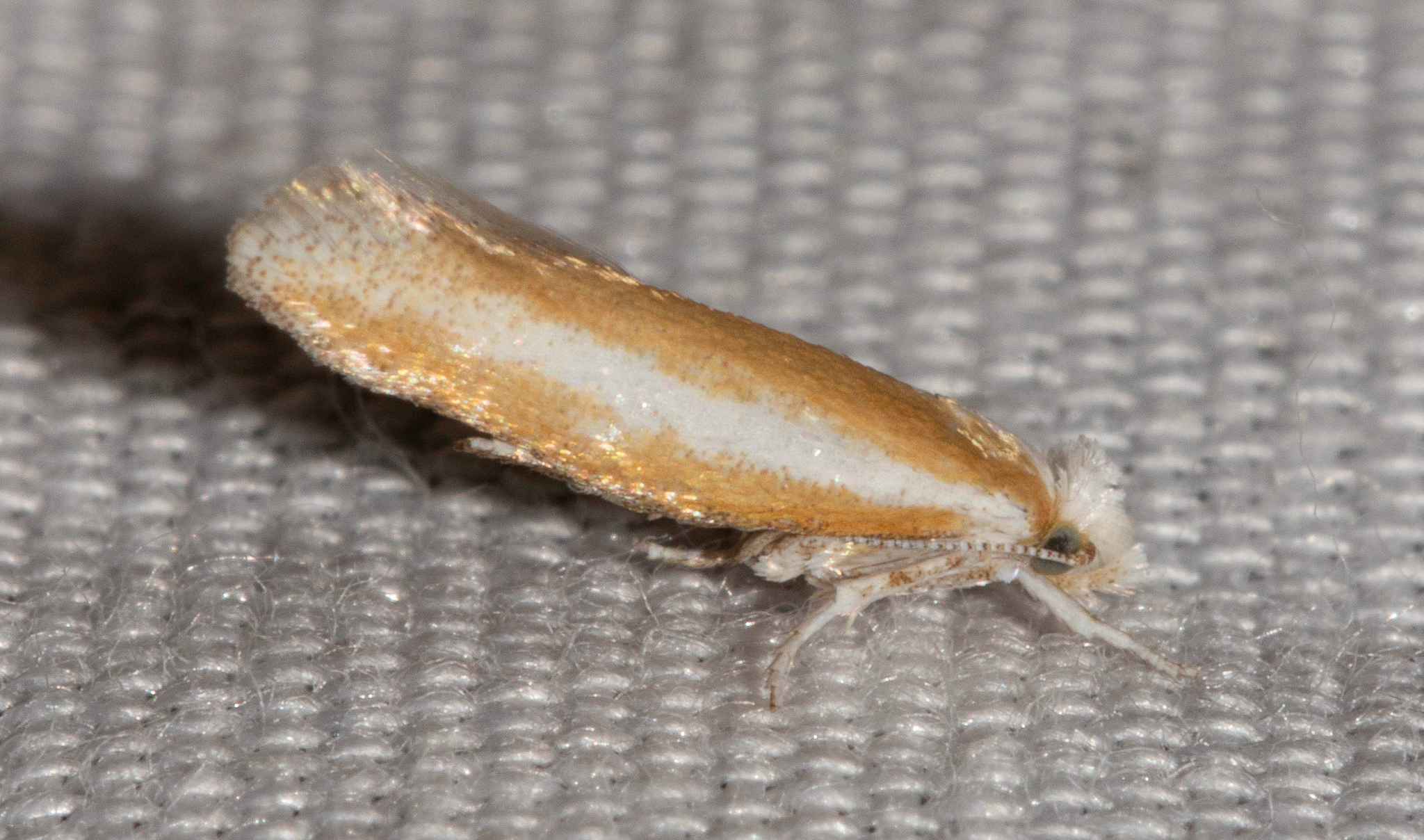
Zelleria haimbachi
is a small moth that has a distinct pattern, with the bright white head and thorax contrasting with a golden-yellow to orange forewing that has a white longitudinal stripe down the center. The maxillary palp is orange, while the labial palp is white with a prominent, upturned scale tuft that often fuses with the adjoining white head tuft. The antenna is white with weak, brown annulations, and the thorax is white, except for orange scales on the lateral margins that merge with a concolorous patagia. The forewing is golden-yellow to orange and has a white longitudinal stripe down the center that often fades away just before reaching the outer margin. The outer fringe is dull-white to dusky-white, with a heavy sprinkling of dark-brown scales near the base. The hindwing and fringe vary from light or medium-brown to pearl-gray. The legs are mostly white, with a sprinkling of orangish scales sometimes present on the tarsi.
Wingspan:
10 mm (Forbes, 1923); 14-15 mm (Freeman, 1960)
Adult Structural Features:
Freeman (1960) has a description and illustration of the male genitalia.
Adult ID Requirements:
Identifiable from good quality photos of unworn specimens.
Immatures and Development:
Freeman (1960) observed specimens from Ontario and reported that the larvae mine the terminal needles at their bases near a staminate flower. Mining only occurs within the needle sheath (fascicle), and eventually all of the needle bases in a sheath are consumed. The frass is ejected from the needle sheath and usually accumulates at the base of adjoining sheaths. The needles are initially held together in the sheath by silk strands, but soon fall away, so the presence of sheaths without needles may signal the presence of this species. A larva will typically consume several bundles of needles during its development. Pupation in Ontario occurs in late-June in an elongated, white cocoon between the bases of the mined sheaths, with the adults emerging about 11 days later.
Stevens (1959) conducted detailed studies at a nursery in California where the larvae fed predominantly on Ponderosa Pine, Jeffry Pine, and their experimental hybrids with other species. At this site, the eggs are laid singly on the needles in midsummer, and the first-instar larvae overwinter as needle miners in the needle on which the egg was laid. In the spring, larvae start to feed on the tender tissue within the sheaths of newly developing needles. The needles are severed within the sheath, and a considerable amount of webbing is produced around the bases of the needles. Each larva appears to require about 10 sheaths with needles for development, and under high population densities nearly every needle on a tip may be destroyed. Pupation takes place in early summer in the tips where the larvae have been feeding, and lasts about 2 weeks.
Stevens (1959) described the larvae as essentially being naked and dark-orange above, with cream-coloration below. They pass through five instars, and towards the end of the final instar they develop a bright green color due to ingested plant material.
Larvae ID Requirements:
Identifiable from good quality photos, especially where associated with known host plants.
Distribution in North Carolina
Distribution:
As currently recognized,
Z. haimbachi
is found in cool climates throughout North America where pines are present. The range includes much of southern Canada, the Pacific Northwest and California, the Rockies southward to Colorado and New Mexico, and portions of the eastern US. In eastern North America, this species occurs in southern Canada from Manitoba eastward to Nova Scotia, and in the US from Maine westward across the Great Lakes region to Minnesota, and southward through New York, Pennsylvania, West Virginia and southeastern Ohio to eastern Kentucky, eastern Tennessee, northwestern North Carolina and northern Alabama. As of 2025, we have a single record from Stokes County.
County Map:
Clicking on a county returns the records for the species in that county.
Flight Dates:
High Mountains (HM) ≥ 4,000 ft.
Low Mountains (LM) < 4,000 ft.
Piedmont (Pd)
Coastal Plain (CP)
Click on graph to enlarge
Flight Comments:
In eastern North America, the adults fly from June through August. As of 2025, our one record is from 1 June.
Habitats and Life History
Habitats:
Local populations are generally found in areas with cool climates that support pine trees other than Eastern White Pine.
Larval Host Plants:
The larvae feed on various species of yellow pines (Stevens, 1959; Freeman, 1960; Eiseman, 2022). The only reported hosts in eastern North America is Jack Pine (
Pinus banksiana
), although larvae will feed to some extent on other eastern yellow pines in nurseries, including Shortleaf Pine (
P. echinata
), Red Pine (
P. resinosa
), and Loblolly Pine (
P. taeda
) (Stevens, 1959). Busck (1915) originally described adults that were bred from "a short-needle pine'', but did not specify the species. Those that occur at his collection site include Virginia Pine (
P. virginiana
), Shortleaf Pine and Pitch Pine (
P. rigida
). Populations in western North America (note: see taxonomic comments about these possibly being a cryptic, undescribed species), use numerous species, but rely primarily on Ponderosa Pine (
P. ponderosa
) and Jeffrey Pine (
P. Jeffry
; (Stevens, 1959; Eiseman, 2022).
Observation Methods:
The adults are attracted to lights.
Wikipedia
Status in North Carolina
Natural Heritage Program Status:
Natural Heritage Program Ranks:
GNR [SU]
State Protection:
Has no legal protection, although permits are required to collect it on state parks and other public lands.
Comments:
As of 2025, we have a single record for this species from Hanging Rock State Park and it is uncertain if a breeding population is present within the park.
Photo Gallery for
Zelleria haimbachi
- Pine Needle Sheathminer Moth
Photos: 1
Recorded by: Ed Corey on 2019-06-01
Stokes Co.
Comment: iNat record - iNat: https://www.inaturalist.org/observations/26824600 (by permission)
 »
»