Moths of North Carolina
Home Page
Recent Entries
Recent Account Updates
County Searches
General Search
Submit a Public Record
Larval Hosts
References
Maps
Draft Checklists
Family Photo Gallery
Family PDFs
NC Biodiversity Project
Comments
Significant Contributors
Scientific Name:
Common Name:
Family (Alpha):
Choose a Family
ACROLEPIIDAE-False Diamondback Moths
ADELIDAE-Fairy moths
ALUCITIDAE-Many-plumed Moths
AMPHISBATIDAE-
ARGYRESTHIIDAE-Shiny Head-standing Moths
AUTOSTICHIDAE-Autostichid Moths
BATRACHEDRIDAE-Batrachedrid Moths
BEDELLIIDAE-Bedelliid Moths
BLASTOBASIDAE-Blastobasid Moths
BOMBYCIDAE-Silkworm Moths
BUCCULATRICIDAE-Ribbed Cocoon-maker Moths
CARPOSINIDAE-Fruitworm Moths
CHOREUTIDAE-Metalmark Moths
COLEOPHORIDAE-Casebearer Moths and Relatives
COSMOPTERIGIDAE-Cosmopterigid Moths
COSSIDAE-Carpenter Moths, Goat Moths
CRAMBIDAE-Grass Moths, Snout Moths
DEPRESSARIIDAE-
DREPANIDAE-Hook-tips and Thyatirid Moths
DRYADAULIDAE-
ELACHISTIDAE-Grassminer Moths and Relatives
EPERMENIIDAE-Fringe-tufted Moths
EPIPYROPIDAE-Planthopper Parasite Moths
EREBIDAE-Erebid Moths
ERIOCRANIIDAE-Eriocraniid Moths
EUTELIIDAE-Euteliid Moths
GALACTICIDAE-Galacticid Moths
GELECHIIDAE-Gelechiid Moths; Twirler Moths
GEOMETRIDAE-Geometer Moths, Loopers
GLYPHIDOCERIDAE-Glyphidocerid Moths
GLYPHIPTERIGIDAE-Sedge Moths
GRACILLARIIDAE-Leafblotch miner moths
HELIOZELIDAE-Shield bearer moths
HEPIALIDAE-Ghost or Swift Moths
HYBLAEIDAE-
INCURVARIIDAE-Leafcutter Moths
LASIOCAMPIDAE-Tent Caterpillar Moths, Lappet Moths
LECITHOCERIDAE-Long-horned Moths
LIMACODIDAE-Slug Caterpillar Moths
LIMOCODIDAE-
LYONETIIDAE-Lyonetiid Moths
MEGALOPYGIDAE-Flannel Moths
MICROPTERIGIDAE-Mandibulate Moths
MIMALLONIDAE-
MOMPHIDAE-Mompha Moths
NEPTICULIDAE-Minute leaf miners
NOCTUIDAE-Owlet Moths
NOLIDAE-
NOTODONTIDAE-Prominents
OECOPHORIDAE-Oecophorid Moths
OPOSTEGIDAE-
PELEOPODIDAE-
PLUTELLIDAE-Diamondback Moths
PRODOXIDAE-Yucca Moths
PSYCHIDAE-Bagworm Moths
PTEROPHORIDAE-Plume Moths
PYRALIDAE-Pyralid Moths, Snout Moths
SATURNIIDAE-Giant Silkworm Moths
SCHRECKENSTEINIIDAE-Schreckensteiniid Moths
SCYTHRIDIDAE-
SESIIDAE-Clearwing Moths
SPHINGIDAE-Sphinx Moths
THYATIRIDAE-
THYRIDIDAE-Window-winged Moths
TINEIDAE-Clothes moths
TISCHERIIDAE-Tischerid Moths
TORTRICIDAE-Leafroller Moths
URANIIDAE-
URODIDAE-Urodid Moths
XYLORYCTIDAE-
YPONOMEUTIDAE-Ermine Moths
YPSOLOPHIDAE-Ypsolophid Moths
ZYGAENIDAE-
«
Home
»
View
PDF
Gracillariidae Members:
Acrocercops albinatella
Acrocercops astericola
Acrocercops unidentified species
Anarsioses aberrans
Aristaea pennsylvaniella
Caloptilia alnivorella
Caloptilia azaleella
Caloptilia belfragella
Caloptilia bimaculatella
Caloptilia blandella
Caloptilia cornusella
Caloptilia coroniella
Caloptilia flavella
Caloptilia glutinella
Caloptilia hypericella
Caloptilia invariabilis
Caloptilia juglandiella
Caloptilia negundella
Caloptilia new species 1 - on Styrax
Caloptilia ostryaeella
Caloptilia packardella
Caloptilia paradoxum
Caloptilia porphyretica
Caloptilia rhoifoliella
Caloptilia sassafrasella
Caloptilia serotinella
Caloptilia stigmatella
Caloptilia superbifrontella
Caloptilia triadicae
Caloptilia umbratella
Caloptilia unidentified species
Caloptilia violacella
Cameraria aceriella
Cameraria aesculisella
Cameraria arcuella
Cameraria bethunella
Cameraria betulivora
Cameraria caryaefoliella
Cameraria castaneaeella
Cameraria cincinnatiella
Cameraria conglomeratella
Cameraria corylisella
Cameraria fasciella
Cameraria fletcherella
Cameraria guttifinitella
Cameraria hamadryadella
Cameraria hamameliella
Cameraria lentella
Cameraria macrocarpella
Cameraria obstrictella
Cameraria ostryarella
Cameraria picturatella
Cameraria quercivorella
Cameraria saccharella
Cameraria tubiferella
Cameraria ulmella
Cameraria unidentified species
Chrysaster ostensackenella
Cremastobombycia ignota
Cremastobombycia solidaginis
Cremastobombycia unidentified species
Cryptolectica strigosa
Leucanthiza amphicarpeaefoliella
Leucospilapteryx unidentified species
Leucospilapteryx venustella
Macrosaccus morrisella
Macrosaccus robiniella
Macrosaccus uhlerella
Marmara apocynella
Marmara auratella
Marmara fasciella
Marmara fraxinicola
Marmara new species 1 - on Symplocos
Marmara new species 10 - on Benthamidia and Swida
Marmara new species 11 - on Dysphania or Chenopodium
Marmara new species 12 - on Euphorbia
Marmara new species 13 - on Gardenia
Marmara new species 14 - on Gelsemium
Marmara new species 15 - on Ilex spp.
Marmara new species 16 - on Impatiens
Marmara new species 17 - on Iva spp.
Marmara new species 18 - on Liquidambar
Marmara new species 19 - on Morella
Marmara new species 2 - on Clematis
Marmara new species 20 - on Nyssa
Marmara new species 21 - on Oxydendrum leaf
Marmara new species 22 - on Oxydendrum stem
Marmara new species 23 - on Passiflora
Marmara new species 24 - on Quercus alba
Marmara new species 25 - on Quercus margaretiae and virginiana
Marmara new species 26 - on Rosa
Marmara new species 27 - on Senna
Marmara new species 28 - on Ulmus
Marmara new species 29 - on Vaccinium
Marmara new species 3 - on Acer spp.
Marmara new species 4 - on Acer negundo
Marmara new species 5 - on Borrichia
Marmara new species 6 - on Carpinus
Marmara new species 7 - on Ostrya
Marmara new species 8 - on Carya spp.
Marmara new species 9 - on Cercis
Marmara serotinella
Marmara smilacisella
Marmara unidentified species
Marmara viburnella
Micrurapteryx salicifoliella
Neurobathra strigifinitella
Neurobathra unidentified species
New genus and species near Neurobathra
Parectopa lespedezaefoliella
Parectopa plantaginisella
Parectopa robiniella
Parectopa unidentified species
Parornix dubitella
Parornix geminatella
Parornix obliterella
Parornix preciosella
Parornix unidentified species
Parornix vicinella
Phyllocnistis ampelopsiella
Phyllocnistis hyperpersea
Phyllocnistis insignis
Phyllocnistis liquidambarisella
Phyllocnistis liriodendronella
Phyllocnistis New Species one
Phyllocnistis subpersea
Phyllocnistis unidentified species
Phyllocnistis vitegenella
Phyllocnistis vitifoliella
Phyllonorycter aeriferella
Phyllonorycter albanotella
Phyllonorycter argentifimbriella
Phyllonorycter argentinotella
Phyllonorycter auronitens
Phyllonorycter basistrigella
Phyllonorycter caryaealbella
Phyllonorycter celtifoliella
Phyllonorycter celtisella
Phyllonorycter crataegella
Phyllonorycter diversella
Phyllonorycter fitchella
Phyllonorycter intermixta
Phyllonorycter lucetiella
Phyllonorycter lucidicostella
Phyllonorycter maestingella
Phyllonorycter mariaeella
Phyllonorycter martiella
Phyllonorycter New Species one
Phyllonorycter obscuricostella
Phyllonorycter occitanica
Phyllonorycter ostryaefoliella
Phyllonorycter propinquinella
Phyllonorycter quercialbella
Phyllonorycter rhododendrella
Phyllonorycter salicifoliella
Phyllonorycter scudderella
Phyllonorycter tiliacella
Phyllonorycter trinotella
Phyllonorycter unidentified species
Phyllonorycter viburnella
Porphyrosela desmodiella
Porphyrosela minuta
Porphyrosela unidentified species
Povolnya quercinigrella
Telamoptilia hibiscivora
Phyllonorycter
Members:
Phyllonorycter aeriferella
Phyllonorycter albanotella
Phyllonorycter argentifimbriella
Phyllonorycter argentinotella
Phyllonorycter auronitens
Phyllonorycter basistrigella
Phyllonorycter caryaealbella
Phyllonorycter celtifoliella
Phyllonorycter celtisella
Phyllonorycter crataegella
Phyllonorycter diversella
Phyllonorycter fitchella
Phyllonorycter intermixta
Phyllonorycter lucetiella
Phyllonorycter lucidicostella
Phyllonorycter maestingella
Phyllonorycter mariaeella
Phyllonorycter martiella
Phyllonorycter New Species one
Phyllonorycter obscuricostella
Phyllonorycter occitanica
Phyllonorycter ostryaefoliella
Phyllonorycter propinquinella
Phyllonorycter quercialbella
Phyllonorycter rhododendrella
Phyllonorycter salicifoliella
Phyllonorycter scudderella
Phyllonorycter tiliacella
Phyllonorycter trinotella
Phyllonorycter unidentified species
Phyllonorycter viburnella
6 NC Records
Phyllonorycter tiliacella
(Chambers, 1871) - Basswood Round-blotch Miner Moth
Taxonomy
Family:
Gracillariidae
Subfamily:
Lithocolletinae
P3 Number:
33a0362
MONA Number:
797.00
Identification
Field Guide Descriptions:
Online Resources:
MPG
,
BugGuide
,
iNaturalist
,
Google
,
BAMONA
,
GBIF
,
BOLD
Technical Description, Adults:
Braun (1908)
Technical Description, Immature Stages:
Eiseman (2022)
Adult Markings:
Phyllonorycter tiliacella
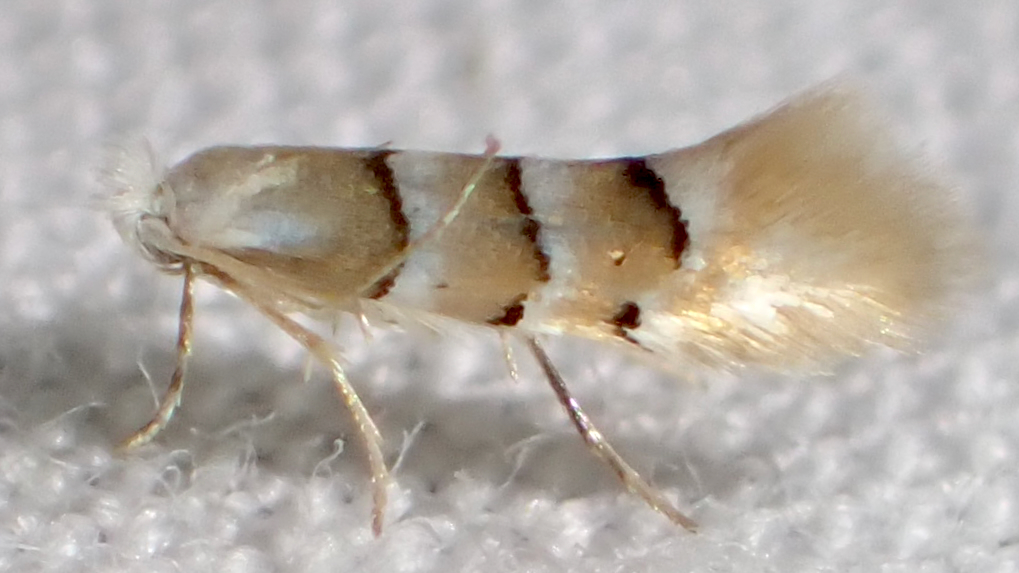
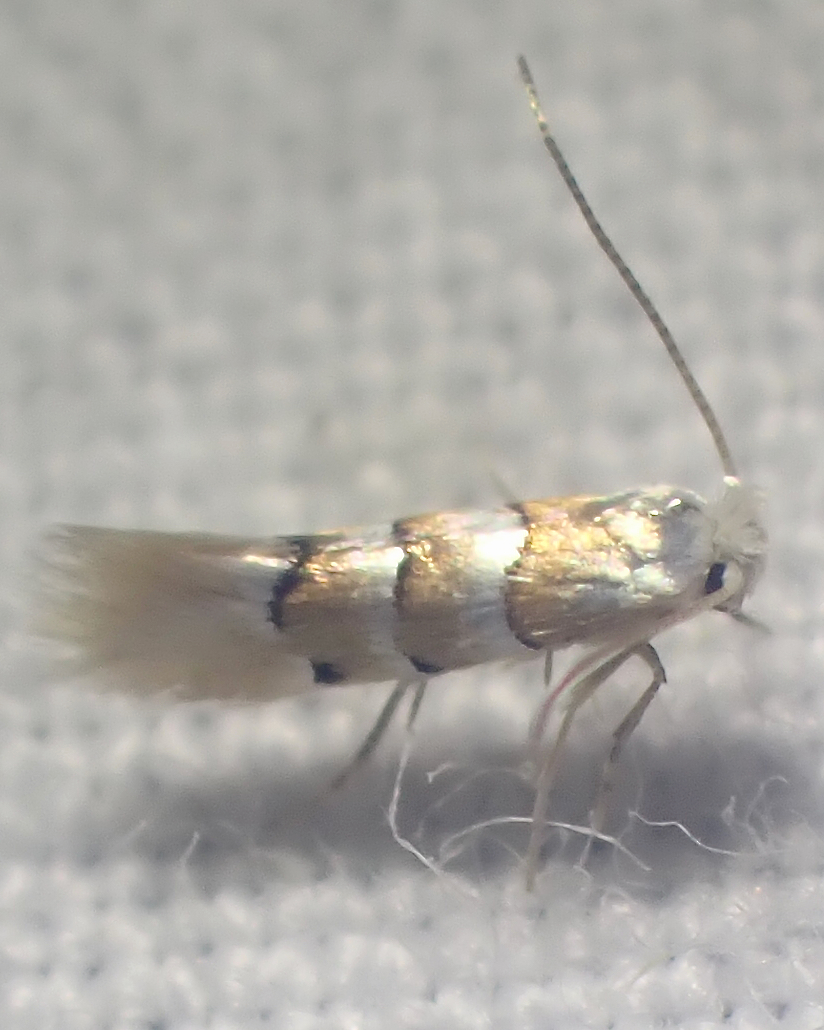
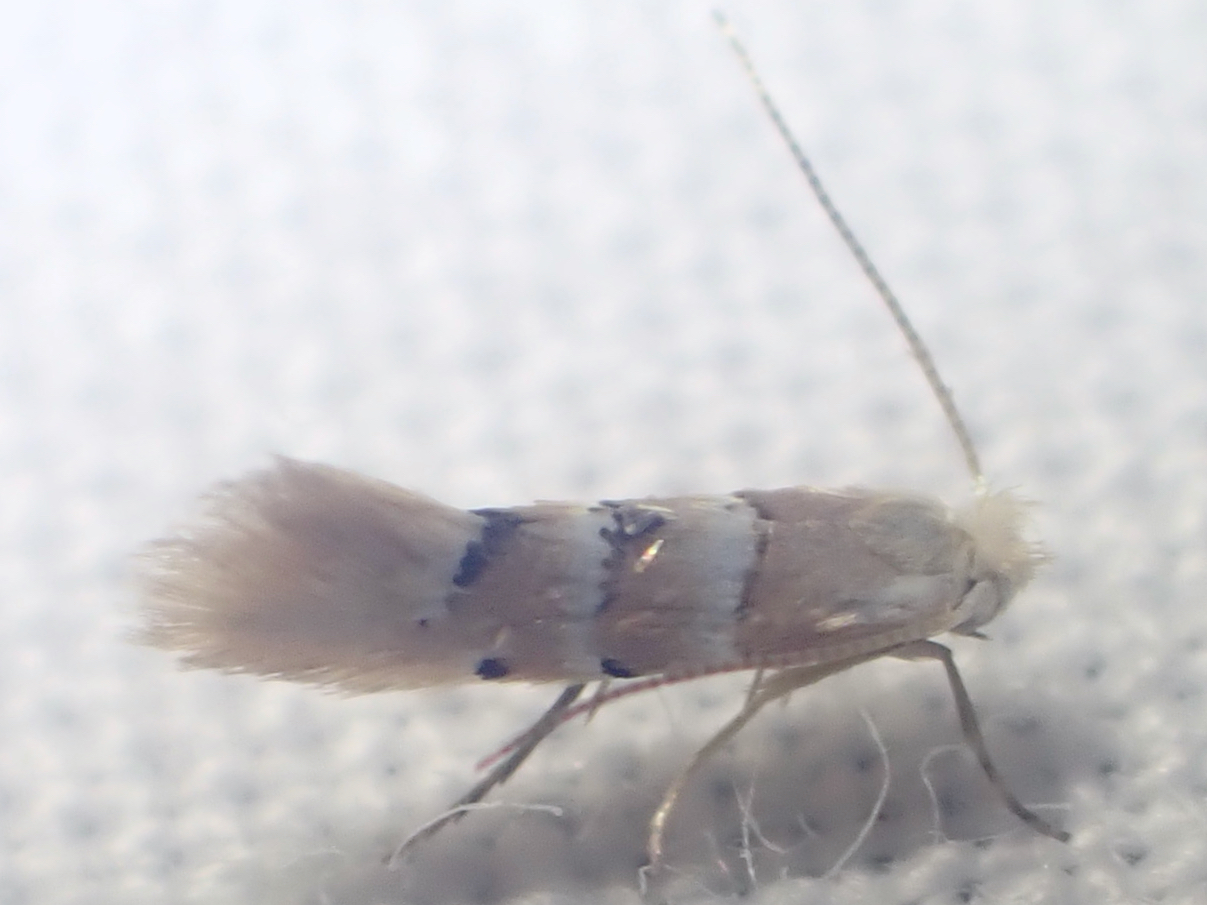
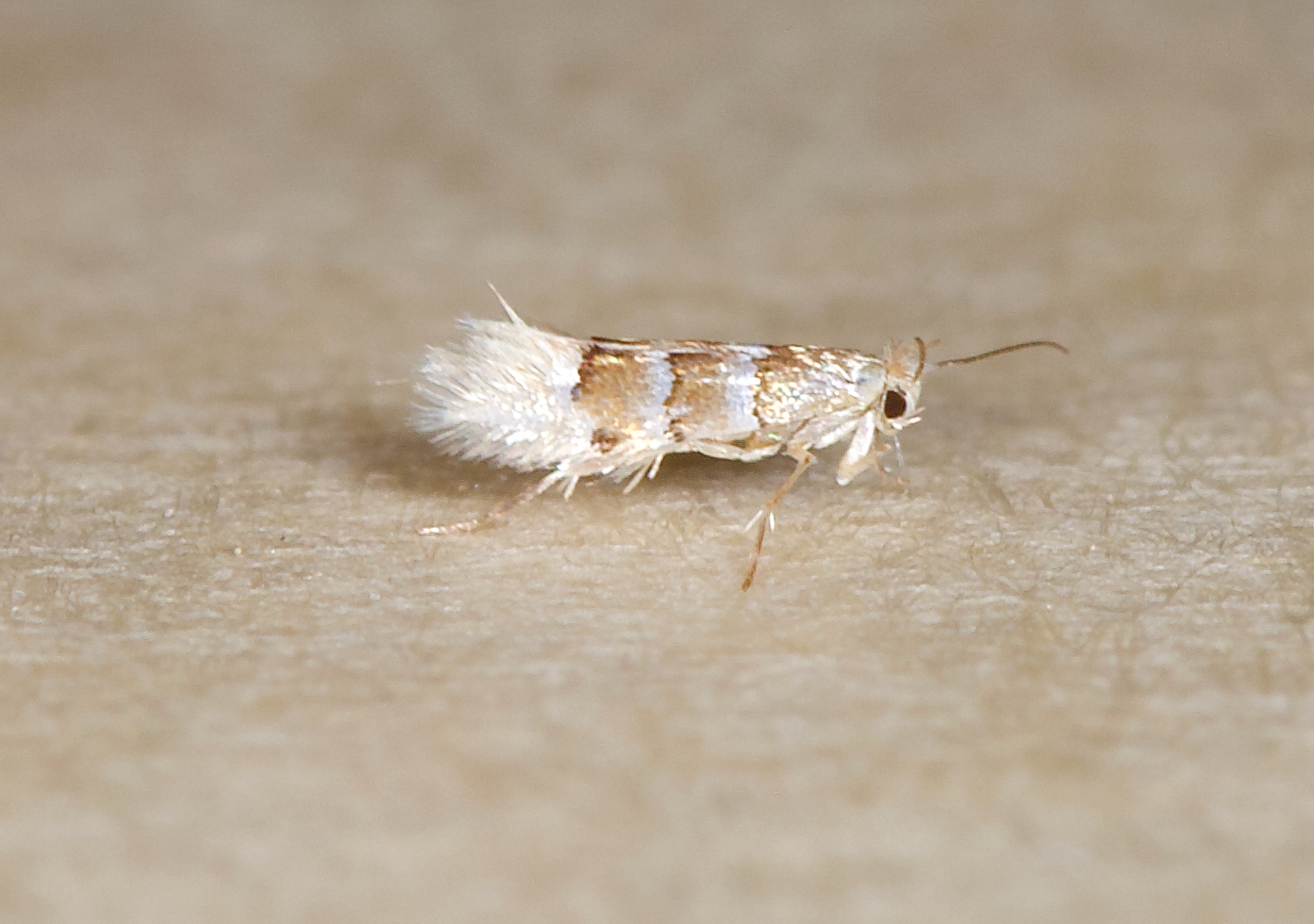
is an easily recognized species that has a glistening, snowy-white head and thorax. The forewing has a pale-golden ground color that has three equally-spaced, silvery-white, angulated fasciae that are boldly margined with black scales on the anterior margin. The first fascia is complete, while the middle and distal fasciae are interrupted on the costal half, with the gap of the latter greater than that on the middle fascia. The fringe is tinged with light-golden coloration, and the legs are mostly light golden-brown.
Wingspan:
6 mm (Braun, 1908).
Adult ID Requirements:
Identifiable from good quality photos of unworn specimens.
Immatures and Development:
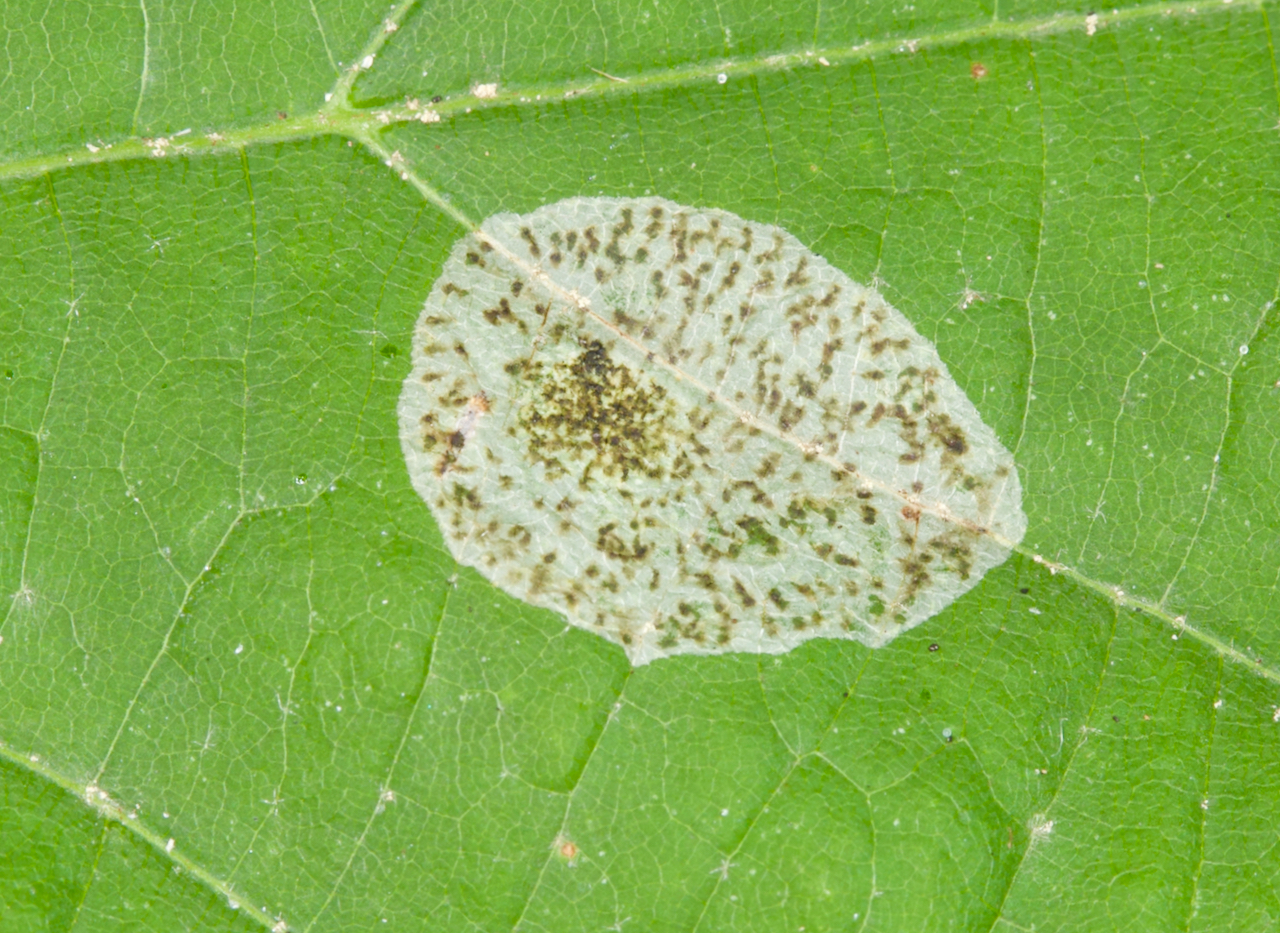
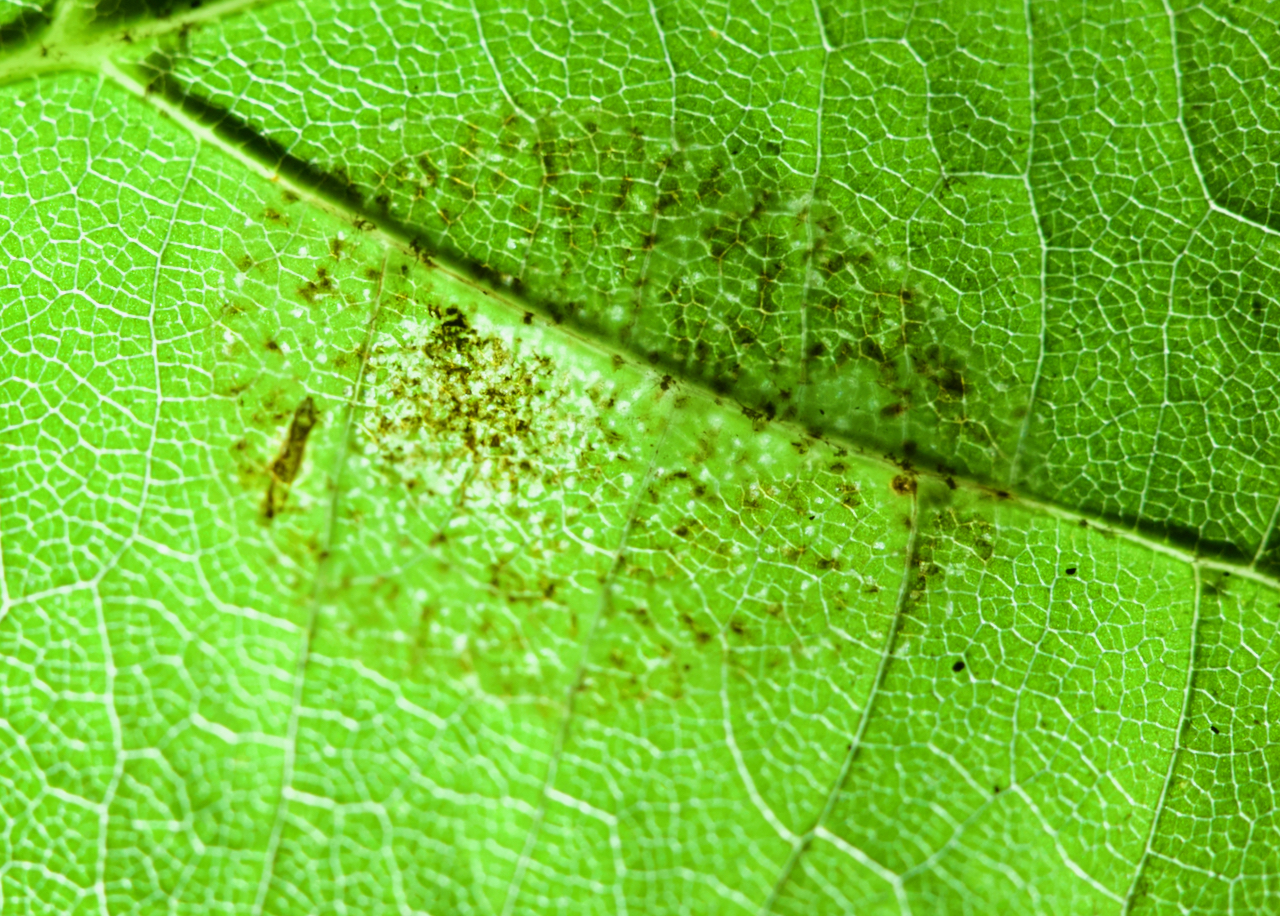
The larvae mine the leaves of American Basswood and produce a whitish mine that is densely speckled with dark brown frass. In some mines the frass is deposited in numerous, fine, overlapping lines rather than scattered about as specks. The mines vary from nearly circular to somewhat oblong and are easily seen on the upper surface of the leaf. They do not become visible on the lower surface until the lower epidermis dies (Braun, 1908; Eiseman, 2022). Local populations are bivoltine and overwinter as pupae in fallen leaves, with the adults emerging after the spring leaf-out. Larvae in the first brood pupate in a very slight silken web that is suspended in the mine, while those in the second brood produce a denser cocoon that is attached to the top and bottom of the mine.
Larvae ID Requirements:
Identifiable from good quality photos, especially where associated with known host plants.
Distribution in North Carolina
Distribution:
Phyllonorycter tiliacella
is mostly found at northern latitudes in the eastern US and adjoining areas of southern Ontario and Quebec. In the US, the range extends from Maine and the New England states southward to New Jersey and Maryland, and westward through New York, Pennsylvania, and Ohio to Iowa, Wisconsin and Minnesota. Populations have recently been documented in the southern Appalachians in the Blue Ridge of North Carolina and an adjoining area of southeastern Tennessee. These appear to be disjunct from the main range to the north. As of 2025, our records are all from mid- to higher-elevation sites in the Blue Ridge.
County Map:
Clicking on a county returns the records for the species in that county.
Flight Dates:
High Mountains (HM) ≥ 4,000 ft.
Low Mountains (LM) < 4,000 ft.
Piedmont (Pd)
Coastal Plain (CP)
Click on graph to enlarge
Flight Comments:
The adults have been observed from March through September in different areas of the range. As of 2025, our records extend from early-May through early-August. Local populations appear to be bivoltine, with the first brood appearing in June or July in most areas of the range.
Habitats and Life History
Habitats:
This species is found in rich, mesic forests where American Basswood is present.
Larval Host Plants:
The larvae appear to specialize on American Basswood (
Tilia americana
; Eiseman, 2022), which is consistent with our observations in North Carolina. -
View
Observation Methods:
The adults are attracted to lights and the leaf mines can be found on American Basswood during the summer months.
Wikipedia
See also Habitat Account for
Basswood Forests
Status in North Carolina
Natural Heritage Program Status:
Natural Heritage Program Ranks:
GNR S1S3
State Protection:
Comments:
North Carolina populations appear to be highly disjunct from those in the main range that is in southern Canada and the northern US. As of 2024, we have only four site records and all are from the Blue Ridge.
Photo Gallery for
Phyllonorycter tiliacella
- Basswood Round-blotch Miner Moth
Photos: 6
Recorded by: tom ward on 2024-05-08
Buncombe Co.
Comment:
Recorded by: tom ward on 2023-08-07
Buncombe Co.
Comment:
Recorded by: tom ward on 2022-06-14
Buncombe Co.
Comment:
Recorded by: Jim Petranka and Becky Elkin on 2021-08-03
Ashe Co.
Comment:
Recorded by: Jim Petranka and Becky Elkin on 2021-08-03
Ashe Co.
Comment:
Recorded by: Jim Petranka and Becky Elkin on 2021-05-21
Madison Co.
Comment:
 »
»