Moths of North Carolina
Home Page
Recent Entries
Recent Account Updates
County Searches
General Search
Submit a Public Record
Larval Hosts
References
Maps
Draft Checklists
Family Photo Gallery
Family PDFs
NC Biodiversity Project
Comments
Significant Contributors
Scientific Name:
Common Name:
Family (Alpha):
Choose a Family
ACROLEPIIDAE-False Diamondback Moths
ADELIDAE-Fairy moths
ALUCITIDAE-Many-plumed Moths
AMPHISBATIDAE-
ARGYRESTHIIDAE-Shiny Head-standing Moths
AUTOSTICHIDAE-Autostichid Moths
BATRACHEDRIDAE-Batrachedrid Moths
BEDELLIIDAE-Bedelliid Moths
BLASTOBASIDAE-Blastobasid Moths
BOMBYCIDAE-Silkworm Moths
BUCCULATRICIDAE-Ribbed Cocoon-maker Moths
CARPOSINIDAE-Fruitworm Moths
CHOREUTIDAE-Metalmark Moths
COLEOPHORIDAE-Casebearer Moths and Relatives
COSMOPTERIGIDAE-Cosmopterigid Moths
COSSIDAE-Carpenter Moths, Goat Moths
CRAMBIDAE-Grass Moths, Snout Moths
DEPRESSARIIDAE-
DREPANIDAE-Hook-tips and Thyatirid Moths
DRYADAULIDAE-
ELACHISTIDAE-Grassminer Moths and Relatives
EPERMENIIDAE-Fringe-tufted Moths
EPIPYROPIDAE-Planthopper Parasite Moths
EREBIDAE-Erebid Moths
ERIOCRANIIDAE-Eriocraniid Moths
EUTELIIDAE-Euteliid Moths
GALACTICIDAE-Galacticid Moths
GELECHIIDAE-Gelechiid Moths; Twirler Moths
GEOMETRIDAE-Geometer Moths, Loopers
GLYPHIDOCERIDAE-Glyphidocerid Moths
GLYPHIPTERIGIDAE-Sedge Moths
GRACILLARIIDAE-Leafblotch miner moths
HELIOZELIDAE-Shield bearer moths
HEPIALIDAE-Ghost or Swift Moths
HYBLAEIDAE-
INCURVARIIDAE-Leafcutter Moths
LASIOCAMPIDAE-Tent Caterpillar Moths, Lappet Moths
LECITHOCERIDAE-Long-horned Moths
LIMACODIDAE-Slug Caterpillar Moths
LIMOCODIDAE-
LYONETIIDAE-Lyonetiid Moths
MEGALOPYGIDAE-Flannel Moths
MICROPTERIGIDAE-Mandibulate Moths
MIMALLONIDAE-
MOMPHIDAE-Mompha Moths
NEPTICULIDAE-Minute leaf miners
NOCTUIDAE-Owlet Moths
NOLIDAE-
NOTODONTIDAE-Prominents
OECOPHORIDAE-Oecophorid Moths
OPOSTEGIDAE-
PELEOPODIDAE-
PLUTELLIDAE-Diamondback Moths
PRODOXIDAE-Yucca Moths
PSYCHIDAE-Bagworm Moths
PTEROPHORIDAE-Plume Moths
PYRALIDAE-Pyralid Moths, Snout Moths
SATURNIIDAE-Giant Silkworm Moths
SCHRECKENSTEINIIDAE-Schreckensteiniid Moths
SCYTHRIDIDAE-
SESIIDAE-Clearwing Moths
SPHINGIDAE-Sphinx Moths
THYATIRIDAE-
THYRIDIDAE-Window-winged Moths
TINEIDAE-Clothes moths
TISCHERIIDAE-Tischerid Moths
TORTRICIDAE-Leafroller Moths
URANIIDAE-
URODIDAE-Urodid Moths
XYLORYCTIDAE-
YPONOMEUTIDAE-Ermine Moths
YPSOLOPHIDAE-Ypsolophid Moths
ZYGAENIDAE-
«
Home
»
View
PDF
Gracillariidae Members:
Acrocercops albinatella
Acrocercops astericola
Acrocercops unidentified species
Anarsioses aberrans
Aristaea pennsylvaniella
Caloptilia alnivorella
Caloptilia azaleella
Caloptilia belfragella
Caloptilia bimaculatella
Caloptilia blandella
Caloptilia cornusella
Caloptilia coroniella
Caloptilia flavella
Caloptilia glutinella
Caloptilia hypericella
Caloptilia invariabilis
Caloptilia juglandiella
Caloptilia negundella
Caloptilia new species 1 - on Styrax
Caloptilia ostryaeella
Caloptilia packardella
Caloptilia paradoxum
Caloptilia porphyretica
Caloptilia rhoifoliella
Caloptilia sassafrasella
Caloptilia serotinella
Caloptilia stigmatella
Caloptilia superbifrontella
Caloptilia triadicae
Caloptilia umbratella
Caloptilia unidentified species
Caloptilia violacella
Cameraria aceriella
Cameraria aesculisella
Cameraria arcuella
Cameraria bethunella
Cameraria betulivora
Cameraria caryaefoliella
Cameraria castaneaeella
Cameraria cincinnatiella
Cameraria conglomeratella
Cameraria corylisella
Cameraria fasciella
Cameraria fletcherella
Cameraria guttifinitella
Cameraria hamadryadella
Cameraria hamameliella
Cameraria lentella
Cameraria macrocarpella
Cameraria obstrictella
Cameraria ostryarella
Cameraria picturatella
Cameraria quercivorella
Cameraria saccharella
Cameraria tubiferella
Cameraria ulmella
Cameraria unidentified species
Chrysaster ostensackenella
Cremastobombycia ignota
Cremastobombycia solidaginis
Cremastobombycia unidentified species
Cryptolectica strigosa
Leucanthiza amphicarpeaefoliella
Leucospilapteryx unidentified species
Leucospilapteryx venustella
Macrosaccus morrisella
Macrosaccus robiniella
Macrosaccus uhlerella
Marmara apocynella
Marmara auratella
Marmara fasciella
Marmara fraxinicola
Marmara new species 1 - on Symplocos
Marmara new species 10 - on Benthamidia and Swida
Marmara new species 11 - on Dysphania or Chenopodium
Marmara new species 12 - on Euphorbia
Marmara new species 13 - on Gardenia
Marmara new species 14 - on Gelsemium
Marmara new species 15 - on Ilex spp.
Marmara new species 16 - on Impatiens
Marmara new species 17 - on Iva spp.
Marmara new species 18 - on Liquidambar
Marmara new species 19 - on Morella
Marmara new species 2 - on Clematis
Marmara new species 20 - on Nyssa
Marmara new species 21 - on Oxydendrum leaf
Marmara new species 22 - on Oxydendrum stem
Marmara new species 23 - on Passiflora
Marmara new species 24 - on Quercus alba
Marmara new species 25 - on Quercus margaretiae and virginiana
Marmara new species 26 - on Rosa
Marmara new species 27 - on Senna
Marmara new species 28 - on Ulmus
Marmara new species 29 - on Vaccinium
Marmara new species 3 - on Acer spp.
Marmara new species 4 - on Acer negundo
Marmara new species 5 - on Borrichia
Marmara new species 6 - on Carpinus
Marmara new species 7 - on Ostrya
Marmara new species 8 - on Carya spp.
Marmara new species 9 - on Cercis
Marmara serotinella
Marmara smilacisella
Marmara unidentified species
Marmara viburnella
Micrurapteryx salicifoliella
Neurobathra strigifinitella
Neurobathra unidentified species
New genus and species near Neurobathra
Parectopa lespedezaefoliella
Parectopa plantaginisella
Parectopa robiniella
Parectopa unidentified species
Parornix dubitella
Parornix geminatella
Parornix obliterella
Parornix preciosella
Parornix unidentified species
Parornix vicinella
Phyllocnistis ampelopsiella
Phyllocnistis hyperpersea
Phyllocnistis insignis
Phyllocnistis liquidambarisella
Phyllocnistis liriodendronella
Phyllocnistis New Species one
Phyllocnistis subpersea
Phyllocnistis unidentified species
Phyllocnistis vitegenella
Phyllocnistis vitifoliella
Phyllonorycter aeriferella
Phyllonorycter albanotella
Phyllonorycter argentifimbriella
Phyllonorycter argentinotella
Phyllonorycter auronitens
Phyllonorycter basistrigella
Phyllonorycter caryaealbella
Phyllonorycter celtifoliella
Phyllonorycter celtisella
Phyllonorycter crataegella
Phyllonorycter diversella
Phyllonorycter fitchella
Phyllonorycter intermixta
Phyllonorycter lucetiella
Phyllonorycter lucidicostella
Phyllonorycter maestingella
Phyllonorycter mariaeella
Phyllonorycter martiella
Phyllonorycter New Species one
Phyllonorycter obscuricostella
Phyllonorycter occitanica
Phyllonorycter ostryaefoliella
Phyllonorycter propinquinella
Phyllonorycter quercialbella
Phyllonorycter rhododendrella
Phyllonorycter salicifoliella
Phyllonorycter scudderella
Phyllonorycter tiliacella
Phyllonorycter trinotella
Phyllonorycter unidentified species
Phyllonorycter viburnella
Porphyrosela desmodiella
Porphyrosela minuta
Porphyrosela unidentified species
Povolnya quercinigrella
Telamoptilia hibiscivora
Phyllocnistis
Members:
Phyllocnistis ampelopsiella
Phyllocnistis hyperpersea
Phyllocnistis insignis
Phyllocnistis liquidambarisella
Phyllocnistis liriodendronella
Phyllocnistis New Species one
Phyllocnistis subpersea
Phyllocnistis unidentified species
Phyllocnistis vitegenella
Phyllocnistis vitifoliella
81 NC Records
Phyllocnistis vitifoliella
Chambers, 1871 - No Common Name
view caption
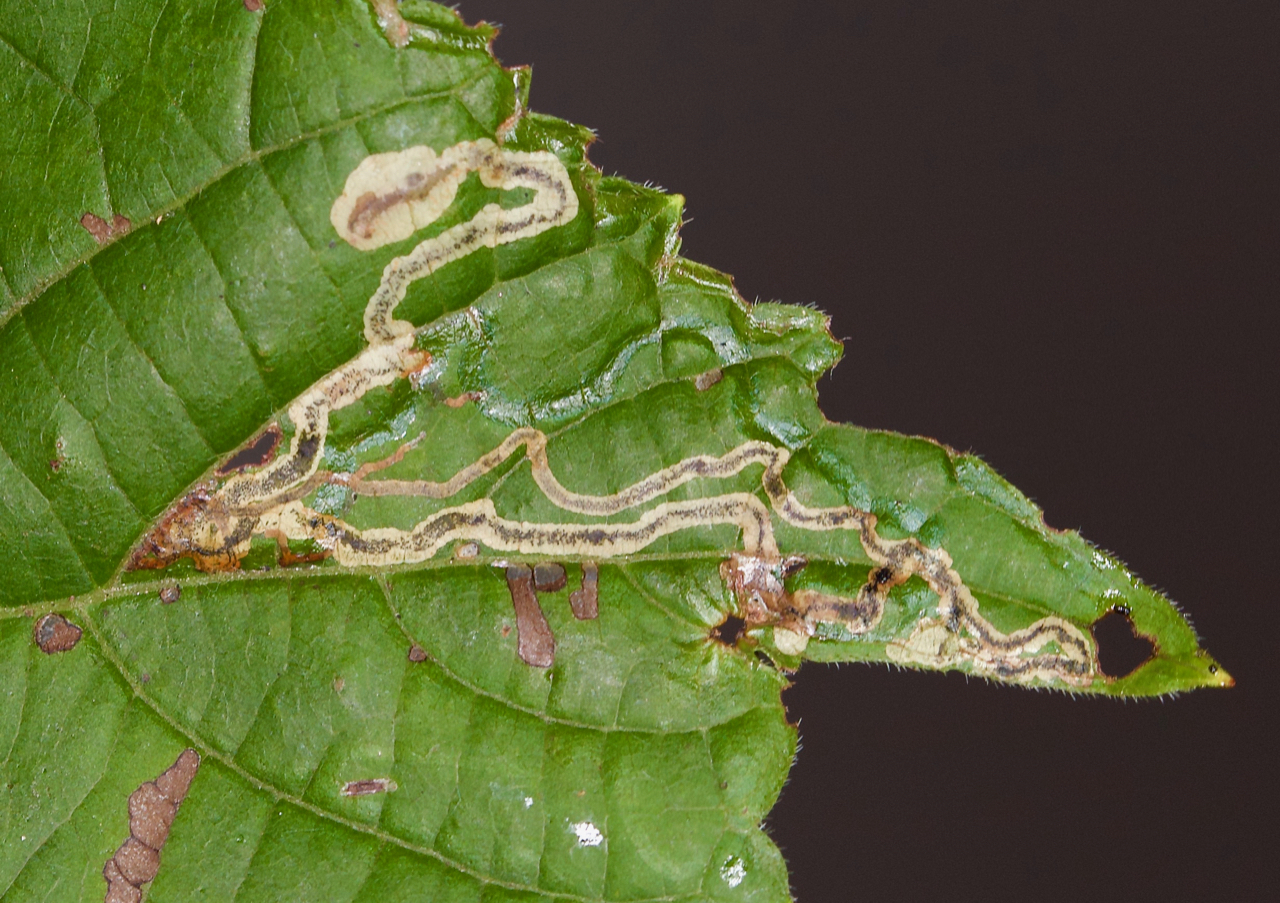
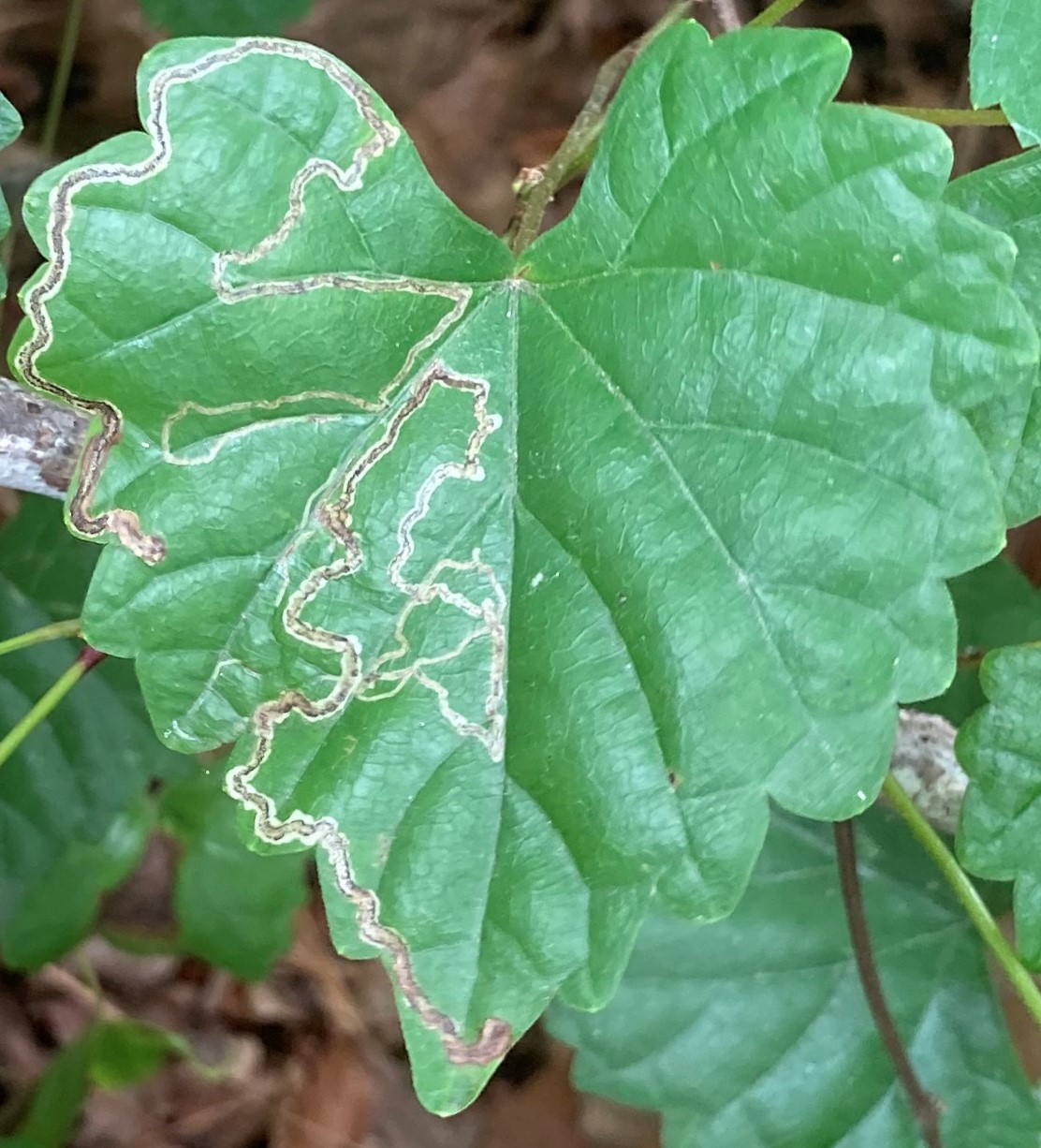
An upper surface linear mine on Vitis baileyana (Possum Grape). Note the prominent frass trail that distinguish this species from P. vitegenella.
view caption
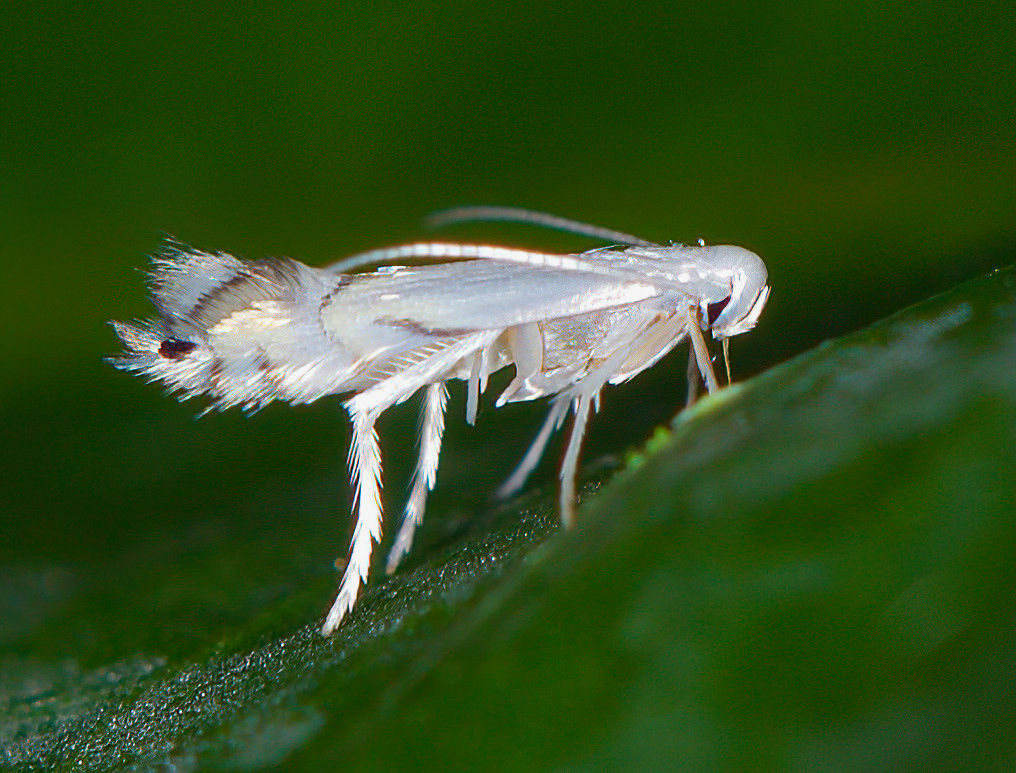
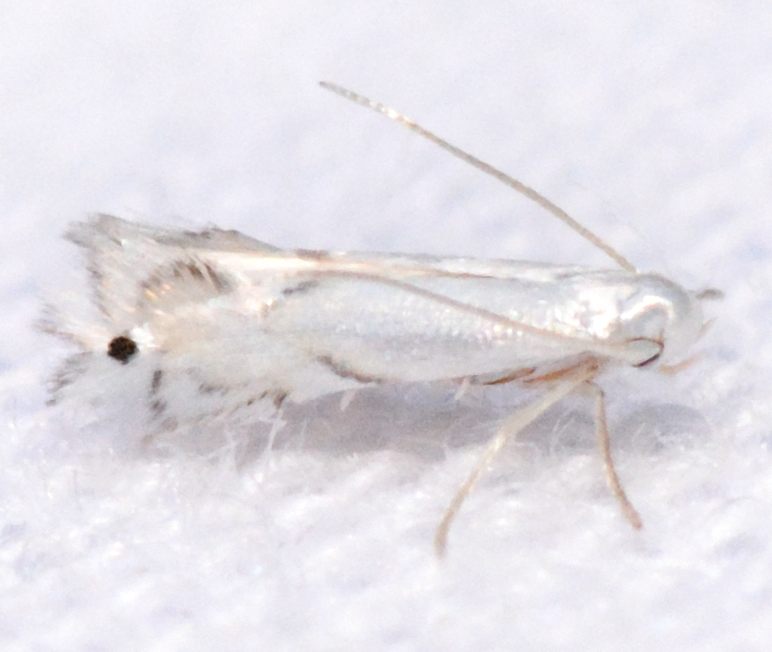
A reared adult.
Taxonomy
Superfamily:
Gracillarioidea
Family:
Gracillariidae
Subfamily:
Phyllocnistinae
P3 Number:
33a0383
MONA Number:
854.00
Comments:
Phyllocnistis
is a large genus with more than 125 described species worldwide, with 16 species currently recognized in North America. Davis and Wagner (2011) surmised that there may be hundreds of undescribed species in the neotropics. The adults of some species are very similar, and knowledge of the host plant and mine characteristics is helpful in identifying morphologically similar species (Eiseman, 2019).
Identification
Field Guide Descriptions:
Online Resources:
MPG
,
BugGuide
,
iNaturalist
,
Google
,
BAMONA
,
GBIF
,
BOLD
Technical Description, Adults:
Chambers, 1871.
Technical Description, Immature Stages:
Eiseman, 2019.
Adult Markings:
The following is based primarily on Chambers’ (1871) original description. The head, thorax, and antenna are glistening snowy white. The ground color of the forewing is also glistening snowy white, but tinged with light golden towards the apex. Overlaying this are a series of narrow, blackish streaks or lines that are less than half the width of the forewing. Near the middle of the wing is a narrow oblique blackish costal streak. Just behind it is a small straight blackish streak that is slightly oblique and that opposes a similar small dorsal streak. There is a conspicuous circular black spot at the wing tip. Just anterior to this there are two straight black costal streaks. At the tip of the wing are three blackish diverging lines in the cilia that tend to converge towards the apical spot. A blackish marginal line arches forward from the apical spot towards the dorsal margin. There is often a broad area of golden wash that adjoins the marginal line on the anterior side. The hindwing and cilia are silvery white. Chambers (1871) noted that
P. vitegenella
closely resembles
P. vitifoliella
, but differs in having antennae that are dark above (whitish in
P. vitifoliella
), a semi-oval dorsal spot (absent in
P. vitifoliella
), and the second costal streak that unites with the opposite dorsal streak to form a narrow fascia (these remain separated in
P. vitifoliella
).
Immatures and Development:
The larvae produce elongated, winding mines on the upper surfaces of leaves. A larva initially mines the epidermis, which produces a silvery mine (Eiseman, 2019). It then mines deeper into the inner tissues and produces dark frass. The frass tends to be loosely concentrated near the middle, but can sometimes be diffuse and fill much of the mine. The frass, along with necrotic tissue, tends to turn the entire track darker with age. Pupation occurs in an enlarged chamber at the end of the mine. This species can be easily distinguished from
P. vitigenella
based on the presence of frass in the mine, and the fact that the pupation chamber of
P. vitifoliella
is not completed beneath a fold on the leaf margin. Chambers (1871) found numerous overwintering adults beneath the bark of hickories in Kentucky.
Larvae ID Requirements:
Identifiable from good quality photos, especially where associated with known host plants.
Distribution in North Carolina
Distribution:
Phyllocnistis vitifoliella
is primarily found in the eastern US and Quebec, with a disjunct population in California. Population records are somewhat unreliable because of the similarity of this species with other white
Phyllocnistis
species. As of 2024, we have scattered records that include the Blue Ridge, Piedmont, and Coastal Plain.
County Map:
Clicking on a county returns the records for the species in that county.
Flight Dates:
High Mountains (HM) ≥ 4,000 ft.
Low Mountains (LM) < 4,000 ft.
Piedmont (Pd)
Coastal Plain (CP)
Click on graph to enlarge
 »
»