Moths of North Carolina
Home Page
Recent Entries
Recent Account Updates
County Searches
General Search
Submit a Public Record
Larval Hosts
References
Maps
Draft Checklists
Family Photo Gallery
Family PDFs
NC Biodiversity Project
Comments
Significant Contributors
Scientific Name:
Common Name:
Family (Alpha):
Choose a Family
ACROLEPIIDAE-False Diamondback Moths
ADELIDAE-Fairy moths
ALUCITIDAE-Many-plumed Moths
AMPHISBATIDAE-
ARGYRESTHIIDAE-Shiny Head-standing Moths
AUTOSTICHIDAE-Autostichid Moths
BATRACHEDRIDAE-Batrachedrid Moths
BEDELLIIDAE-Bedelliid Moths
BLASTOBASIDAE-Blastobasid Moths
BOMBYCIDAE-Silkworm Moths
BUCCULATRICIDAE-Ribbed Cocoon-maker Moths
CARPOSINIDAE-Fruitworm Moths
CHOREUTIDAE-Metalmark Moths
COLEOPHORIDAE-Casebearer Moths and Relatives
COSMOPTERIGIDAE-Cosmopterigid Moths
COSSIDAE-Carpenter Moths, Goat Moths
CRAMBIDAE-Grass Moths, Snout Moths
DEPRESSARIIDAE-
DREPANIDAE-Hook-tips and Thyatirid Moths
DRYADAULIDAE-
ELACHISTIDAE-Grassminer Moths and Relatives
EPERMENIIDAE-Fringe-tufted Moths
EPIPYROPIDAE-Planthopper Parasite Moths
EREBIDAE-Erebid Moths
ERIOCRANIIDAE-Eriocraniid Moths
EUTELIIDAE-Euteliid Moths
GALACTICIDAE-Galacticid Moths
GELECHIIDAE-Gelechiid Moths; Twirler Moths
GEOMETRIDAE-Geometer Moths, Loopers
GLYPHIDOCERIDAE-Glyphidocerid Moths
GLYPHIPTERIGIDAE-Sedge Moths
GRACILLARIIDAE-Leafblotch miner moths
HELIOZELIDAE-Shield bearer moths
HEPIALIDAE-Ghost or Swift Moths
HYBLAEIDAE-
INCURVARIIDAE-Leafcutter Moths
LASIOCAMPIDAE-Tent Caterpillar Moths, Lappet Moths
LECITHOCERIDAE-Long-horned Moths
LIMACODIDAE-Slug Caterpillar Moths
LIMOCODIDAE-
LYONETIIDAE-Lyonetiid Moths
MEGALOPYGIDAE-Flannel Moths
MICROPTERIGIDAE-Mandibulate Moths
MIMALLONIDAE-
MOMPHIDAE-Mompha Moths
NEPTICULIDAE-Minute leaf miners
NOCTUIDAE-Owlet Moths
NOLIDAE-
NOTODONTIDAE-Prominents
OECOPHORIDAE-Oecophorid Moths
OPOSTEGIDAE-
PELEOPODIDAE-
PLUTELLIDAE-Diamondback Moths
PRODOXIDAE-Yucca Moths
PSYCHIDAE-Bagworm Moths
PTEROPHORIDAE-Plume Moths
PYRALIDAE-Pyralid Moths, Snout Moths
SATURNIIDAE-Giant Silkworm Moths
SCHRECKENSTEINIIDAE-Schreckensteiniid Moths
SCYTHRIDIDAE-
SESIIDAE-Clearwing Moths
SPHINGIDAE-Sphinx Moths
THYATIRIDAE-
THYRIDIDAE-Window-winged Moths
TINEIDAE-Clothes moths
TISCHERIIDAE-Tischerid Moths
TORTRICIDAE-Leafroller Moths
URANIIDAE-
URODIDAE-Urodid Moths
XYLORYCTIDAE-
YPONOMEUTIDAE-Ermine Moths
YPSOLOPHIDAE-Ypsolophid Moths
ZYGAENIDAE-
«
Home
»
View
PDF
Cosmopterigidae Members:
Anatrachyntis badia
Anatrachyntis rileyi
Anatrachyntis unidentified species
Cosmopterix astrapias
Cosmopterix clandestinella
Cosmopterix clemensella
Cosmopterix dapifera
Cosmopterix delicatella
Cosmopterix floridanella
Cosmopterix gemmiferella
Cosmopterix lespedezae
Cosmopterix magophila
Cosmopterix nitens
Cosmopterix pulchrimella
Cosmopterix scirpicola
Cosmopterix teligera
Cosmopterix thelxinoe
Cosmopterix unidentified species
Eralea albalineella
Eteobalea sexnotella
Eteobalea wyattella
Euclemensia bassettella
Limnaecia phragmitella
Melanocinclis lineigera
Melanocinclis sparsa
Melanocinclis unidentified species
Nepotula secura
Perimede erransella
Perimede ricina
Perimede unidentified species
Periploca unidentified species
Pyroderces albistrigella
Stilbosis quadricustatella
Stilbosis tesquella
Stilbosis unidentified species
Stilbosis venifica
Tanygona lignicolorella
Triclonella pergandeella
Walshia elegans
Walshia floridensis
Walshia miscecolorella
Walshia new species nr. elegans
Walshia particornella
Walshia similis
Walshia unidentified species
Walshia [asymmetrica]
Perimede
Members:
Perimede erransella
Perimede ricina
Perimede unidentified species
7 NC Records
Perimede ricina
Hodges, 1962 - No Common Name
Taxonomy
Superfamily:
Gelechioidea
Family:
Cosmopterigidae
Subfamily:
Chrysopeleiinae
Tribe:
[Chrysopeleiini]
P3 Number:
59a0337
MONA Number:
1631.00
Identification
Field Guide Descriptions:
Beadle and Leckie (2012)
Online Resources:
MPG
,
BugGuide
,
iNaturalist
,
Google
,
BAMONA
,
GBIF
,
BOLD
Technical Description, Adults:
Hodges (1978)
Adult Markings:
Perimede
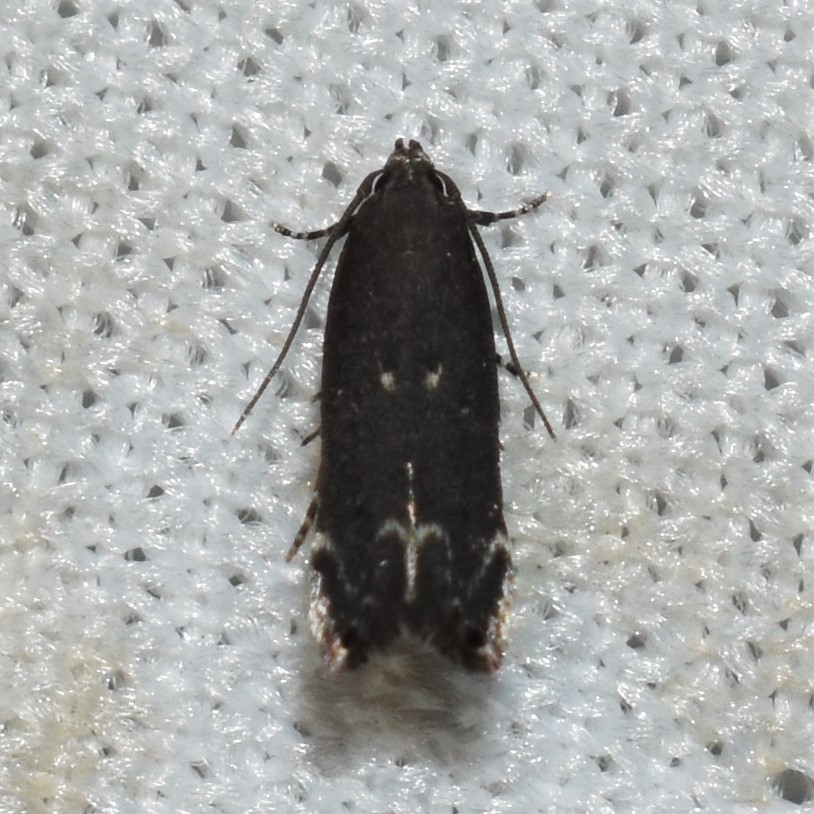
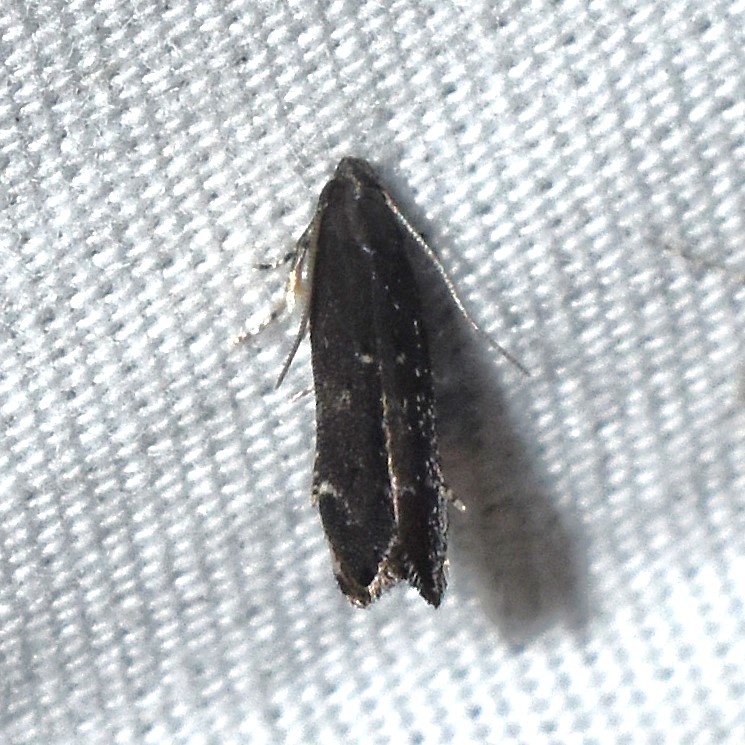
species in eastern North America are very similar and are often best identified by using genitalia and other structural features. The following description is based on that of Hodges (1962b). The labial palps, antennae and thorax are all fuscous-brown. The forewing is also predominantly fuscous-brown, with four relatively large black spots that are preceded by a few white scales. These are found at one-third the wing length on the fold, at one-half the wing length on the middle of wing, at two-thirds the wing length on the middle of wing, and a relatively large one at the apex. Both a costal and a dorsal patch of white scales are usually present at three-fourths the wing length. The fringe is concolorous with the forewing except for the outer half along the outer margin (below the apex), which is white and best seen in spread specimens. The hindwing is fuscous-brown, with a dark-brown apex and a buff-brown fringe.
Perimede ricina
is very similar and often requires dissection for a positive identification. In North Carolina specimens,
P. ricina
tends to be a shade lighter in overall coloration, and often has both a costal and a dorsal patch of white scales at three-fourths the wing length (versus only a costal patch for
P. erransella
). The former also often has a row of two or three small spots of white scales that extend from the apical black spot towards both the tornus and the costa (versus only towards the tornus in
P. erransella
). These features are often reduced or missing in specimens, which hampers identification based on photographs alone.
Wingspan:
10-14 mm (Hodges, 1962b).
Forewing Length:
5-6 mm (Hodges, 1978)
Adult Structural Features:
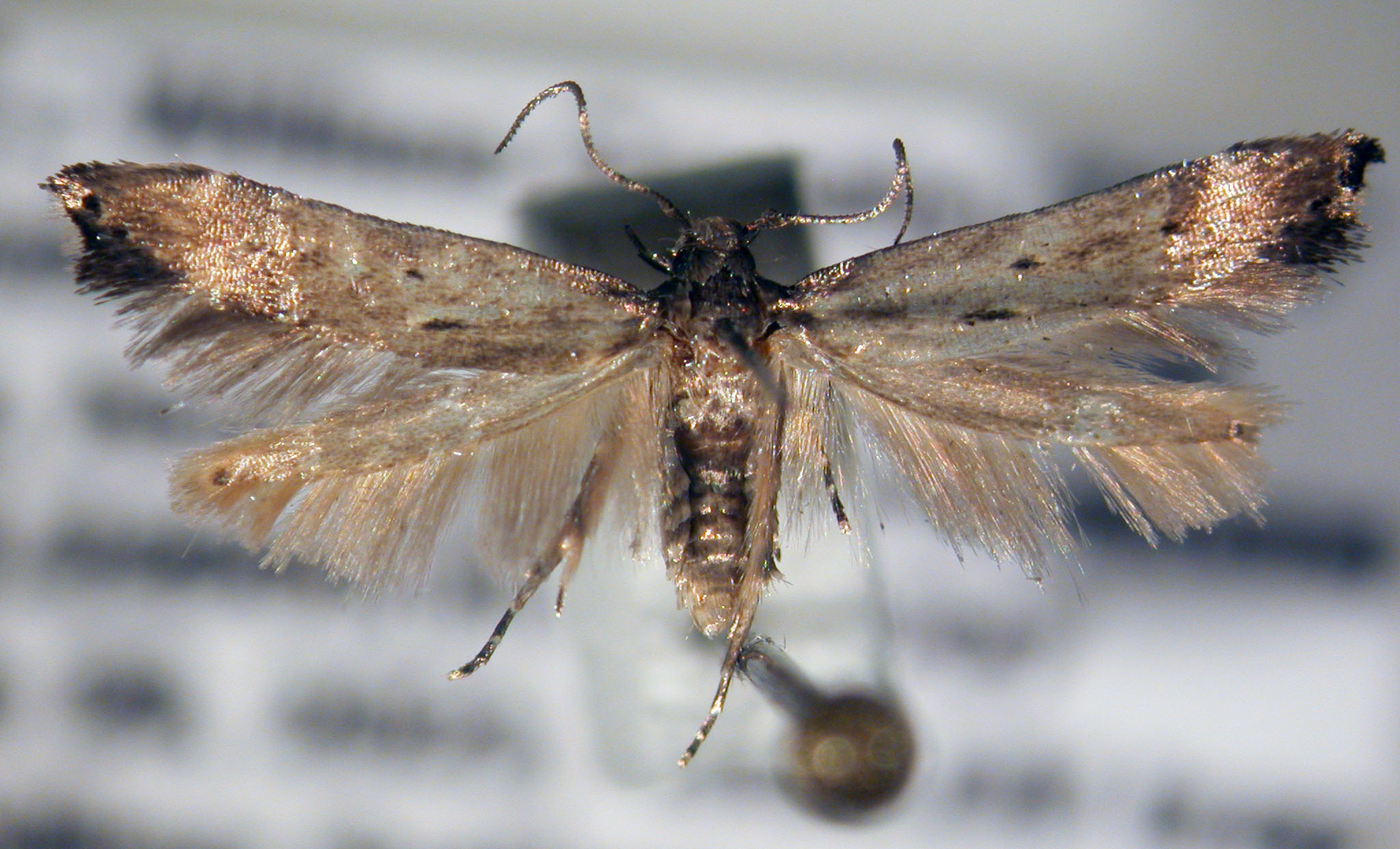
Hodges (1962b, 1978) has descriptions and illustrations of the male and female genitalia. Also, see images below for North Carolina specimens.
Genitalia and other structural photos
Male genitalia; Wilkes County; J.B. Sullivan.
Male pelt; Wilkes County; J.B. Sullivan.
Male metatarsus; Wilkes County; J.B. Sullivan.
Adult ID Requirements:
Identifiable only by close inspection of structural features or by DNA analysis.
Immatures and Development:
As of 2025, we are unaware of any documentation of the host plants or larval life history.
Larvae ID Requirements:
Identifiable only through rearing to adulthood.
Distribution in North Carolina
Distribution:
Perimede ricina
in found in the eastern US and in adjoining areas of southern Ontario and Quebec. In the US the range extends from Massachusetts and vicinity westward through the Great Lakes region to Illinois and Wisconsin, and southward to West Virginia, eastern Kentucky, Tennessee and North Carolina. Geographic isolates occur farther south in Florida and perhaps elsewhere, but need verification using genitalia. As of 2025, all of our records are from the Piedmont and Blue Ridge.
County Map:
Clicking on a county returns the records for the species in that county.
Flight Dates:
High Mountains (HM) ≥ 4,000 ft.
Low Mountains (LM) < 4,000 ft.
Piedmont (Pd)
Coastal Plain (CP)
Click on graph to enlarge
Flight Comments:
The adults mostly fly from April through September in different areas of the range, with a seasonal peak in June through August. As of 2025, our very limited records are from mid-April through early-July.
Habitats and Life History
Habitats:
Our records are mostly from areas with mesic or bottomland forests, as well as semi-wooded residential neighborhoods.
Larval Host Plants:
The hosts are apparently unknown. -
View
Observation Methods:
The adults are attracted to lights.
Wikipedia
Status in North Carolina
Natural Heritage Program Status:
Natural Heritage Program Ranks:
GNR [S2S3].
State Protection:
Has no legal protection, although permits are required to collect it on state parks and other public lands.
Comments:
Photo Gallery for
Perimede ricina
- None
Photos: 5
Recorded by: David George, Tracy Feldman, Jeff Niznik, Rich Teper, Patrick Coin, Becky Watkins on 2024-06-08
Wake Co.
Comment:
Recorded by: Jim Petranka on 2023-07-08
Madison Co.
Comment:
Recorded by: J.B. Sullivan on 2023-06-28
Wilkes Co.
Comment: verified by dissection.
Recorded by: David George, Jeff Niznik on 2023-06-06
Durham Co.
Comment:
Recorded by: K. Kittelberger on 2012-04-17
Wake Co.
Comment:
 »
»