Moths of North Carolina
Home Page
Recent Entries
Recent Account Updates
County Searches
General Search
Submit a Public Record
Larval Hosts
References
Maps
Draft Checklists
Family Photo Gallery
Family PDFs
NC Biodiversity Project
Comments
Significant Contributors
Scientific Name:
Common Name:
Family (Alpha):
Choose a Family
ACROLEPIIDAE-False Diamondback Moths
ADELIDAE-Fairy moths
ALUCITIDAE-Many-plumed Moths
AMPHISBATIDAE-
ARGYRESTHIIDAE-Shiny Head-standing Moths
AUTOSTICHIDAE-Autostichid Moths
BATRACHEDRIDAE-Batrachedrid Moths
BEDELLIIDAE-Bedelliid Moths
BLASTOBASIDAE-Blastobasid Moths
BOMBYCIDAE-Silkworm Moths
BUCCULATRICIDAE-Ribbed Cocoon-maker Moths
CARPOSINIDAE-Fruitworm Moths
CHOREUTIDAE-Metalmark Moths
COLEOPHORIDAE-Casebearer Moths and Relatives
COSMOPTERIGIDAE-Cosmopterigid Moths
COSSIDAE-Carpenter Moths, Goat Moths
CRAMBIDAE-Grass Moths, Snout Moths
DEPRESSARIIDAE-
DREPANIDAE-Hook-tips and Thyatirid Moths
DRYADAULIDAE-
ELACHISTIDAE-Grassminer Moths and Relatives
EPERMENIIDAE-Fringe-tufted Moths
EPIPYROPIDAE-Planthopper Parasite Moths
EREBIDAE-Erebid Moths
ERIOCRANIIDAE-Eriocraniid Moths
EUTELIIDAE-Euteliid Moths
GALACTICIDAE-Galacticid Moths
GELECHIIDAE-Gelechiid Moths; Twirler Moths
GEOMETRIDAE-Geometer Moths, Loopers
GLYPHIDOCERIDAE-Glyphidocerid Moths
GLYPHIPTERIGIDAE-Sedge Moths
GRACILLARIIDAE-Leafblotch miner moths
HELIOZELIDAE-Shield bearer moths
HEPIALIDAE-Ghost or Swift Moths
HYBLAEIDAE-
INCURVARIIDAE-Leafcutter Moths
LASIOCAMPIDAE-Tent Caterpillar Moths, Lappet Moths
LECITHOCERIDAE-Long-horned Moths
LIMACODIDAE-Slug Caterpillar Moths
LIMOCODIDAE-
LYONETIIDAE-Lyonetiid Moths
MEGALOPYGIDAE-Flannel Moths
MICROPTERIGIDAE-Mandibulate Moths
MIMALLONIDAE-
MOMPHIDAE-Mompha Moths
NEPTICULIDAE-Minute leaf miners
NOCTUIDAE-Owlet Moths
NOLIDAE-
NOTODONTIDAE-Prominents
OECOPHORIDAE-Oecophorid Moths
OPOSTEGIDAE-
PELEOPODIDAE-
PLUTELLIDAE-Diamondback Moths
PRODOXIDAE-Yucca Moths
PSYCHIDAE-Bagworm Moths
PTEROPHORIDAE-Plume Moths
PYRALIDAE-Pyralid Moths, Snout Moths
SATURNIIDAE-Giant Silkworm Moths
SCHRECKENSTEINIIDAE-Schreckensteiniid Moths
SCYTHRIDIDAE-
SESIIDAE-Clearwing Moths
SPHINGIDAE-Sphinx Moths
THYATIRIDAE-
THYRIDIDAE-Window-winged Moths
TINEIDAE-Clothes moths
TISCHERIIDAE-Tischerid Moths
TORTRICIDAE-Leafroller Moths
URANIIDAE-
URODIDAE-Urodid Moths
XYLORYCTIDAE-
YPONOMEUTIDAE-Ermine Moths
YPSOLOPHIDAE-Ypsolophid Moths
ZYGAENIDAE-
«
Home
»
View
PDF
Prodoxidae Members:
Lampronia russatella
Prodoxus decipiens
Tegeticula unidentified species
Tegeticula yuccasella
Prodoxus
Members:
Prodoxus decipiens
23 NC Records
Prodoxus decipiens
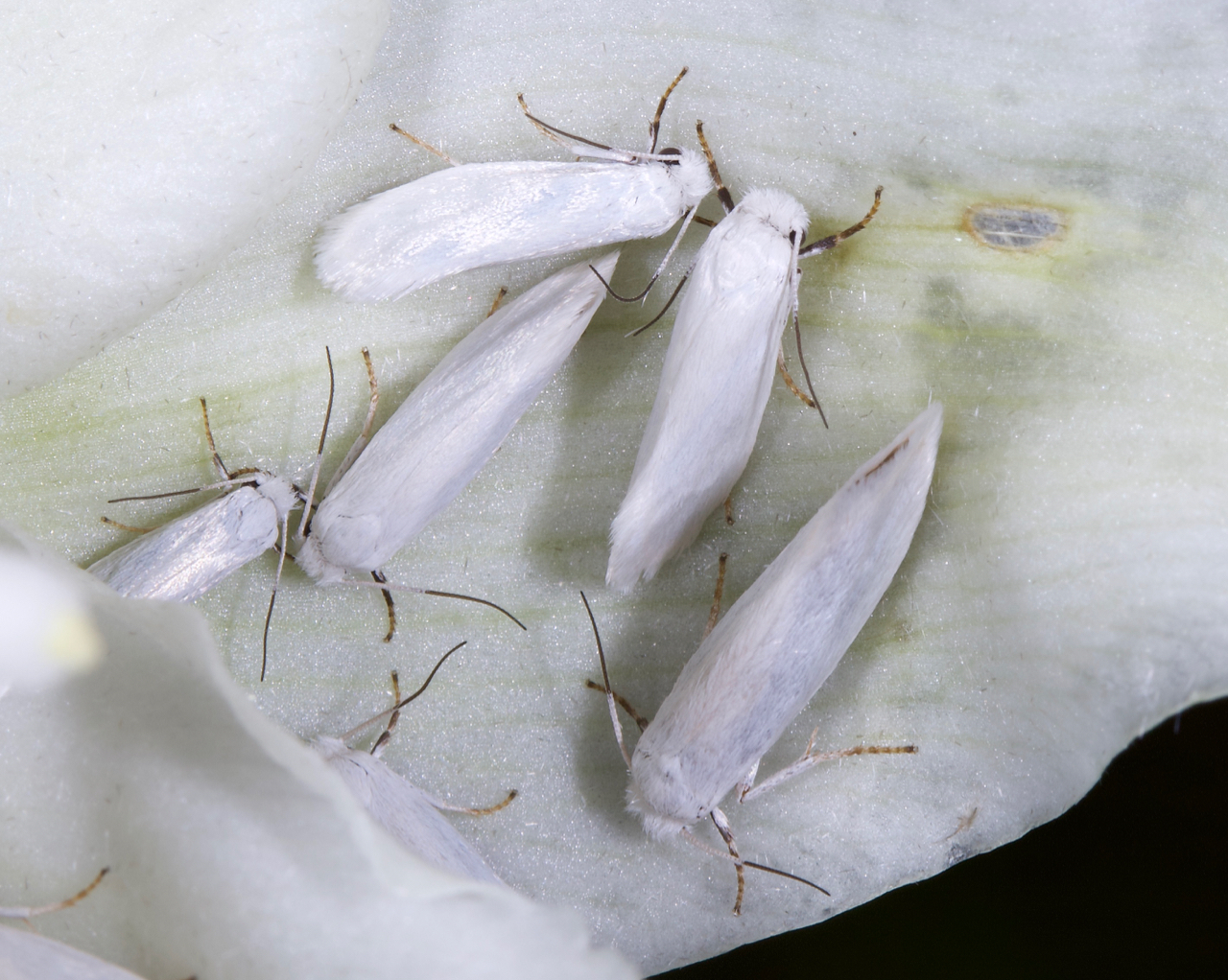
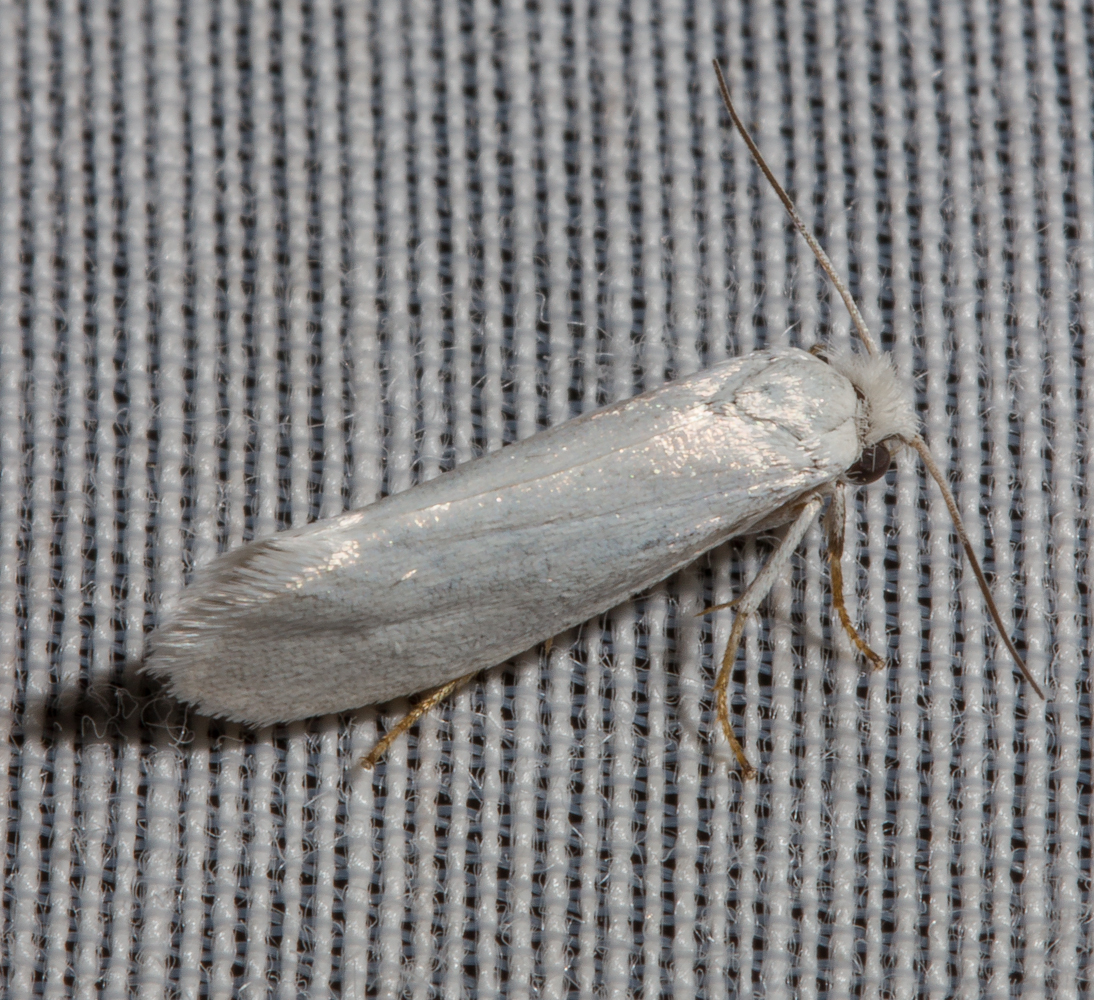
Riley, 1880 - Bogus Yucca Moth
view caption
Adults on a Yucca filamentosa flower in Madison County.
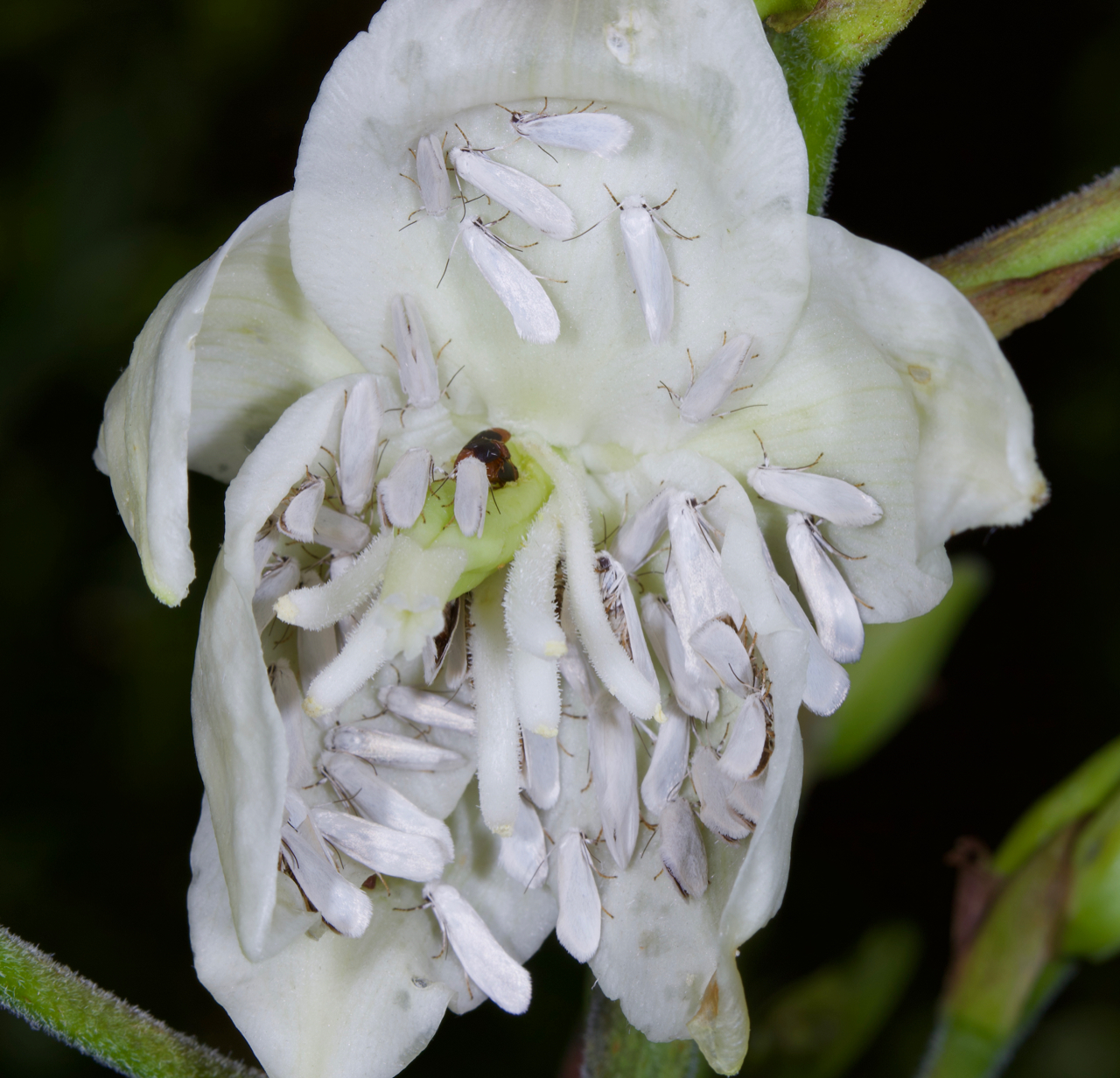
view caption
This exceptionally large gathering on moths was found on a Yucca filamentosa flower in Madison County.
Taxonomy
Superfamily:
Incurvarioidea
Family:
Prodoxidae
Subfamily:
Prodoxinae
Tribe:
[Prodoxini]
P3 Number:
21a0045
MONA Number:
200.10
Comments:
The genus
Prodoxus
contains 22 described species in North America. This genus is a sister group to the pollinating yucca moths (
Tegeticula
and
Parategeticula
) that have mutualistic relationships with yuccas. Althoff et al. (2001) split what was previously a single, wide-ranging species (
P. quinquepunctella
) into two species. The eastern form is now recognized as
P. decipiens
, while the western form is
P. quinquepunctella
(sensu stricto).
Prodoxus decipiens
is the only
Prodoxus
that is found east of the Mississippi River.
Identification
Field Guide Descriptions:
Leckie and Beadle (2018)
Online Resources:
MPG
,
BugGuide
,
iNaturalist
,
Google
,
BAMONA
,
GBIF
,
BOLD
Technical Description, Adults:
Althoff et al., 2001.
Adult Markings:
The following is based on Althoff et al.'s (2001) redescription of the species. The integument is amber to medium brown. The head and thorax have white scales. The maxillary palp is five-segmented and lacks a tentacle on the basal segment as is seen in
Tegeticula
. The labial palp is three-segmented with a prominent apical sensilla. The proboscis is tan-colored and relatively long, while the antenna is dark brown, with white scales on the basal half. The dorsal surface of the forewing is completely white, except for a dark frontal edge on the basal quarter of the costa. The underside is brown except for a yellowish white portion that overlaps the light to medium grayish brown hindwing. The underside of the hindwing is sparsely scaled in brownish gray, with a darker area along the fore edge where it overlaps with the forewing. The wing fringes are white. The abdomen has dorsal scaling that is white and light tan, with the last two segments with white linear semierect scales that form a brush. The underside is white to light tan in females, and light to medium tan and rarely white in males. The legs are whitish with rusty brown on the tarsi.
Our two yucca moths (
P. decipiens
and
Tegeticula yuccasella
) often co-occur locally and can be found resting inside the same yucca flowers during the day. They are very similar externally, and are best identified via genitalia or by examination of the head region. Female
T. yuccasella
have a conspicuous tentacle at the base of the maxillary palp that is used to pollinate flowers (Pellmyr and Krenn, 2002), while
P. decipiens
does not. The species also differ in size (Althoff et al., 2001, Pellmyr, 1999) as follows:
T. yuccasella
; wing length = 8.4-10.0 mm for males and 9.3- 11.7 mm for females,
P. decipiens
; 4.0–8.8 mm for males and 4.6–11.0 mm for females.
Wingspan:
Males 11.0–18.0 mm; females 14.5–24.5 mm (Althoff et al., 2001).
Forewing Length:
Males 4.0–8.8 mm, females 4.6–11.0 mm (Althoff et al., 2001).
Adult Structural Features:
The following description of the genitalia is based on Althoff et al. (2001). Males: The valva is mostly linear, but expanded dorsally at the apex and has 3–6 short spines along the apico-ventral margin. The aedeagus is 1.21–1.96 mm long. Female genitalia: The posterior apophyses are 3.6–7.6 mm long, while the ovipositor is 0.06–0.19 mm high near the tip, with 5–11 dorsal teeth. The corpus bursae has two 0.10- to 0.22 mm signa (Althoff et al., 2001).
Genitalia and other structural photos
Male genitalia; North Carolina; J.B. Sullivan.
Male genitalia; Guilford County; J.B. Sullivan.
Aedeagus; Guilford County; J.B. Sullivan.
Female genitalia; North Carolina; J.B. Sullivan.
Female genitalia; Madison County; J.B. Sullivan.
Female genitalia; Wilson County; Jim Petranka.
Adult ID Requirements:
Identifiable from photos showing hindwings, abdomen, or other specialized views [e.g., frons, palps, antennae, undersides].
Immatures and Development:
Prodoxus decipiens
is a specialist on yuccas, but does not actively pollinate the flowers like members of the genus
Tegeticula
. Adults are active at night, and mate within the yucca flowers. After mating, a female lays her eggs individually in the flower stalk using her serrated ovipositor like a saw to cut into the tissue. The larvae feed on tissue within the stalk for about a month. Prior to diapause, they excavate a tunnel to the surface of the stalk, then retreat to the back of the feeding gallery and remain in diapause for the winter. Pupation occurs in the stalk the following spring, about one week prior to emergence (Groman and Pellmyr, 2000). Larvae can remain in diapause for several years during prolonged droughts, and the adults emerge from the previous years’ scapes throughout the flowering period (Althoff et al., 2004).
Larvae ID Requirements:
Identifiable from good quality photos, especially where associated with known host plants.
Distribution in North Carolina
Distribution:
Prodoxus decipiens
occurs throughout much of the east-central and eastern US, from central Texas and Florida northward to Kansas, Illinois, Ohio, and Virginia (Althoff et al., 2001). Populations appear to be patchily distributed statewide, and are restricted to sites where the host plants occur.
County Map:
Clicking on a county returns the records for the species in that county.
Flight Dates:
High Mountains (HM) ≥ 4,000 ft.
Low Mountains (LM) < 4,000 ft.
Piedmont (Pd)
Coastal Plain (CP)
Click on graph to enlarge
 »
»