|
|
|
| synonym |
|
| description |
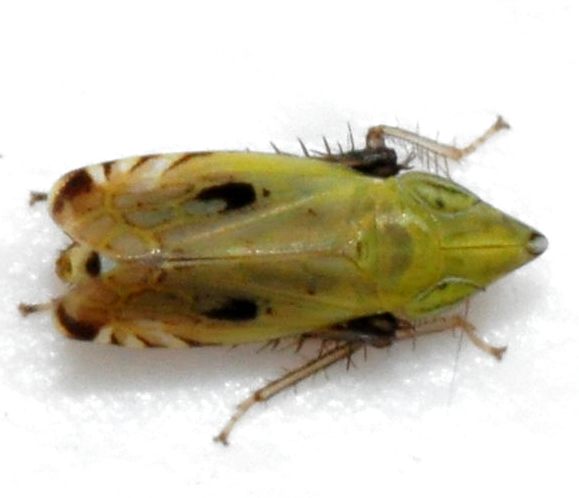
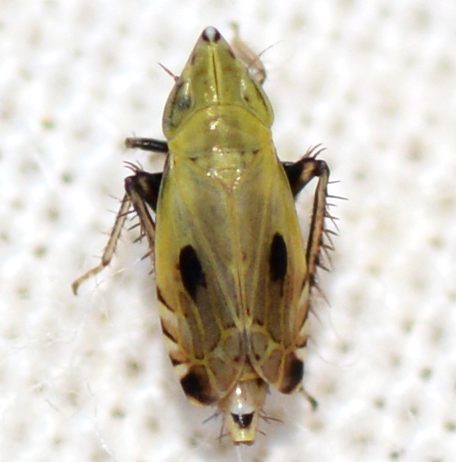
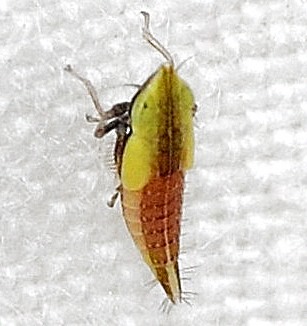
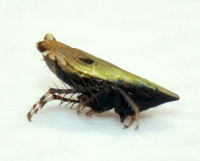
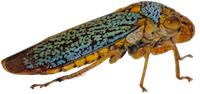
A distinctively marked small, greenish leafhopper; nothing else looks like this Flexamia. This species has greenish wings (the rear half has a reddish tint), thorax, head, and eyes (the top half). Oblique black dashes on the wings are 'reflexed' crossveins, turning inward; this is characteristic of Flexamia. This is the only member of this genus with bold black "eyes spots" on the wings (BG). The underside of the abdomen, face, and eyes is black. The female pregenital sternite has the posterior margins concave on each side of an apically notched, convex median projection; the posterior margin is sinusoidal. The male genital plates are elongate, gradually narrowing to the apex. Adult males are 2.6-3.2 mm long, while females are 3.2-4.0 mm. The nymph has a greenish abdomen and thorax, with a broad brown stripe down the middle. The abdomen is reddish, and the underside of the body is black, like the adult. (Whitcomb & Hicks 1988)
For diagrams of this species, see: Zahniser. |
| distribution |
Throughout most of eastern and central North America, possibly as far west as Arizona |
| abundance |
This species has been recorded recently from a couple counties in the Piedmont; it is locally common at Kerr Lake State Park in Vance county. Possibly more abundant in the state in the right habitat. |
| seasonal_occurrence | |
| habitat |
Has been found in grassy, brushy field type habitat on forest edge. |
| plant associates |
A specialist on lovegrass, Eragrostis spectabilis (BG) |
| behavior |
|
| comments |
The black "eye spots" on the wings mimic the small seeds of its host plant, lovegrass (BG). |
status |
[Native:]
[Introduced:]
[Extirpated:] | | list_type |
[Official:]
[Provisional:] |
| adult_id | Unmistakable and widely known Identifiable from good quality photos of unworn specimens
Identifiable from photos showing undersides, or other specialized views [e.g., legs, face]
Identifiable only by close inspection of structural features or by DNA analysis NULL |
| nymph_id | Unmistakable and widely known Identifiable from good quality photos, especially where associated with known host plants
Identifiable from close inspection of specimens or by DNA analysis
Identifiable only through rearing to adulthood NULL |
| G_rank |
|
| S_rank |
|
| rank_comments |
|
| tribe |
Paralimnini |
| subgenus |
|
Species Photo Gallery for Flexamia areolata No Common Name |
 | Photo by: Kyle Kittelberger, Brian Bockhahn, Paul Scharf
Vance Co.
Comment: Field/forest edge habitat | 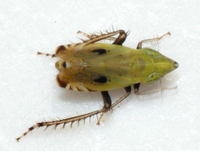 | Photo by: Kyle Kittelberger, Brian Bockhahn, Paul Scharf
Vance Co.
Comment: Field/forest edge habitat |
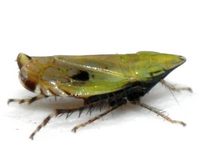 | Photo by: Kyle Kittelberger, Brian Bockhahn, Paul Scharf
Vance Co.
Comment: Field/forest edge habitat | 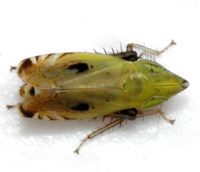 | Photo by: Kyle Kittelberger, Brian Bockhahn, Paul Scharf
Vance Co.
Comment: Field/forest edge habitat |
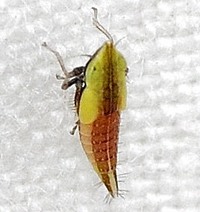 | Photo by: Paul Scharf, Kyle Kittelberger
Vance Co.
Comment: Nymph, Caught sweeping | 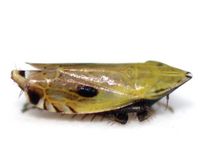 | Photo by: Kyle Kittelberger, Paul Scharf
Wake Co.
Comment: brushy habitat near mixed hardwood forest |
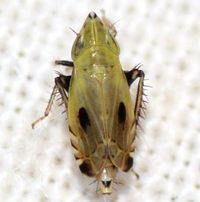 | Photo by: Kyle Kittelberger, Paul Scharf
Wake Co.
Comment: brushy habitat near mixed hardwood forest | 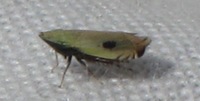 | Photo by: B. Bockhahn, K. Kittelberger
Vance Co.
Comment: KELA |
|

 »
»