
|
|
|
| synonym |
Limotettix instabilis |
| description |
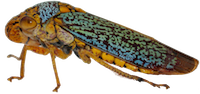
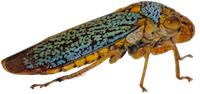
Fairly black overall with pale wing venation, pale inner wing cell areas, and some yellowish marks on the body. The pro- and mesothoracic legs are not bicolored. Adult males are 3.8-4.0 mm long, while females are 4.2-4.7 mm. (McKamey 2001)
See here for images of specimens: BOLD. |
| distribution |
Throughout much of North America; transcontinental in Canada, more scattered in the United States (3I) |
| abundance |
A single record from the mountains; possibly more abundant in the right habitat. |
| seasonal_occurrence | |
| habitat |
|
| plant associates |
Bitter cherry (Prunus emarginata), chokecherry (Prunus virginiana), scarlet sumac (Rhus glabra), pussy willow (Salix discolor), weeping willow (Salix sepulcralis), Salix sp. (Chandler & Hamilton, 2017) |
| behavior |
|
| comments |
This species was previously treated as a junior synonym of the Palearctic species Ophiola corniculus; old records of O. corniculus in North America apply to Limotettix plutonius and L. instabilis.
NOTE: Some authors treat Ophiola, Ophiolix, and Scleroracus as distinct genera, while other authors treat these as subgenera within Limotettix. More work needs to be done to verify these distinctions/determine the borders of each genus (J. Kits pers. comment). For now, we will follow the latest treatment used in the World Auchenorrhyncha Database (BG). |
status |
[Native:]
[Introduced:]
[Extirpated:] | | list_type |
[Official:]
[Provisional:] |
| adult_id | Unmistakable and widely known Identifiable from good quality photos of unworn specimens
Identifiable from photos showing undersides, or other specialized views [e.g., legs, face]
Identifiable only by close inspection of structural features or by DNA analysis NULL |
| nymph_id | Unmistakable and widely known Identifiable from good quality photos, especially where associated with known host plants
Identifiable from close inspection of specimens or by DNA analysis
Identifiable only through rearing to adulthood NULL |
| G_rank |
|
| S_rank |
|
| rank_comments |
|
| tribe |
Limotettigini |
| subgenus |
|

 »
»