
|
|
|
| synonym |
|
| description |
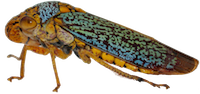
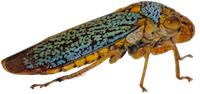
Green, with moderately reticulated wing venation, with reticulations on the clavi (the inner part of the wings). The vertex is roundedly produced, being a little more than half as long in the middle as the width between the eyes at the base. The female pregenital sternite is shallowly excavated and sloping on the median half of the posterior margin to form a broad, shallow V-shaped notch on the median fourth. The size range for males is 8.5-9.5 mm in length, on the smaller side for members of this genus; females are typically 9.5-10.5 mm (females are typically about 1.0 mm longer than males). (Hamilton 1982, DeLong 1942, DeLong & Freytag 1964)
For images of a specimen, see: 3I. For images of potential individuals, see: BG. |
| distribution |
Eastern North America |
| abundance |
A single record from the mountains, perhaps more abundant in the right habitat. |
| seasonal_occurrence | |
| habitat |
Blueberry barrens, forests |
| plant associates |
Blueberry, bush honeysuckle (Diervilla lonicera), sweet-fern (Compotnia perigrina), green alder (Alnus crispa) (Hamilton 1982) |
| behavior |
Can be attracted at night with a light. |
| comments |
Gyponana can be a challenging genus to identify, with many species looking similar to one another and not being able to be identified to species unless [a male is] dissected. Further complicating this situation is that the genus in general is likely overdescribed, with numerous species likely synonymous and needing to be lumped. It is important to take clear photos showing the wing venation, and get measurements and underside photos for size and sex. |
status |
[Native:]
[Introduced:]
[Extirpated:] | | list_type |
[Official:]
[Provisional:] |
| adult_id | Unmistakable and widely known Identifiable from good quality photos of unworn specimens
Identifiable from photos showing undersides, or other specialized views [e.g., legs, face]
Identifiable only by close inspection of structural features or by DNA analysis NULL |
| nymph_id | Unmistakable and widely known Identifiable from good quality photos, especially where associated with known host plants
Identifiable from close inspection of specimens or by DNA analysis
Identifiable only through rearing to adulthood NULL |
| G_rank |
|
| S_rank |
|
| rank_comments |
|
| tribe |
Gyponini |
| subgenus |
Gyponana |

 »
»